| OCR Text |
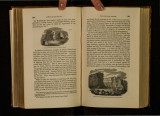
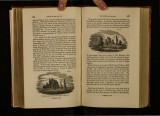
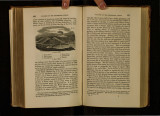
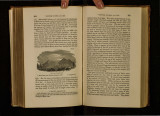
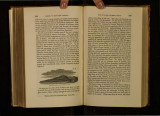
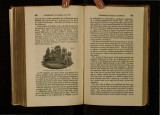
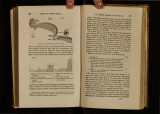
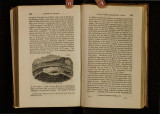
Show 274 ENCROACHMENTS OF TilE SEA ON and the pil1ars of the cloister are soon to follow. The waves have almost isolated the promontory, and invaded the cemetery, where they have made sport with the mortal relics, and thrown up a skull upon the beach. In the foreground is seen a broken tombstone, erected, as its legend tells, " to perpetuate the memory" of one whose name is obliterated, as is that of the county for which he was "Custos R~tul?rum.'.' A cor~orant is perched on the monument, defilmg It, as If to remmd some moralizer like Hamlet of " the base uses" to which thincrs sacred may be turned. Had this excellent artist desired to s~tirize certain popular theories of geology, he might have inscribed the stone to the memory of some philosopher who taucrht "the permanency of existing continents"-" the era of rebp ose"-" the impotence of mo de rn causes. , South of Dunwich are two cliffs, called Great and Little Cat Cliff. That which bears the name of Great, has become the smallest of the two, and is only fifteen feet high, the more elevated portion of the hill having been carried away; on the other hand, the Lesser Cat Cliff has gained in importance for the sea has here been cutting deeper into a hill whi;h slopes towards it. But at no distant period, the ancient names will again beeome appropriate, for at Great Cat Cliff' the base of another hill will soon be reached, and ' . at Little Cat Cliff, the sea will, at about the same time, arnve at a valley. The incursions of the sea at Aldborough were formerly very destructive, and this borough is known to have been once situated a quarter of a mile east of th~ , present shore. ;r'he inhabitants continued to build farther inland, till they arrived at the extremity of their property, a~d then the to.wn decayed greatly but two sand-banks, thrown up at a short distance, now afford ~ temporary safeguard to· the coast. Between these banks and the present shore, where the current now flows, the sea is twenty-four feet deep on the spot where the town formerly stood. Continuing our survey of the Suffolk coast to ~he southward we find that the cliffs of Bawdsey and Fehxtow arde found' ering slowly, and that t h e po·m t on wh ' h Landguar IC • h' Fort is bm. lt suffers gradual d ecay. I t appear s that ' w. tt md 1. · 1 0 11 river contmue the memory of persons now Ivmg, t 1e rwe h its course m. a more d1' rect 1m' e to t h e sea, .a..,n.. d entered to t e THE EAST COAST OF ENGLAND. 275 north ill~tead ~f th: south of the low bank on which the fort last ment10ned 1s bmlt. Harwich, in Essex, stands on an isth h' h .11 b bl b . mus, w 1c WI pro-a y ecome an Island in little more than h lf t ~ h 'll h a a cen ury ; 1or t e sea wi t . en have made a breach n ear L ower D over Cm~rt, should It continue to advance as rapidly as it has done durm. g the last fifty years. Within te11 yea rs, tl1 ere was a considerable space between the battery at Harwich, built twenty-three years ago, and the sea; part of the fortification has already been swept away, and the rest overhangs the water. At Walton Naze, in the same county, the cliffs, composed of Lo~don clay, capped by the shelly sands of the crag, reach th.e he1ght of about one hundred feet, and are annually undermmed by the waves. The old churchyard of Walton has been washed. away, and the cliffs to the south are continually disappearmg. On the coast bounding the estuary of the Thames, there are numerous examples both of the gain and loss of land. The Isle of Sh.eppey, which is now about six miles long by four in breadth, ~s composed ?f London clay. The cliffs on the north, whiCh ~re from sixty to eighty feet high, decay rapidly, fifty acres ha~mg been lost within the last twenty years. The ~burch ~t Mmster, now near the coast, is said to have been m the middle of the island fifty years ago; and it is computed tba~, ~t the. present rate of destruction, the whole isle will be anmhilated m about another half century*. On the coast to the e~st of Sheppey stands the Church of Reculver, upon a sandy ~hff.about twenty feet high. In the reign of Henry VIII. it !~said to hav; been n~arly a mile .distant from the sea. In the dl Gentleman s Magazme," there Is a view of it about the mid-e of th.e last c~ntury' which still represents a considerable :~c:h as I~tervenmg between the north wall of the churchyard h e chff. About twenty years ago, the waves came within ~:fr 0~ndr~d and ~fty feet of the boundary of the churchyard, d . whiCh has smce been washed away. The church is now · tsmantled (1829) d · · d 6 . . ' an Is m great anger ; several houses ln a eld Immediately adjoining having been washed away. • For this information I am indebted to W. Gunnell, Esq. T2 |