| OCR Text |
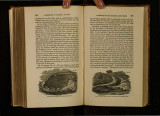
Show 218 PETUOI~EUM SPRINGS. Petroleum Springs.-Springs impregnated with petroleum, and the various minerals allied to it, as bitumen, naphtha, asphaltum, and pitch, are very numerous, and are, in many cases, undoubtedly connected with subterranean fires, which raise or sublime the more subtle parts of the bituminous matters contained in rocks. Many springs in the territory of Modena and Parma, in Sicily, produce petroleum in abundance; but the most powerful, perhaps, yet known, are those on the Irawadi, in the l~nrman empire. In one locality there are said to be five hundred an~ twenty wells, which yield annually four hundred thousand hogsheads of petroleum*· Fluid bitumen is seen to ooze from the bottom of the sea, on both sides of the island of Trinidad, and. to rise up to the surface of the water. Near Cape La Braye there is a vortex which, in stormy weather, according to Captain Mallet, gushes out, raising the water five or six feet, and covers the surface for a considerable space with petroleum, or tar; and the same author quotes Gumilla, as stating in his " Description of the Orinoco," that, about seventy years ago, a spot of land on the western coast of 'l'rinidad, near half-way between the capital and Indian vlllage, sank suddenly, and. was immediately replaced by a small lake of pitch, to the great terror of the inhabitants t. It is probable, that the great pitch-lake of Trinidad owes its origin to a similar cause, and Dr. Nugent has justly remarked, that in that district all the circumstances are now combined from which deposits of pitch may have originated. The Orinoco has, for ages, been rolling down great quantities of woody and vegetable bodies into the surrounding ~ea, where, by the influence of currents and eddies, they may be arrested and accumulated in particular places. · 'l'he frequent occurrence of earthquakes and other indications of volcanic action in those parts, lend countenance to the opi· nion, that these vegetable substances may have undergone, by the agency of subterranean fire, those transformations and chemical changes which produce petroleum, and may, by the same causes, be forced up to the surface, where, by exposure * Symes, Embassy to Ava, vol, ii.-Gcol. Trans., second series, vol. ii., part 3, p. 388. t Dr. Nugent, Geol. Trans., vol. i., p. 69. PETROLEUM SPRlNGS. 219 to .t hte' airf ' it becomd es i nsp·i ssate1(' and forms the different vane Ies o pure an earth · b in the island*· y pitc ' or asphaltum, so abundant The bituminous shales so com . 1 . f d·.tr ' mon m geo ogiCal formations o Iuerent ages, as well as many t. t'f' d 1 • d · h s Ia I 1e ( cposits of bitu men an p1tc , seem clear I y to attest th t ~ . - springs, in various pal·ts of the world a ' .at ormer pel'l~ds, d . , were as commonly 1m pregnate as now with bituminous m tt . . 1 . ·l . - d b · . a 01 ' w nc 1 was earned own 11 y rihv ers m] to lakes and seas . W e~ may m. d ee d remark genera .Y' t at a arge portion of the finer particles and the more crystallme substances found in sedimenta k f d. c ry roc s o 1fferen t ages,. are comp.osed of. the same elements as are now held in solutwn by sprmgs, while the coarser mate r I. a1s b ear an equally strong resemblance to the alluvial matter in the b d f . ing torrents and rivers. e 8 o exist- "' Dr. Nugent, Geol. Trans., vol. i., P· 67. |