| OCR Text |
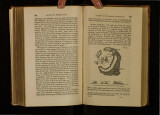
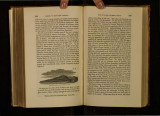
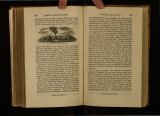
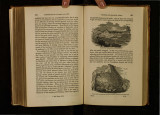
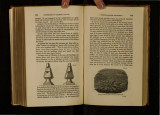
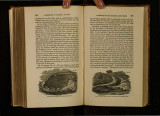
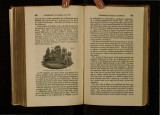
Show 376 ERUPTION OF J'ORULLO, A.D. 1759. ten thousand feet, and its greatest more than double that of the Himalaya mountains. Amongst the ancient strata, no i<rneous rock of such colossal magnitude has yet been met with, :ay it would be most d.iff~cult to poit~t out a 1~ass of igne.ous origin of ancient date d1stmctly refernble to a smgle eruption, which would rival in volume the matter poured out from Skaptar J okul in 1783. It is, however, a received principle in geological reasoning, not only in France, but in England and other countries, that we ought always to assume that the energies of natural forces have been impaired a~d enf~ebled~ until the contrary can be shewn; and as we have hitherto mvcsugated but a small part of the globe, evidenc: may hereaf:er be b~·oug?t to light of the superior violence of st~gle volcamc cru.ptlons m remote ages. If the proofs be deficient at present m fav~ur of the general declin~ o~ the agents of decay and re~o~at10n, we must be content with the argument of the geologist m one of Voltaire's novels, Monsieur, on en decouvrira! * Eruption of Jorullo in 1759.-As another example of the stupendous scale of modern :olc~~ic eruptions, we may mention that of Jorullo in Mexico m 1759. We have already described the great region to which this mountain belongs. The plain of Malpais forms part of an elevated plateau, between two and three thousand feet above the level of the sea and is bounded by hills composed of basa1t, trachyte, and vol~anic tuff, clearly indicating that the country had previo~sly, though probably at a remote period, been the theatre of Igneous action. From the era of the discovery of the New World to the middle of the last century, the district had remaine~ u~disturbed, and the space, now the site of the volcano, w?tch IS thirty-six leagues distant from the nearest sea, was occupied by fertile fields of sugar-cane and indigo, and watered by the two brooks Cuitimba and San Pedro. In the month of June, 1759, ho1low sounds of an alarming nature were heard,, a~d earthquakes succeeded each other for two months, until, 111 September, flames issued from the ~r~und, a~d fragm~nts of burning rocks were thrown to prodigiOus heights. SIX volcanic cones, composed of scorire and fragmentary lava, were • L'Ilomme aux quo.rante ccus, CONVEXITY OF TilE PLAIN OF MALPAIS, 377 formed on the line of a chasm which ran in the direction from N.N.E. t~ S.S .. W. The least of these cones was three hundred feet 111 height, a~d Jorullo, the central volcano, was elevat~ d one thou sand SIX hundred feet above the level of the plam. It sent forth great streams of basaltic lava, containinO' mcluded fragments of primitive rocks, and its ejections did no~ cease till the month of February, 1760. Humboldt visited the country. twenty years after the occurrence, and was informed by the Indians, ~hat when they returned long after the catastrophe to the plam, they found the ground uninhabitable from the exccssi vc heat. When the Prussian traveller himself visited the locality, there appeared, round the base of the cones, and spreading from them as from a centre over an extent of four square miles, a mass of matter five hundred and fi~ty f~et in height in a convex form, gradually sloping in all d1rect10ns towards the plain. This mass was sti1l in a heated s~ate, the temperature in the ~ssures being sufficient to light a cigat· at the depth of a few mches. On this convex protuberance were thousands of flattish conical mounds from six to nin~ feet high, which, as well as large fissures tr~versing the plmn, acted as fumeroles, giving out clouds of sulphuric acid and hot aqueous vapour. The two small rivers before mentioned disappeared during the eruption, losing themselves below the eastern extremity of the plain, and reappearinO' as hot springs at its western limit. Humboldt attributed 0 the convexity of the plain to inflation from below, supposing the ground, for four square miles in extent, to have risen up in the shape of a bladder, to the elevation of five hundred and fift! fee: abo~e the plain in the highest part. But this theory, wluch Is entirely unsupported by analogy, is by no means borne o~t. by the fac~s described; and it is the more necessary to scrutimze closely the proofs relied on, because the opinion of ~umboldt appears to have been received as if founded on direct observation, and has been made the groundwork of other bold and extraordinary theories. Mr. Scrope has suggested ~lat the p~1enomena may be accounted for far more naturally, Y supp~smg that lava flowing simultaneously from the different onfices, and principally from Jorullo, united into a sort 0~ pool or lake. As they were poured forth on a surface preVlously flat, they would, if their liquidity was not very great, |