| OCR Text |
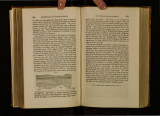
Show 296 CVRRENT IN TilE STRAITS OF GIBRALTAR. Straits of Gib,raltm·.-It is well l<~o':n that a po~verful current sets constantly from the Atlantic mto the Mediterra~ nean, an d 1't s influence extends along the who• le so•u thern Cbo rder· s of that sea, and even to the shores of Asia Mmor. aptam Smyth found, during his survey, that t.he c~ntral current ran con~ t tly at the rate of from three to s1x miles an hour eastward san b. l '1 into the 1\tfediterranean, the body of water emg t ll'ee mi es and a half wide. But there are also two lateral currents-one on the European, and one on the African sid<:; each of them about two miles and a half broad, and flowmg at about the same rate as the central stream. These .lateral curren.ts ebb and flow with the tide, setting alternately mto the Mediterra~ nean and into the Atlantic. The escape of the great body of ater which is constantly flowing in, has usually been accounted fwo r by' evaporation, which mus.t be very. rapi'd an d copw. us m. the Mediterranean; for the wmds blowmg from the shores of Africa are hot and dry, and hygrometrical experiments recen~ly made in Malta and other places show that the mean ~uantity of moisture in the air investing the l\1:editerranean IS eqt~al only to one half of that in the atmosphere of England. It Is, however, objected that evaporat~on carri~s ~wa~ only fresh~ water, and that the current is contmually brmgmg m salt-water: why then do not the component parts of the waters of the Mediterra~ean vary? or, why do they remain apparently the same as those of the ocean? Some have imagined that the excess of salt might be carried away by an .under-cm-re~t runninO' in a contrary direction to the superiOr; and. this hypoth~sis appeared to receive confirmation from a late dJs~overy that the water taken up about fifty m,iles within the s.trmts, from a depth of six hundred and seventy fathoms, contamed .a quantity of salt four times greater than ~he water of ~he smface. Dr. Wollaston*, who analysed this water obtamed by Captain Smyth, truly inferred that an under-current of such denser water, flowing outward, if of equal breadth and dept~ with the current near the surface, would carry out as. muc salt below as is brought in above, although it moved with less than one-fourth part of the velocity, and would thus prevenht a perpetualm. crease of sa l tness m. t h e M e dI' te 1 .I ·anean beyond t at * On the Water of the Med1. terranean, by W • H • unro 1 1 as ton ' M.D. ' F.R.S.,Phil. Trans. 1829, part I., p. 29. ,PRECIPITATION OF SALT IN THE MEDITERRANEAN. 297 existing in the Atlantic. It was also remarked by others, that the result would be the same if, the swiftness beinO' equal the inferior current had only a fourth of the volume0 of th~ superior. At the same tim~ there appeared reason to conclude that this great specific gravity was only acquired by water at immense depths ; for two specimens of the water taken at the distance of some hundred miles from the Straits, and at depths of four hundred, and even four hundred and :fifty fathoms, were found by Dr. Wollaston not to exceed in density that of many ordinary samples of sea-water. Such being the case, we can now prove that the vast amount of salt brought into the Mediterranean does not pass out again by the Straits. For it appears by Captain Smyth's soundings, which Dr. Wollaston had not seen, that between the Capes of 'rrafalgar and Spartel, which are twenty~two miles apart, and where the Straits are shallowest, the deepest part, which is on the side of Cape Spartel, is only two hundred and twenty fathoms. It is therefore evident that if water sinks in certain parts of the Mediterranean, in consequence of the increase of its specific gravity, to greater depths than two hundred and twenty fathoms, it can never flow out again into the Atlantic, since it must be stopped by the submarine barrier which crosses the shallowest part of the Straits of Gibraltar. What, then, becomes of the excess of salt ?-for this is an inquiry of the highest geological interest. The Rhone, the Po, ~nd many hundred minor streams and springs, pour annually Into the Mediterranean large quantities of carbonate of lime, together with iron, magnesia, silica, alumina, sulphur, and other mineral ingredients, in a state of chemical solution. 'l'o explain why the influx of this matter does not alter the comP? sition of this sea has never been thought to present a great difficulty; for it is known that calcareous rocks are forminO' in th: delta of the Rhone, in the Adriatic, on the coast of Asia Mmor, and in other localities. Precipitation is acknowledged to be the means whereby the surplus mineral matter is disposed of, after the consumption of a certain portion in the secretions of testacea and zoophytes. But some have irnaO'ined that b f, • 0 ' e ore mur~ate of soda can, in like manner, be precipitated, the whole Mediterranean ought to become as much saturated with salt as the brine-springs of Cheshire, or Lake Aral, or the |