| OCR Text |
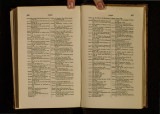
Show 352 MASS ENVELOPING COMPOSITION· OF TliE • . tact with fire, and that the1r burnt up, if they had come ml condemonstration of their having l b nizcd was a c ear . d f being on y car 0 • r' '1 d in a sediment depostte rom been enve1 o p ed ' hke O. S.S l WO. O t'h eir report on h't s pamp hl et ' water. The Acad~ml~ansh~~heatre was first cleared out, the assert, that when t 1e mpl 1 t s in a succession of concave matter was arran ged. ' on ht 1e s 1e p ' to the interior form of t1 le layers, accommo datmg t elmds el' ve'fs' it had fallen there. 'fh'I s . d' . t s snow wou Ie I d' m bml mg, JUS a . t' and points to the merence . · hio-hly mteres mg, . . d · observatwn lS I? . of ashes in an open bmldmg, an m between the stratifi~atwn d 11 Nor ought we to call · f edrPces an ce ars. the interwr o · . b se it could not be substan- . . questiOn ecau 11 this allegation m ' . y when the matter was a 1 t' of the controvet s , d tiated at tle Ime L' . t k advantao-e of this removal, an removed; although lpl~l oo t o-onists by requiring therp. to met the argument of us an ab prove the. fact. . . . ce that no stream of lava has ever There IS dectslve ev~den E. t b l'lt although the founda-d p .. since It was urs u ' reache ompen d tl e old leucitic lava of Somma; tions of the town stan upo~ h ~ ff interposed have been cut several o~ whose st.reams, ~:t He~·culaneum th~ case is different, through m excavatwns. hich fills the interior of the houses although the substance w . t duced in a state of mud, 1 t have been m ro . and the vau ts mus . . Pompeii. the superm-d · · milar situatwns m · like that foun 1~ SI holl in composition and thickness. cum bent mass differs w d y 1 miles nearer to the volcano, Hercu1 a neum wa:s~ situate severa osed to be covere d , no t and has therefore been alway~ ~o~ e:huvions and streams of only by show~rs of ashes, fu botl; have accumulated on each lava. Accordmgly, masses o l f where less than seventy, other above t h e c.t ty, t o a depht 1 do ndo and twelve feet*. 'l'h e and in many places of one .u~ re consists of comminute~! tuff which envelops the btul~mgs A k imbedded in tlns volcanic ashes, mt. xe d 'tl pumtce mas db Wl 1 . f which was compare y matrix has left a cast' the ~harp ness o . was the mask in the Hamilton to those in Paris pl~s~r; nor tit to have been, if it 1 ast degree scorched, as we mlg t exp~~· tuffis porous, and, }~ad been imbeddeddin ?eateft ~~~te:~sily ~orked, but acquires when first excavate ' ls so . M nt Vesuvius, P· 94 • London, 1774. • IIamilton'tii Observations on ou . IIERCULANEUM AND POMPEII. 353 a considc~able degree of induration on exposure to the air. Above this lowest stratum is placed accordin(J' to Hamilton "the matter of six eruptions,, each se' parated frbo m the other by' veins of good soiL In these soils Lippi informs us, that he collected a considerable number of land shells-an observation which is no doubt correct, for we know that in Italy several species burrow annual1y, in certain seasons, to the depth of five feet and more from the surface. Della Torre also informs us, that there is in one part of this superimposed mass a bed of true siliceous lava (lava di piet·ra dura); and, as no such current is believed to have flowed till near one thousand years after the destruction of Herculaneum, we must conclude, that the origin of a large part of the covering of Herculaneum was long subsequent to the first inhumation of the place. That city, as well as Pompeii, was a sea-port. Herculaneum is still very near the shore, but a tract of land, a mile in length, intervenes between the borders of the Bay of Naples and Pompeii. In both cases the gain of land is due to the fi1ling up of the bed of the sea with volcanic matter, and not to elevation by earthquakes, for there has been no change in the relative level of land and sea. Pompeii stood on a slight eminence composed of the lavas of the ancient Vesuvius, and flights of steps led down to the water's edge. The lowermost of these steps are said to be still on an exact level with the sea. After these observations on the nature of the strata enveloping and surrounding the cities, we may proceed to consider their internal condition and contents, so far at least as they offer facts of geological interest. Notwithstanding the much greater depth at which Herculaneum was buried, it was dis· covered before Pompeii, by the accidental circumstance of a well being sunk, in 1713, which came right down upon the theatre, where the statues of Hercules and Cleopatra were soon found. Whether this city or Pompeii, both of them founded by Greek colonies, was the most considerable, is not yet determined; but both are mentioned by ancient authors as among the seven most flourishing cities in Campania. The walls of Pompeii were three miles in circumference; but we have, as yet, no certain knowledge of the dimensions of Herculaneum. In the latter place the theatre alone is open for inspection; the Forum, Temple of Jupiter, and other buildings, having been Vot,I, . ' 2 A |