| OCR Text |
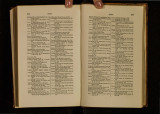
Show 314: .GEOGRAPHICAL BOUNDARIES . that they will take place because they have often been repeated in former ages, but assume the improbability of such a conclusion and throw the whole weight of proof on those by whom that doctrine is embraced. In our view of igneous ca~ses we sh~U consider, first, the volcano and afterwards the earthquake ; for although both are probabl~ the effects of the same subterranean process, they give rise to very different phenomena on the surface of the globe. Both are confined to certain regions, but the subterrane~n movements ~re least violent in the immediate proximity of volcan1c vents, especially where the discharge of aerifprm fluids and melted rock is made copstantly from the same crater. We say that there are certain regions to which bo~h the points of eruption, and the movemen~s of great earthqua\{c.s are confine?; and we shall beO'in by tracmg out the geographiCal boundanes of some of thes:, that tbe readet· may be aware of the magnificent scale on which the agency pf subt~rranean fire is now simulta~eously developed. Over the whole of the vast tract~ alluded to, active volcanic vents are distributed at intervals, a11d most commonly arranged in a linear direction. ThroughOl1t the interrqediate spaces there is abundaqt evidence th~t the s~bterranean fire is at work continuously, for the ground is convulsed from time to time b.y earthquakes; gaseous vapours, e&pe~ially carbonic acid ga~, are disengaged plentifully from t~e soil; springs often issue at a very h1gh temperature, and. their waters are very commonly impregnated with the same mmeral matters which are discharged by volcanos during eruptions. Of these great regions, that of the Andes is one of the_ be_st defined. Respecting its southern extremity, we .a:e st~ll m need of more accurate information, some concetvmg It to extend into 'rerra del Fuego ~nd Patagonia*. But if '~e beain with Chili in the forty-sixth degree of south latl-tudo e we find th' at in proceeding from this po.m t towar ds the n' orth to the tw' enty-seventh degree, there is a r1 _ne of volcanos so uninterrupted, that it is rare to find any mt~rvening deO'ree of latitude in which there is not an active vent. Ab~ut twenty of these are now enumerated, but we may expect the number to augment greatly when the country • Hoff, vol. ii., p. 476. OF VOLCANIC REGIONS, 315 has. been more oarefull! examined, and throughout a longer p.erwd. How long an mterval of rest entitles us to consider a volcano extinct, cannot yet be determined; but we know that in Ischia, there intervene?, between two consecutive eruptions,~ pause of seventeen centunes! and a much longer period, perhaps, elapsed between the eruptiOns of Vesuvius before the earliest Greek colonies settled in Campania, and the renewal of its activity in th~ reign of Titus. It will be necessary therefore, t? wait for _at least six times_ as many centuries as h~ve elapsed smce the discovery of Amenca, before any one of the dormant craters of the Andes can be presumed to be entirely spent, unless there are some geological proofs of the last eruptions having belonged to a remote era. The Chilian volcanos rise up through granitic mountains. Villarica, one of the principal, continues burning without intermission, and is so high that it m~y be distinguished at the dist~nce of one hundred and fifty miles. A year never passes in this province without some slight shocks of earthquakes; and about once in a century, or oftener, tremendous convulsions occur, by which, as we shall afterwards see, the land has been shaken from one extremity to the other, and continuous tracts, together with the bed of the facific, have been raised permanently from one to twenty feet and upwards above ~heir former level. Hot springs are numerous in this district, as well as springs of naphtha and petroleum and miner~l waters of various kinds. If we pursue our cours; northwards, we find in Peru only one active volcano as yet known; but the province is so subject to earthquakes, that scarcely a week happens without a shock, and many of these have been so con~iderable as to create great changes of the sur~ace. Proceedmg farther north, we find in the middle of Quito, where the Andes attain their highest elevation, from the second degree of south, to the third deO'ree of north latitude T . o ' unguragua, Cotopaxi, Antisana, and Pichinca the three former of which throw out :Hames not unfrequen~ly. From fissures on the side of Tunguragua, a de]uae of mud (moya) descended in 1 '79'7, and filled valleys a th~usand feet wide to the depth of six hundred feet, formina barriers whereby rivers wer d d 0 . e amme up, and lakes occasioned. Earthqual'es have 111 th . f\. ' £ e same provmce, caused gl'eat revolutions in the physical .eatures pf the surface. Farther north, there a:re thr~e vol- |