| OCR Text |
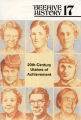
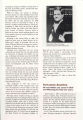
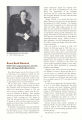
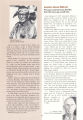
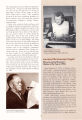
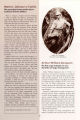
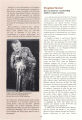
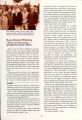
Show & U 20th- century Utahns of Achievement This group of minibiographies is intended to high-light the lives of Utah women and men of diverse backgrounds and accomplishments. The basic criteria for inclusion were that the per-son's achievements occurred in the 20th century and that he or she had not been featured previously in Beehive History or Utah Historical Quarterly. No living persons are included. No governors of the state or other very well known individuals were selected, nor were notorious characters such as " Big Bill" Haywood chosen. Indeed, the object was to showcase less well known Utahns and those who though widely recognized in their day may be unknown to younger generations. Given such criteria the list of potential subjects was enormous. Every town has its heroes and heroines. Newspaper files reveal hundreds of men and women who made their town, their state, or the world a better, or at least a more interesting, place to live. Several issues of Beehive History could be filled with the life stories of such individuals. Those included here are not necessarily " the top 34," but all contributed to the history of the state. We are richer culturally, scientifically, politically, and so-cially because of these women and men. Florence Ellinwood Allen She was the first woman appointed to a federal appellate court. Florence Ellinwood Allen was born March 23, 1884, to Clarence Emil and Corinne Marie Tuckerman Allen in Salt Lake City where her fam-ily had moved in 1881 in an attempt to cure her father's tuberculosis. He taught at Hamlnond Hall, a school run by the Congregational church as part of the New West Education Movement. Florence was born in a house on the school grounds, the third of six children. Her father resigned after six years to go into the mining business and moved his family to Bingham. As a child Florence loved out-door activities and carpentry. Her father eventually studied law, passed the bar exam, and served in the territorial legislature in 1888, 1890, and 1894. He was elected to the U. S. House of Representatives when Utah achieved statehood in 1896. Equally active, Florence's mother was involved in a number of organizations, including the Congress of Mothers ( predecessor of the PTA), Free Public Library, and the State Fed-eration of Women's Clubs. While her father was serving in Congress Florence and her two older siblings lived in New Lyrne Station, Ohio, where they attended school. The family returned to Utah after two years when her father did not seek reelection. In 1900 Florence moved to Cleveland to study at the Women's College of Western Reserve University, graduating in 1904. Then she traveled to Berlin with her mother who spoke to the 1904 Interna-tional Council of Women. Florence stayed in Berlin for two years, mainly studying piano, to see if she wanted a career as a concert pianist, but she decided against it. Returning to the United States in 1906, she taught for three years at Laurel School, an ex-clusive girls' school in Cleveland. She also en-rolled at Western Reserve University in a master's program in political science. While there she decided to become a lawyer. Although most universities did not accept women into law school then, she was able to attend the University of Chicago Law School for one year. In Chicago she became associated with Hull House Settlement and was induced by a friend to move to New York City the following year and become a social worker for the League for the Pro-tection of Immigrants and the Henry Street Settlement. Still, the law beckoned and she enrolled in New York University Law School in the fall of 1910. At first she worked during the day and attended school in the evening, but eventually she left social work and enrolled in law school full time. She supported herself by lecturing at private schools and by working for the National College Women's Equal Suffrage League. After graduation in 1913 she moved to Cleveland. Unable to find a position with a law firm, she opened her own law office in 1914 and volunteered for the Cleveland Legal Aid Society, where she met several other idealistic young at-torneys with whom she combined law offices. Her legal career included serving as assistant county prosecutor for Cuyahoga County, Ohio, in 1919- 20; as judge for the Court of Common Pleas, Cuyahoga County, 1920; and as justice of the Supreme Court of Ohio ( the first woman elected to a court of last resort in the U. S.), 1922- 34. In 1926 she ran in the Democratic primary for United States senator but was defeated. In 1934 she was appointed to the U. S. Circuit Court of Appeals for the Sixth District by President Franklin D. Florence E. Allen. Courtesy Western Reserve HistoricalSociety. Roosevelt, the first woman to fill such a post. In 1927- 38 Allen headed a three- judge federal tribunal that decided the constitutionality of the Tennessee Valley Authority. She served for twenty- five years on the federal appellate bench, retiring in 1959 at age 75. At various times she had been considered a strong candidate for the U. S. Supreme Court. Among her legal accomplishments are several books she au-thored: This Constitution of Ours ( 1940), To Do Justly ( 1965), The Treaty as an Instrument of Legislation ( 1952), and The Ohio Woman Suf-frage Movement ( 1952). She died September 12, 1966, in White Hill, Ohio. Fortunato Anselmo He was Italian vice consul in Utah and Wyoming for forty- one years. Born October 1, 1883, in Grimaldi, Province of Cosenza, Calabria, Italy, Fortunato Anselmo im-migrated to the United States at the turn of the 20th century. He first settled in Pueblo, Colorado, and worked as a reporter for the Italian- American newspaper I1 Vindice and engaged in mercantile in-terests. Fortunato married Anna Pagano in Pueblo in 1909. They were to have three children, Annette, Gilda, and Emma. In 191 1 the Anselmos moved to Salt Lake City where Fortunato operated a wholesale imported |