| OCR Text |
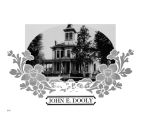
Show JOHN E. DOOLY 216 T he delightful Victorian home built by Benjamin Durell, an early real estate magnate and banker, dates back to the early 1870s. Although the families of Charles W. Lyman, manager of Mountain Bell Telephone Company, and a Lord Medhurst, English mining engineer, lived in the home following Durell, the home has been identified since 1885 with the Dooly family. John E. Dooly was born June 8, 1841, the son of Richard W. and Catherine Lonergan Dooly. The Doolys farmed a section of land in Lake County, Illinois, near Benton. In John's twenty- first year he made plans to go to San Francisco. He was a handsome young man, seemingly self- assured, when he arrived in the city in 1863. But San Francisco was in a frenzy of speculation. The Comstock Lode was still pouring its wealth into the great financial center. Fortunes were made in stocks and bonds almost daily and were lost just as easily. John worked at various odd jobs until he obtained a position with Wells Fargo Company, working in their Sacramento office. He was sent from there to what is now Truckee, California. Then in 1873 he was transferred to Ogden, Utah, as an agent. Several years later he was appointed cashier of the company, representing their financial interests in Utah. Dooly's first love was his banking career. While John E. Dooly he was still working for Wells Fargo he established the first bank in Ogden under the name of J. E. Dooly & Company. He was one of the organizers of the Utah National Bank of Ogden and served as its president for the remainder of his life. He was also identified with the Syndicate Investment Company and had real estate interests. One outstanding venture of his was the Dooly Building at Second South and West Temple in Salt 217 Lake City. The plan was to include an imposing hotel adjoining the business building on the south. However, the hotel was never constructed. The Dooly Building, designed by the famous Chicago architect Louis H. Sullivan, was demolished in 1964. It had housed offices for many prominent business firms and was the first home of the Alta Club. Dooly became interested in Antelope Island as a stock range. Brigham Young and Heber C. Kimball had kept horses and sheep on the island and had also introduced antelope. Although conditions were not suitable for the antelope, the name remained. Dooly's Island Improvement Company bought the small farms homesteaded by Mormon settlers. Archilecturul master drawing of the Dooly Building and the proposed Ontario Hold, which was never built. The Dooly Building wus located on the southwest corner of Second South und West Temple. 218 The property owned by the Deseret Livestock Association ( Young and Kimball) and some shoreline property owned by Southern Pacific Railroad Company was purchased. In 1893 the company ran a fine herd of buffalo on the island, also experimenting with a few elk. The ranch remained a family business until recent years. In 1876, while still living in Ogden, John Dooly married the lovely Eleanor M. Taylor. The Doolys were together for eighteen years, during which time Eleanor had five children: Eleanor, Margaret, Ethel, John E., and Ruth. They moved into the home on East Brigham Street in Salt Lake City in 1885. There were still no mansions that far east on the street, and the home stood out among the scattered pioneer adobes. The basic style of the attractive dwelling was Victorian, but elements of Greek architecture resulted in a rather pleasing eclectic blend. The rooms on the main floor were spacious and designed to create a feeling of openness. As one entered the home into a central hallway the rooms on the right ( the west side) included the library, the large dining room, and beyond that the kitchen and utility areas. On the east were two parlors that were kept open and functioned as one large room. To the rear of the parlors in the southeast corner of the house was the schoolroom, completely outfitted with desks, blackboards, Eleanor Taylor Dooly and a fireplace. The younger children attended public school, but the older children were tutored in the family schoolroom. The woodwork in the home was outstanding, as were the eight- foot arched doorways. Newel lamps depicted a Roman woman on one post and a gladiator on the other, each holding a torch equipped with gas lighting. These were later changed to electric lamps. The home contained fourteen fireplaces. 219 Bronze newel figurine depicts gladiator. The square tower, too small to function as a room, served as a vantage point from which one could see over the city, then comprised of only a few buildings more than two stories high. From the tower Dooly, who was president of the Salt Lake City Board of Education, could check the schools for signs of fire, a possibility that gave him great concern. The tower was not a neglected area of the home. Beautiful walnut stair railings led up to it, and the walnut shutters and trim were kept in excellent condition. The carriage house and stables lay to the east of the home at the rear. Dooly was a lover of horses, his beautifully matched teams being one of his greatest joys. He loved to drive his family up and down Brigham Street, and on Sundays theyjoined the promenade around Liberty Park. It became necessary in 1894 for John Dooly to take Eleanor to California because of her health. While on the Central Pacific Railroad near Carlin, Nevada, on May 23, Eleanor died. Two and a half years later Dooly married May V. Cavanaugh, a prominent schoolteacher. Two children, Mary and Richard, were born to them. In public life Dooly was an actively interested and conspicuous participant. In addition to his school board duties, he served as a regent of the university, chairman of the territorial Board of Equalization, 220 chairman of the Board of Public Works of Salt Lake City, and chairman of the Republican State Committee. He was one of the first four Gentiles chosen to membership in the Salt Lake City Council in the late 1880s. At the time of the Scofield mine disaster in 1900 in which 199 men and boys were killed, Dooly took an active part in extending aid to the widows and orphans as well as to the injured miners. He was a charter member of both the Alta and Commercial clubs. Death came to John E. Dooly on October 25, 1911, at seventy years of age. He had been ill for a number of months. The Rev. W. H. Corcoran of the Cathedral of the Madeleine conducted the last rites, it JOHN E. DOOLY 506 East South Temple Built in early 1870s Architect: unknown Original owner: Benjamin Durell Demolished 1946 Dooly as he appeared during his politically active years in Salt Lake City. 221 |