| OCR Text |
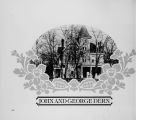
Show ^ JOHN AND GEORGE DERN^ 140 J ohn Dern came from a prominent German family who had been involved in I public affairs for more than two hundred years. He was born in 1850 and * m - 4kt£! mk attended a b< > ys' academy near his home ^ m town of Haussen. \ m^^ k% i ' l Following the American Civil War, a stream of German emigrants sailed to America, many of them settling in the Mississippi Valley. Seeing a chance to get to the American Midwest where his sister was living, John left his homeland and came to America. He spent the next four years completing his education, then moved on to Dodge City, Nebraska, where the railroad was at that time pushing its way through the frontier towns. In 1870 John's mother and a distant cousin, Elizabeth Dern, made the long journey to the United States to join John who was then living near the town of Fremont, Nebraska. That same year he and his cousin Elizabeth were married and the two set about working the land that would afford them a living. At the end often years, in 1888, he was operating a grain elevator and John Dern a lumber business. Having inherited an interest in political affairs, he was also serving in the Nebraska State Senate. Out west in the Rocky Mountains, in the Camp Floyd Mining District of Utah, was the mining camp of Lewiston, later to become Mercur. It had been a major silver- producing area, but by 1880 the silver deposits were exhausted and Lewiston had become a ghost town. A gold ledge had been discovered in 1883, but all known processes were unsuccessful in extracting the precious metal. Then, in 1890, when all seemed hopeless, a new process was tried: a special cyanide solution was used to leach gold from the ore, depositing the values as gold cyanide powder, or gold dust. Thirty thousand dollars was needed to finance the gold mining enterprise, and the mill had to be remodeled to accommodate the new process before the actual operations could begin. A Capt. Joseph Smith, who was promoting the project, approached some Nebraska friends, one of whom was John Dern. Dern was looking about for more challenges and business opportunities and was only too eager to get in on the ground floor of a mining enterprise. John assumed an active role in the affairs of the new Mercur Mining and Milling Company from the time he arrived in Utah. Up to 1892 the Dern family 141 still resided in Nebraska, but because of the phenomenal success of the mining operation, John moved his family to Salt Lake City. A son, George, who was attending the University of Nebraska, remained to continue his studies; but two years later John sent for him and he reluctantly left the university. George was an excellent student and was particularly interested in his English courses, taking great pride in his ability as a writer. He was the captain and star player on the football team and also played saxophone in the school band. When George arrived in Utah he kept the books and performed the duties of treasurer of the mining company in offices located in the McCornick Building in Salt Lake City. Two years later he married Lottie Brown, also from Nebraska, whom he had recently met in Salt Lake. An impressive ceremony united the two, according to newspaper reports, and " an afternoon reception of great brilliancy" was held. Following a three- month honeymoon Lottie Brown Dern adjusted to her new home and the social life of the Dern family. George and Lottie were to have five children. The year 1895 marked a boom period for the mining area of Mercur. A year later the bustling town with its hodgepodge of narrow streets had twelve hundred people and three hundred houses and buildings; by 1897 the population had increased to nearly three thousand. At twenty- three years of age George was left in charge of the Mercur Mining and Milling Company while his father left to revisit his homeland and to negotiate business affairs in London. George managed the problems of the company so satisfactorily that upon John's return he again left the mines in George's care while he pursued other mining ventures ( icorgc II. Den 142 in Nevada. In the meantime, the Derns had acquired the Brickyard claim, adjacent to their Mercur property, along with a number of other claims. At this time Capt. Joseph R. DeLamar, successful owner of mines in several states, began to develop his Mercur interests. He purchased the Golden Gate Gold Mining Company and later obtained full control of the Brickyard Mining Company, buying out the Derns and consolidating the Mercur with the Golden Gate. DeLamar hired Daniel C. Jackling to undertake the planning and construction of a gigantic reduction mill. By 1898 the Golden Gate Mill was completed and put into operation as the primary ore- treating facility for the Consolidated Mercur- Golden Gate Company. George Dern was twenty- nine when he became general manager and superintendent of this company. He then moved his family to Mercur to be closer to his base of operation. George was connected with the mining business until the mill closed on Sunday, March 30, 1913. On that day at 8: 40 a. m. the last car, decorated with bunting and flags, was loaded at the Mercur station and hauled out and dumped in the Mercur pockets. As the last skip was hoisted, the flag was raised on the great mill. For an hour the whistles blew, the bells of the church, the school, and the fire station rang, and the famous producer passed into history. Memories of Mercur remained with the Derns. During the years of the Consolidated it had been a one- company town. The townspeople roamed the hills on horseback and depended on the old buck-board for short drives and the Salt Lake & Mercur Railroad for the fifty- five- mile trip to Salt Lake City. The new automobiles that chugged their way up the canyon and arrived with radiators boiling over held no fascination for George. Horsepower produced by oats and hay, according to him, was more dependable than horsepower produced by gasoline. Like others who spent much of their lives in mining camps, he retained memories of the sound of the skip dumping, the rumble of the tramway, and the three blasts of the whistle to say the power was off and the working day was over. Without knowing it George Dern had laid the groundwork for his future political success. He had made many friends from his business contacts, and his congenial manner and his genuine interest in others increased his popularity. In addition, he was tall and well- built with a ruggedly handsome face and a ready smile. His eyes were set deep under rather heavy brows. Elected to the Utah State Senate in 1914, he served in that capacity until 1922. In 1924 he won the office of governor of Utah, and during his admini- 143 stration he served as chairman of the National Conference of Governors. In 1933 Franklin Delano Roosevelt, appointed him secretary of war, making him the first Utahn to hold a cabinet post. On August 27, 1936, at the age of sixty- four, George died of cardiac and kidney complications following severe influenza. Military funeral services were held in Washington, D. C., after which a special Governor Dern at Fort Douglas, reviewing the troops with Col. Howard C. Price, post and regimental commander. Thirty- eighth United States Infantry. 144 Crowds gathered to pay last respects to Secretary of War Dern as the cortege moved slowly up South Temple, passing the Dern family home. 145 train bearing high- ranking officials accompanied the body to Salt Lake City where it lay in state in the Capitol rotunda. Services for Dern, a thirty- third degree Mason and a member of the Congregational church, were held in the Mormon Tabernacle on Temple Square. He was buried in Mount Olivet Cemetery where the Masonic Grand Lodge conducted Bern's body lying in state in the Capitol rotunda in Salt Lake City. the graveside ceremony. Cannons boomed salutes throughout the United States and its territories in honor of the distinguished Utahn. Lottie Brown, who had been born in Fremont, Nebraska, in 1875, had remained at her husband's side throughout his prestigious career, always managing to stay out of the limelight. She nonetheless was a capable woman, giving a great deal of her time to her church. She was a gracious and lovely hostess, and was known in local social circles for her elegant teas. Mrs. Dern survived her husband by sixteen years, dying in 1952 after a long illness. Only three of her children survived her. The Victorian home, devoid of the gingerbread frills typical of its era, was built in 1887 by Jeremiah C. Conklin, a real estate manager. John Dern purchased the home from Conklin in 1897. At that time a unique rosewood fence surrounded the property, which included fine stables and a carriage house in the rear. Exquisite chandeliers, fireplaces, and stained glass windows were outstanding features of the home. Each room was dressed in its own fine woodwork of cherry, mahogany, walnut, maple, and oak. A third floor ballroom was converted into a billiard room by John Dern. After John's death in 1922 George and Lottie moved their family into the home, and it became the official residence during 146 Lottie Brown Dern George's gubernatorial administration. Franklin D. Roosevelt, who was then governor of New York and a friend of George, was entertained in the home. After the death of her husband, Mrs. Dern lived in the East where her children resided. Woodbury Corporation Realtors bought the home for office space in 1944, and in its eighty- third year it bowed to the demolition crews. The carriage house, some of the lighting fixtures, and fireplaces were turned over to the Sons of Utah Pioneers Museum, now the property of Lagoon Amusement Park. & JOHN AND GEORGE DERN 715 East South Temple Built ca. 1888 Architect: unknown Owners: Jeremiah C. Conklin, John Dern, George Dern Demolished 1970 147 |