| OCR Text |
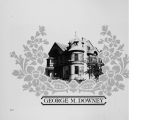
Show I GEORGE M. DOWNEY 212 O ne of the most pleasant surprises to greet the restoration hopefuls of the 1970s was the miraculous change in the old Downey residence at South Temple and Eighth East. The home had stood unnoticed by many for years until Clyde Harvey decided to restore it for use as offices for the Rio Vista Oil Company. The sand- blasting of the brown paint covering the cedar shingles revealed the work of a master craftsman. The shingles, arranged in flowing designs, add uniqueness to the particular style of architecture. The Shingle Style, originating in New England, was popular for a span often years during the 1880s and the early 1890s. The uniform covering of natural shingles on the upper stories combined with stone - buff brick in this case - on the ground story is characteristic of the Shingle Style, as is the main front unified by a single broad gable. The round turret and segmental bays are also characteristic. Although the home is two- and- a- half stories high, the embellishment of the dormers in the turret gives the horizontal effect necessary to this architectural style. Architect Steven T. Baird took charge of the restoration, with Wallace N. Cooper II acting as job captain. An adaptive restoration to make the best possible design for office use was employed for both the home and the carriage house. The house contains Handsome bronze hardware adds dignity to the main entrance. 213 offices other than the oil company. Two rooms have seen little change and retain the original parquet floors in allover patterns. The fireplaces are of an early date, enhancing the country manor feeling sought by the Shingle Style. Quarry tiles were used for the facings which were outlined with polished steel held in place with a series of large steel bolts. The tiles, The old carriage house, altered onlv slightly on the t makes allructiftc office space. being a man- made product, have different surfaces to complement the particular room, the ones used in the library having an almost leathery appearance. The carriage house, in a state of disrepair, had to have the entire beamed construction raised from the sagging position into which it had fallen over the years. The reconstruction was done without altering the exterior design. Upon arriving in Salt Lake City in 1888, Maj. George M. Downey hired architect Frederick A. Hale to design the home, one of the early residences on East Brigham Street. Downey, who was born in Maryland on December 25, 1841, received his education at military academies in his home state and in Virginia. He was described as a genial, pleasant, sincere and modest man, attributes that may seem unusual in a man who spent twenty- eight years of his fife on the military frontiers. He had entered the Civil War at nineteen as a first lieutenant and served in the Fifth Corps of the Army of the Potomac. He was bre-vetted captain and major by President Lincoln for his meritorious services at Chancellorsville and Gettysburg. At the close of die war Major Downey married the cultured Lizzie Faber of Pennsylvania and they had one son whom they named George Faber. Downey was then sent to the Pacific Coast for military duty on that frontier. After nineteen vears he was sta- 214 tioned in Arizona where he remained for another five years until his retirement in 1888. In Salt Lake City, where the Downeys chose to make their home, the retired major became president of the Commercial National Bank, located in the Commercial Block ( later known as the Beason Building) on Second South and Commercial Street. He was also vice- president of Rocky Mountain Bell Telephone Company and was active in civic affairs, it GEORGE M. DOWNEY 808 East South Temple Built 1893 Architect: Frederick A. Hale Present status: offices George M. Downey 215 |