| OCR Text |
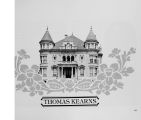
Show * » THOMAS KEARNS, 89 Thomas Kearns was one of the most prominent figures in Utah's mining history. He had a strong and positive personality, was direct in speech and action, and had a keen interest in the welfare of others. Although he could be pugnacious, he was also generally good natured. Born in Canada in 1862 of Irish immigrant parents, Tom moved with his family to Nebraska farm country where he grew up performing the duties of a frontier farm boy. At seventeen he set out to seek his fortune in the mineral- rich lands of the West. Four years passed during which he assisted in freighting supplies across the plains. He then arrived in Park City, without money in his pockets, and found work in the Ontario Mine. Life in Park City seemed to rid him of his wanderlust. So anxious was he to get ahead that he used his spare time to study geology and mineralogy. After a grueling six and a half years of hardship and self- denial, he was rewarded by the discovery of the ore vein that led to a partnership Thomas Kearns with David Keith and three others in the purchase of the Mayflower property. The initial shipment of ore from this venture netted Tom 820,000. His first thoughts were for his aging parents for whom he promptly bought a farm near his old home in Nebraska. His next step was to marry Jennie Judge, the lovely niece of his partner John Judge. In 1892 Kearns and his partners purchased the Silver King property. The dividends paid by this mine soon transformed the twenty- eight- year- old Irish farm boy into a millionaire. The rise to riches did not change Tom into the selfish or greedy capitalist one might imagine. His sympathies were with the mine workers and he was one of the first mine owners to institute an employees' benefit system. His interest in politics was stimulated by his election as an alderman of Park City. Then, in 1895 he served as a delegate to the constitutional convention, and six years later he was elected United States senator. In those capacities he continued to work for better health and safety conditions for the mine, smelter, and factory workers. The campaign statement that Tom Kearns was " a graceless, hard- rock miner who did not know how to wear a dress suit" apparently did not reach the ears of Washington society, which singled out the mining king from Utah as a prominent social figure. 90 While Tom was in Washington Mrs. Kearns was overseeing the construction of a magnificent home in the form of a French Renaissance castle located on East Brigham Street. However, a kidnap threat prompted Mrs. Kearns to take the three children, Edmund, young Tom, and Helen, and leave Utah. Pausing in Washington, D. C., to observe the inauguration of President McKinley, they continued on to Lausanne, Switzerland. Architect Carl M. Neuhausen carried on the planning and work while Mrs. Kearns Base of the grand stairway showing carved newels with bronze figurines. Detail of Grand Hall column. 91 shopped the European markets for art objects and furnishings for the new home. C. W. Benedict of Beattie Manufacturing Company of Saint Louis supervised the finishing touches of the interior. Upon entering the imposing oolite stone mansion visitors passed through an all- marble vestibule with handsome iron and bronze grillwork embellishing the windows and massive doors. Hand- chipped marble mosaic tile comprised the flooring of the grand hall, and the large wood columns featured hand- carved allegorical scenes by European craftsmen. The sweep of stairs, the newels, and balustrades, all of French The French parlor was richly elaborate. Note the crystal and gold chandelier. 98 oak, drew one's gaze up the artistically designed stairway to the third- story dome of high relief, illumined with hidden lights. The French drawing room with its ivory- toned walls and panels of palest blue provided a light and airy contrast to the adjoining Moorish parlor, to the black- stained Flemish oak library across the grand hall, and to the formal dining room with its rich red-stained mahogany brought from the Ural Mountains of Russia. The tapestry covering the upper walls was made in Italy; the tooled leather screen, bronze chandelier, and polished steel fireplace appointments suggested medieval Europe. At the back of the fireplace the relief in steel of a gladiator riding his horse-drawn chariot created a dramatic effect in the embers' glow. Mahogany beams supported a ceiling covered with canvas, metal- glazed to a rich, golden brown. The dining room has remained the outstanding showpiece of the home. The room still contains mahogany furniture left by the Kearns family, making it possible to re- create the atmosphere of original elegance. Quartersawed golden oak for the less formal family dining room was enhanced by delightful Wedgwood- like frescoes on the upper walls and ceiling. The room had a warm and friendly feel with its built- in credenza and fireplace. The marble kitchen and the butler's pantry, containing a callboard for the The Moorish room. A room such as this was a social fad at the turn of the century. It was used for the sole purpose of after-dinner coffee when the guests would reassemble to drink Moorish, or Turkish, coffee from fine china cups. This room and the French parlor were remodeled in 1930, making one large drawing room as seen today. 93 The formal dining room remains today much as it looked In this photograph. servants, completed the first floor. The rooms on the second floor and part of the third floor were bedrooms. There were thirty- two rooms in all, including a bowling alley ( now removed), a ballroom, billiard room, two parlors, two dining rooms, and three vaults for silver, jewels, and wine. The nine fireplaces and nine turret corners were a decorator's delight. One of the grandest occasions held at the home of Senator and Mrs. Kearns honored President Theodore Roosevelt when he visited Salt Lake City in May 1903. Luncheon was served in the formal dining room. American Beauty roses, Roosevelt carnations, and greens enhanced the magnificence of the furnishings. The T- shaped table was adorned with a two- foot width of American Beauty roses bordered by smilax and maidenhair. The credenza and mantel both contained American flags made of cut flowers and vases of velvety red roses. Yards and yards of plumosa were draped gracefully over doors, windows, and mantels. White carnations were used in the library and Moorish parlor, and pink carnations decorated the drawing room. In the grand hall was a vase of roses six feet high standing on a center table. Palms were used effectively throughout the hallways. In a letter written by Roosevelt to John Hay, the president noted his visit to Salt Lake City, saying that Tom Kearns had invited a Catholic bishop, an Episcopal bishop, and a Mormon apostle and his plural wife among other prominent people. The discussion at the table ranged from Wagner to Bacon and from the passion play to the flora of the Rocky 94 The Mansion was profusely decorated to welcome President Theodore Roosevelt in 1903. 95 Mountains, including " in short every combination of beliefs and systems of thought and civilizations that were ages apart. In many of the leading men in Utah I was particularly struck by a queer combination of the fanaticism of the ages of faith, within nonreligious matters the shrewdest and most materialistic common sense." Only Tom Kearns would have invited so naively the particular combination of guests. But when it came to making out guest lists, Kearns was especially broad- minded. Ordinary miners, old friends from Park City, were often invited to the millionaire's home. Tom Kearns, in partnership with David Keith, purchased the Salt Lake Tribune. While negotiations were taking place, Kearns sailed to Europe for the purpose of bringing his family home. However, the family decided to remain in Switzerland until school was out for the season. Returning via London the senator was entertained by Sir Thomas Lipton, world famous tea king. Guests included distinguished members of Parliament and other prominent Britons. Kearns was responsible for building the Kearns Building on Main Street and was a generous contributor to the construction of the Cathedral of the Madeleine, whose majestic towers and spires rose proudly over the homes of Brigham Street. Mrs. Kearns endowed the Saint Ann's Orphanage at Twenty- First South and Fifth East streets in Salt Lake City, completed far in advance of her own beautiful marble palace. Saint Ann's was an excellent facility in its day, complete in every detail, meeting the needs of the seventy motherless children whose home it became. Mrs. Kearns visited there regularly JennlcJ. Kearns 96 and supplied huge, beautifully decorated trees and presents for the children at Christmas. In her own yard the neighborhood children played on the east lawn, sliding down the slopes and using window wells for forts. Sometimes she would bring them cookies fresh from the oven. Children felt the warmth of her smile and her gentle qualities. Mrs. Kearns was an accomplished seamstress and enjoyed making dresses for her daughter, Helen, and her two Gallivan nieces who, with their brother, lived in the Kearns home. She was also charming and witty and never forgot her old friends. Kearns died October 18, 1918, of injuries suffered when he was struck by a car at Main Street and South Temple. Because of the influenza epidemic at that time, public gatherings were not allowed, so private graveside services were held at Mount Calvary Cemetery. He had died six months and two days after the death of David Keith, his friend and associate of nearly thirty years. The family continued to live in the home until 1937 at which time Mrs. Kearns presented it to the state of Utah to be used as a governor's home. Refurbished and decorated it served the administrations of Governors Henry H. Blood, Herbert B. Maw, and J. Bracken Lee. In 1957 a new home for the chief state executive was built on Fairfax Road and the legisla- A family group photograph taken in 1917, a year before the death of Thomas Kearns. Standing, Mr. Kearns, Helen, and Edmund; seated, Mrs. Kearns and Thomas F. in World War I uniform. 97 ture placed the mansion in the care of the Utah State Historical Society. Then in 1977 the legislature determined to restore the Kearns mansion to use as the governor's residence, beginning another era in the history of one of Utah's great homes, & THOMAS KEARNS 603 East South Temple Built 1900- 1902 Architect: Carl M. Neuhausen Owners: Thomas Kearns, State of Utah ( 1937) Present status: governor's residence 98 |