| OCR Text |
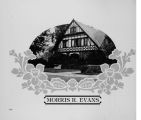
Show MORRIS R. EVANS, 208 T he man known as the father of baseball in Salt Lake City was a New Yorker by the name of Morris R. Evans. He was instrumental in bringing big time baseball to the city and served as director of and was a large stockholder in the Salt Lake City baseball club of the Pacific Coast League in its early years. Morris Evans was born in Lockport, New York, in 1849 and at twenty- two years of age set out for California, at the request of his father, for the purpose of seeking investments. That same year he left California to come to Salt Lake City where mining opportunities were just opening up and where he did some prospecting in the nearby mountains. From there he made his way to the Ute Indian Agency at White Rocks in Uintah County, where he met Capt. Pardon Dodds, who had established the Indian Agency in 1869. ( Dodds was later hired by Maj. John Wesley Powell to accompany the U. S. Geological Survey party down the Green and Colorado rivers.) Morris R. Evans In 1872 Evans and Captain Dodds went to the Vernal section on Ashley Fork to become the first white settlers in that area. There Evans engaged in the cattle business, later moving on to the Green River near the mouth of the White. During those years, although Evans established headquarters in Salt Lake City, he managed his cattle business and also found time to do some prospecting in the Uinta Basin. He discovered the first coal and asphalt beds found near Ashley Fork, and he brought back to Salt Lake City the first Gilsonite specimens. He also continued with other mining activities, working the old Jones Bonanza and Empire claims in Park City. In 1883 the land occupied by the Evans cattle in Uintah County was taken by the United States government for use as a military and Indian reservation, and Evans decided it was time to center his activities in Salt Lake City where his family was residing. 209 Nine years earlier Evans had married Alice A. Vincent, and over the years they were to have six children. Evans went into the sporting goods business which lasted for thirteen years. During that time he also kept up his mining interests in various parts of the state and had patented claims in Nevada. In 1890 he turned his attention to the Deep Creek Mining District. Although he was successful in all his endeavors, the Deep Creek development with its rich mineral resources yielded the greatest profits. The Columbus Rexall Mine in Little Cottonwood Canyon, of which Evans and his son Charles were part owners, was another profitable source of income. He retained his interests in the cattle industry and was a director in Utah Implement Company, Hillside Land & Cattle Company, the Land Development Company, and Fort Harriman Land & Livestock Company. As early as 1878 the Evanses had bought land on Brigham Street between " I " and" J" streets with a view that looked south on Seventh East. There they built a two- story brick house, and in 1911 they built the present house around the first home, Frank Winder Moore being employed as architect. The style of architecture was English Tudor with a combination of brick, stucco, and wood trim. The bricks, brownish-purple in color, were manufactured in Georgia. The Evanses were collectors of fine furnishings. Their marble statuary from Italy was shipped around South America to San Francisco then overland by railroad to Salt Lake City. Ornate pieces of Chinese teak-wood furniture and other costly objects of art decorated the home. An exquisite crystal and gold chandelier, which hung from a two- story height in the entrance hall, and the mahogany- paneled fireplace in the main parlor were brought from New York. There were originally fourteen rooms and three baths, two of which were marble. Even the tubs were set in outer casings of marble. There was also a silent toilet- flushing system serviced by an attic tank. Whereas the typical commode of that day had its own water closet set high on the wall and was activated by handles on the ends of long chains, in this case a marble slab set at the rear of the commode with a protruding handle set off the action which took place in the attic tank and muffled the sound. This house, as did many others on the street, had a vacuum cleaning system. Another item of interest was the gas pump Installed in the garage in 1911. During World War II the home was remodelled into apartments by Mr. and Mrs. Llewellyn O. Thomas, Carolyn Thomas being a granddaughter of Morris Evans. In the early 1970s Mrs. Thomas sold the home, and it is now used as office space, it 210 MORRIS R. EVANS 701 East South Temple Built 1878; major reconstruction 1911 Architect: Frank Winder Moore ( 1911) Present status: offices Motorists on a typical unpaved city street, ca. 1910. Seft'eral Brigham Street gentlemen had difficulty driving the new machines. 211 |