| OCR Text |
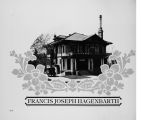
Show FRANCIS JOSEPH HAGENBARTH, A r 164 F rank Hagenbarth's years at the University of Notre Dame marked him as a studentof high scholastic achievement and social acceptance. He was first vice- president of the school during his second year. He also endeared himself to the curators of the university museum by presenting them with some gold and silver ore and several live rattlesnakes. Frank was affiliated with two campus organizations, one that promoted proper elocution and the other, one of the most prestigious societies at the university, the Saint Cecilia Philomatheon Association. This organization performed dramatic, musical, and oratorical compositions. The Oechtering Gold Medal for church history was awarded him in 1885, and one year later he received the Barry Gold Medal for excellence in elocution. Graduating with a degree in commerce in 1887, Frank returned to Idaho where he was employed by the Salmon River Mining & Smelting Company. That same year his stepfather, David Wood, offered him one- fourth interest in his livestock business and a managerial position. Under Frank's direction the business grew steadily until 1896 when his brother, Hugh, acquired interests, and the business was then incorporated under the name of Wood Live Stock Company with Frank as vice- president. The Wood Live Stock Company began a systematic acquisition Frank Hagenbarth in 1885 when he was a student at Notre Dame. 165 of land in five different counties of Idaho and two counties of Montana. Its sixteen ranches eventually totaled 750,000 acres. Frank took an active part in protecting the wool interests of Idaho and became one of the best- informed men in the country on all aspects of wool growing and manufacturing. This recognition and leadership eventually brought about his election as president of the National Live Stock Association. In 1902, at age thirty- four, Frank joined his stepfather, his brother, and William S. McCornick of Salt Lake City in the purchase of the Palomas Ranch in Mexico. This venture, organized under the name of Wood- Hagenbarth Cattle Company, further extended a fabulous livestock empire to include 2,465,000 acres of land and about thirty- five thousand head of cattle. Hagenbarth was the company's first vice-president and general manager. After the death of his stepfather in 1908 he assumed the presidency of both companies. It seemed inevitable that Frank should one day meet Anthony W. Ivins who also had interests in Mexican cattle lands. Ivins, who ultimately became a counselor to Heber J. Grant in the First Presidency of the Church of Jesus Christ of Latter- day Saints, had assisted in the establishment of Mormon colonies in Mexico. As manager of the Mojave Land and Cattle Mary Ellen painting china at the school she attended before lur marriage to Hagenbarth, 166 Company in southern Utah and one of the owners of the Kaibab Cattle Company, he was an experienced cattleman. By 1909 Ivins had become general manager of the Mexican Colonization and Agricultural Company near Colonia Juarez. A deep friendship grew between the Ivins and Hagenbarth families, the one Mormon and the other Catholic, and their contacts with each other extended from Mexico to Utah. Hagenbarth's education, his extensive experience, and his impressive personality gave him high qualifications for many callings. During World War I he was appointed chairman of the livestock section of the Agricultural Advisory Commission under Herbert Hoover; in 1929 he was a member of the first board of directors of the National Wool Marketing Corporation and worked with the Federal Farm Board. His ease and dignity while presiding at public meetings added to his professional stature, making him a worthy choice as president of the National Wool Growers Association, a position he held for twenty-one years until his death in 1934. Hagenbarth had other interests as well, holding high positions on the boards of many companies, including stockyards, banks, insurance companies, and several mining companies. Mary Ellen Browne, daughter of Gen. and Mrs. James A. Browne, of Melrose, Montana, became the bride of Frank Hagenbarth in 1897. May, as she was known to her friends, was beautiful and accomplished, having been sent to good schools where she studied art. Over the years the Hagenbarths reared a family of four children: Mary Catherine, David Vincent, Catherine Aloysia, and Francis Joseph III. 167 Soon after acquiring the Mexican property Hagenbarth purchased a house owned by Thomas Woodbury on East Brigham Street opposite the new mansion of the J. D. Woods. Since it was difficult to build an adequate stable and carriage house on the north side of the street against the hill of the Wood property, the two families built facilities on the Hagenbarth property. The carriage house was large enough to accommodate the fifteen vehicles acquired by the two families. In 1914 a fire destroyed the original home. In rebuilding, the foundation was completely removed First home of the Hagenbarth s, right, was purchased from Thomas Woodbury. The immense carriage house at the rear was shared by the Woods and Hagenbarths. 168 and a new structure, designed by D. C. Dart, was erected in its place. The Hagenbarths also built a hunting lodge near Sheridan, Wyoming. May was as enthusiastic as the other family members and assisted in the planning. While the lodge was still under construction, May fell ill in Chicago and died. The Mary Ellen Lodge was completed, and throughout their lives the family spent holidays and vacations at the Sheridan location, continuing their close and happy relationships. Because of Hagenbarth's widespread interests he did not take an active part in the civic affairs of Salt Francis Joseph Hagenbarth when he lived on South Temple. The parlor, ca. 1925. looks much the same today. 169 The central room of the home, ca. 1935, with iIN paneled walls and stained- glass window, was used by Larkin Mortuary Tor small funerals, 170 Lake City, although he was a member of the Alta and Commercial clubs, and the family's social activities were woven into the life of the city. At the time of Hagenbarth's death on October 20, 1934, the National Wool Grower paid a three- page tribute to " a great leader of America's flockmasters." The Hagenbarth residence was sold to the Larkin Funeral Directors in 1925, one year before Mary Ellen's death. The house has had additions and a very few adaptive changes, but the original structure is essentially the same. Beautiful wood paneling and art glass windows throughout continue to reflect its original charm. The home has dignity and warmth and provides historical significance to a neighborhood that is now void of its once fine residential structures. & FRANCIS JOSEPH HAGENBARTH 360 East South Temple Built 1915 Architect: D. C. Dart Owner: Francis Joseph Hagenbarth Present status: Larkin Mortuary 171 |