| OCR Text |
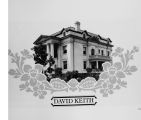
Show ' DAVID KEITH, > f 79 T he stately mansion and carriage house of David Keith still stand, appearing much the same as they did seventy- five years ago. Four massive Tuscan stone columns support the home's Greek- style portico. The imposing entry is further intensified by the beautifully designed wrought- iron doors, added during the Thompson period. The magnificence of the interior is unforgettable. An octagonal rotunda of polished cherry wood was used as living space. The furniture was grouped around the fireplace, located on the north wall, while doors and passageways opened from the other seven sides of the room. On the second floor mezzanine is a series of Gothic archways. From here one can enjoy the beauty of the splendid woodwork and the elegant skylight which diffuses a soft light over the area below. Frosted white and sun yellow are the predominant colors, with jewel- like touches of ruby and amethyst. This massive work of art was made by Louis Tiffany & Company of New York, as were the chandeliers and newel lamps. An east window on the stair landing depicts a figured garden scene also in Tiffany art glass. The Salt Lake Tribune reported that the " new residence of David Keith on East Brigham Street was brilliantiy lighted last night to study effects of the electric lighting from the new fixtures." The Gothic archways on the second floor balcony and the Tiffany art glass skylights are entrancing features above the rotunda. 80 lighting is truly magnificent and the windows' beveled glass picks up the light and plays with it, creating a lovely effect. Other features of the home included a wine cellar, ballroom, and a walk- in icebox large enough to hold a ton of ice. The carriage house - probably the largest on Brigham Street - contained, besides a bowling alley, shooting gallery, and a pigeon coop, living quarters for several servants. The east stair landing is graced by a figured art glass garden scene designed by Tiffany of New York. Detail of the beveled window treatment, m*- - r , l ttill/ v 81 David Keith was born of Scottish parents in Cape Breton, Nova Scotia, May 27, 1847, the thirteenth child of John and Margaret Ness Keith. In his fourteenth year his parents died and it was necessary for him to seek employment. He obtained work in the gold mines of Nova Scotia, becoming a superintendent at the age of twenty. The news of the day was full of glowing reports of successful strikes in the gold fields of the far western regions of the United States. The lure of new horizons was too tempting for him to ignore, so traveling first by vessel to the Isthmus of Panama he made his way to California and then to the famed Comstock Lode in Virginia City, Nevada. David made steady progress, first as a miner, then as a proficient pumpman. For that reason he was brought to Park City in 1883. The installation of the great Cornish pump at the Ontario Mine would free the mine from water until a drain tunnel could be constructed. His expert handling of the job led to his becoming a foreman. At the time Keith was foreman of Ontario's Shaft No. 3, he met Thomas Kearns who was to be his lifelong friend and business associate. Five years later Keith was in charge of the underground work at the Woodside Mine. Kearns had contracted to build a tunnel through this same property. While engaged in this work Kearns noticed that the trend of the ore 82 vein led toward the undeveloped Mayflower Mine. After he consulted with his friend David Keith, the two, with other associates, John Judge, Albion Emery, and Windsor Rice, secured a lease on the Mayflower property. In three months they struck a vein of unusually rich ore. The five miners then leased the adjoining property known as the Silver King. In July 1892 they organized a company bearing that name with Keith as president and Kearns as vice- president. The ore of this mine yielded lead, silver, and gold. By the time of its amalgamation into the Silver King Coalition Mines Company in 1907, the mine had paid more than ten million dollars in dividends. Keith was highly esteemed in Park City. His election as a delegate to represent Summit County in the state constitutional convention of 1894 was evidence of his popularity when he received the greatest majority " The Park" had ever given a political candidate. This convention framed the constitution upon which Utah was admitted to the Union as a state. Keith's business interests increased over the years. He was associated with banks and railroads and was sole owner of the Pioneer Roller Mills. He had real estate holdings and financed the building of the David Keith and Ness buildings and the Little Hotel. He was also instrumental in organizing the Keith- O'Brien Company. In 1901 Keith and Kearns purchased the Salt Lake Tribune, a venture Keith continued in until 1919 when the Kearns estate purchased his half-interest. Outwardly their personalities were dissimilar, but the two natures found their complements in each other. In their partnerships Keith held the more impressive title, but Kearns was the one who dominated the operations. Perhaps Kearns wanted it that way. Keith was fifteen years his senior and Kearns held him in high regard. Keith had been an advisor and a friend, and they worked well together. Keith was far from loquacious, but he was genial and a warm companion among his intimates. He let few people into his private life, and yet he related well with almost anyone. He was short with a large head set on heavy shoulders. Married twice, Keith had four children, Charles, Etta, LUlie, and Margaret, by his first wife, and a son, David, by his second wife, Mary, whom he married in 1894. He also had an adopted son. The records tell little of the first Mrs. Keith, but Mary Ferguson, a capable telephone company manager in Park City, married this quiet and good man a year after the Silver King began to produce its tremendous dividends. She was born in Salt Lake City in 1854, receiving her education at Saint Mark's. She taught school in Park City, then, a few years later, went to work for the 83 Mary F. Keith Rocky Mountain Bell Telephone Company in Salt Lake City. In 1888 she became the company's branch manager in Park City. Orson F. Whitney in his History of Utah, published in 1904, called her " a lady universally esteemed for her goodness of heart, intelligence, modesty, and the strength and sweetness of her character." But she was many things to many people. A few have remembered her as austere and cold and as imposing her will on those around her. David Keith's life was not without its tragedies and inner conflicts. It was rumored that his first wife left him for another man. Even though she returned penitently seeking to take her place again in the household, Keith could not forgive her. If this rumor is accepted, it explains why mention of her was ignored by his biographers, why records on her are scant, and why Keith retained the parental responsibility. The strange and mysterious story of his youngest daughter was another deep heartache he was to carry for the remainder of his life. After Margaret's return from school in the East, she went into virtual seclusion in the family home, hiding her face behind a heavy black veil. Twenty-four years later, following the deaths of her father and stepmother, the heiress, reportedly worth over a million dollars, purchased two estates in California, one in Beverly Hills and one in Palos Ver-des. She divided her time between the two homes, continuing a bizarre life- style that fascinated those who knew of her. She remained heavily veiled at all times, even before her servants. The homes themselves reflected her self- imposed isolation: most of the rooms were unused, the furniture shrouded with 84 dust covers, and most of the windows covered with blankets. On April 28, 1934, the strange woman staged her own suicide. When a doctor, summoned by note, arrived at Miss Keith's Beverly Hills estate he found her lying on a divan, a chloroformed cloth covering her face. Removal of the cloth revealed not the disfigured face many had imagined but a handsome, unscarred one. The press sensationalized the suicide and the wealthy woman's eccentric behavior, but not until the 1970s was a published explanation of it offered: a document allegedly written by David Keith asserts that at age sixteen Margaret was seduced by Keith's adopted son and gave birth to a child who was reared in the Midwest by guardians. In David and Mary Keith visit Salisbury School in Connecticut where son David attended school. Curtis, Edward, and Pat Qr.) Moran from Brigham Street, who also attended the school, and the headmaster complete those in the picture. Note the traveling or dust coat worn by Mrs. Keith. 85 A run- emergence from seclusion, ca. 1901, when Margaret Keith consents to have her picture taken in a new ermine cape. remorse the young girl retreated from the world for four decades. Despite Margaret's early withdrawal from society, the Keith family took part in the social life of Brigham Street. Mrs. Keith had her weekly " at home" where she greeted friends, and other entertainments in the beautiful residence were reported in the society news of the day. Senator Kearns, for example, home from Washington for the Christmas holidays, was the guest of honor at an elegant dinner party hosted by the Keiths. And they gave their daughter Etta a lavish wedding reception in the best Brigham Street tradition. Nevertheless, the socially prominent Keiths did not entertain as frequently as many of their neighbors. Keith, quiet and mild of manner, no doubt was more comfortable chatting with a few close friends in his library than mingling with many guests. The Keiths moved to the Hotel Utah in 1916, where both died in a few years. Keith died of pneumonia on April 16, 1918. Mrs. Keith, who had reportedly become addicted to alcohol, lived only one year and a month longer dian her husband, dying of a heart ailment on May 17, 1919. The Thompson family, who lived a block east on Brigham Street, became the new owners of the Keith mansion. The beautiful home was filled with the vibrant personality of Ezra Thompson, the calm in- 86 Carriage house after Terracor remodeling. 87 fluence of Emily, and the voices of young people. After Thompson's death in 1923 and Emily's in 1936, their son Clyde continued to live there, converting the third- story ballroom into a handsome bachelor's apartment. A sister, Norinne, and her husband, Roy Brown, moved in in 1939, remaining until they leased the home to Terracor in 1969. A land developing company, Terracor set out to adapt the old mansion for the company's headquarters, preserving its structural beauty and architectural integrity. The carriage house was redesigned for the company's architectural offices. The home, carriage house, and grounds remain as an ideal example to those concerned with the preservation of Utah's cultural heritage, & DAVID KEITH 529 East South Temple Built 1898- 1900 Architect: Frederick A. Hale Owners: David Keith, Ezra Thompson ( 1917), T. Roy Brown ( 1939) Present status: Terracor 88 |