| OCR Text |
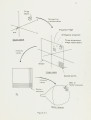
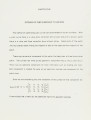
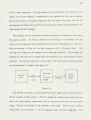
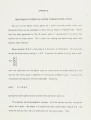
Show 5 A "frame-buffer" is a memory large enough to store all of the intensity values prior to displaying. An intensity value in the frame-buffer can be addressed in a way that corresponds to the position where the value will be displayed on the raster. Locations in the frame-buffer will also be called "raster-elements" since there is a strong one-to-one correspondence between those locations and the geometric locations of the raster-elements and because the distinction between the two is not important here. For our purposes, the frame-butter is made with random-access memory so that values can be written into it in any order, as opposed to scan-line order only. The size of the frame-buffer is determined by the resolution of the raster-display and the number of "bits" used to store intensity values. For example, if the raster has 512 scan-lines and 512 raster-elements per line and each element has 8 bits for the intensity value, then the frame-buffer requires a storage capacity of 512x512x8 bits. For the most part we will ignore the raster-display and address ourselves to the issue of putting the right intensity values in the raster-elements of the frame-butfer. The terms relating the original description of an object to its image will now be defined. "Object-space" is the three-dimensional space in which objects will ordinarily be described. In order to generate realistic pictures of objects we make a perspective transformation [1,7,8) of the object from object-space to "image-space." Image-space is also three-dimensional but the objects have undergone a perspective distortion so that an orthogonal projection of the object onto the x-y plane would result in the expected perspective image. We want the image-space to be three-dimensional in order to preserve depth information which will later be used to solve the |