| Title |
Interviews with Japanese in Utah: Grace Oshita |
| Alternative Title |
Grace Oshita: interviews on February 20, 21 and 26, 1985, and May 22 and 30, 1985 |
| Creator |
Oshita, Grace Fujimoto, 1925- |
| Contributor |
Kelen, Leslie G., 1949- |
| Publisher |
Digitized by J. Willard Marriott Library, University of Utah |
| Date |
1985-02-20; 1985-02-21; 1985-02-26; 1985-05-22; 1985-05-30 |
| Date Digital |
2014-05-07 |
| Access Rights |
I acknowledge and agree that all information I obtain as a result of accessing any oral history provided by the University of Utah's Marriott Library shall be used only for historical or scholarly or academic research purposes, and not for commercial purposes. I understand that any other use of the materials is not authorized by the University of Utah and may exceed the scope of permission granted to the University of Utah by the interviewer or interviewee. I may request permission for other uses, in writing to Special Collections at the Marriott Library, which the University of Utah may choose grant, in its sole discretion. I agree to defend, indemnify and hold the University of Utah and its Marriott Library harmless for and against any actions or claims that relate to my improper use of materials provided by the University of Utah. |
| Spatial Coverage |
San Francisco, San Francisco County, California, United States, http://sws.geonames.org/5391959/ ; Topaz Camp, Millard County, Utah, United States, http://sws.geonames.org/5548582/ |
| Subject |
Oshita, Grace Fujimoto, 1925- --Interviews; Japanese Americans--Utah--Interviews; Japanese Americans--Forced removal and internment, 1942-1945; Central Utah Relocation Center |
| Description |
Transcript (typescript, 174 pages) of a series of interviews with Grace Oshita, a Japanese-American living in Utah in 1985. Mrs. Oshita (b. 1925) speaks of her early life in San Francisco, her father's business ventures, and the Japanese relocations of World War II. Her family was interned at the Topaz, Utah, relocation center |
| Type |
Text |
| Genre |
oral histories (literary works) |
| Format |
application/pdf |
| Language |
eng |
| Rights |
 |
| Relation |
http://archiveswest.orbiscascade.org/ark:/80444/xv45901 |
| Scanning Technician |
Matt Wilkinson |
| Conversion Specifications |
Original scanned with Kirtas 2400 and saved as 400 ppi uncompressed TIFF. PDF generated by Adobe Acrobat Pro 9 for CONTENTdm display |
| ARK |
ark:/87278/s6j4099m |
| Topic |
Japanese Americans; Evacuation and relocation of Japanese Americans (United States : 1942-1945); Central Utah Relocation Center |
| Is Part of |
Aileen H. Clyde 20th Century Women's Legacy Archive |
| Relation is Part of |
Mitsugi M. Kasai Memorial Japanese American Archive |
| Setname |
uum_ijau |
| ID |
897992 |
| Reference URL |
https://collections.lib.utah.edu/ark:/87278/s6j4099m |
| Title |
Page 37 |
| Format |
application/pdf |
| Setname |
uum_ijau |
| ID |
897859 |
| OCR Text |
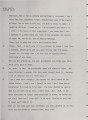
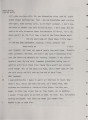
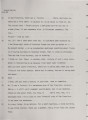
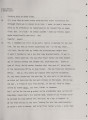
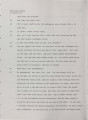
Show Grace Oshita 2-21-85 s1:4 rice. Sprinkle on. And then - this is all done on the floor, you know. And the workers used to rub the heels of their hands. Get on their hands and knees, rub the yeast into the rice. And then, since they didn't want it to cool completely, because they needed the warmth for it to activate --any yeast --they would cover it over, like fold it into three. Just cover it over and leave it until all the rice had been in with the yeast. And then fuey would take this into a warm. Let's see, what kind of room? MURO is the name of the room in Japanese. Which we call hot room. It's just for fermentation purposes. It was small rooms. Let's see, made with. Oh. Sawdust insulation. Maybe it was about 8 inches thick, the walls, so that it would stay very warm. Butt was made completely of wood. So that it also held the moisture in the room. L So it could breathe. GO And so. There was a large box, like - ah, what would it be like. Might have been about five by ten and about three feet deep. They would line this with more mats or canvas. And then they just threw the rice in there. Minus the mats. In this big box. And then. They would let it sleep overnight that way. They would cover it with more mats and then quilt- a quilt on top. Comforter type thing. A quilt on top. Andleave it overnight. And the next morning, -- In this muro, is a shelf all the way around. And individual boxes, trays that are about 24 inches long by twelve inches wide and a couple of inches deep, ah, wooden boxes. We had many many of those trays. And the following morning, the Koji would be ready to be individually separated or poured into fuese trays. I don't know |
| Reference URL |
https://collections.lib.utah.edu/ark:/87278/s6j4099m/897859 |