| OCR Text |
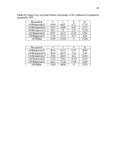
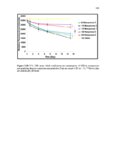
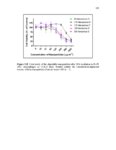
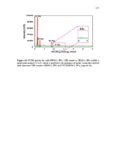
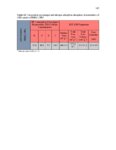
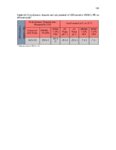
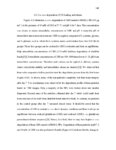
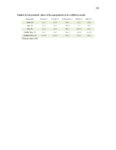
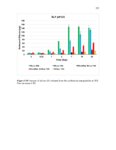
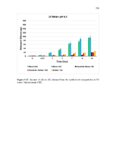
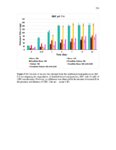
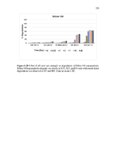
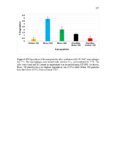
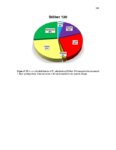
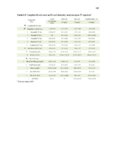
Show 242 and 5.31 illustrate degradation and biodistribution of Stöber 100, Meso 100, and Disulfide Hollow 100 nanoparticles, respectively, 7 days postinjection. Highly perfused organs were selected for these experiments including liver, spleen, lung, and kidney. As shown, all three particles accumulated in the liver and spleen more than lung and kidney. It is noteworthy that in organs, Si can be found in form of soluble degradation products, and as intact or broken nanoparticles while in the urine Si should be in its soluble degradation form or in the form of nanoparticle fragments that are less than ~5 nm. As shown in Figure 5.29, for Stöber 100 nanoparticles, the Si content was: 27% (urine), 25% (liver), 16% (spleen), 4% (lung), 2% (kidney), and 26% (the rest of the body). For Meso 100 nanoparticles (Figure 5.30), the Si content was: 53% (urine), 17% (liver), 10% (spleen), 4% (lung), 2% (kidney), and 14% (rest of the body). As indicated in Figure 5.31, these values for Disulfide Hollow 100 nanoparticles were: 39% (urine), 19% (liver), 13% (spleen), 3% (lung), 3% (kidney), and 23% (rest of the body). Regarding fecal and blood analyses after 7 days, no Si was found in fecal samples and only ca. 0.2% of Si was found in the blood of the mice treated with Disulfide Hollow 100 nanoparticles. Results indicate that porosity, surface area, and composition play significant roles for degradation and bio-elimination of these SiO2 NPs in vivo since in mice treated with Meso 100 nanoparticles ca. 2 times more Si was found in urine than mice treated with Stöber 100 nanoparticles. In addition, for the particles studied, density does not seem to play a substantial influence on biodistribution of these particles in CD-1 mice since regardless of their density, all of the particles followed a similar pattern of biodistribution. |