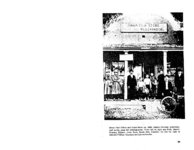
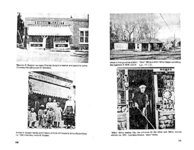
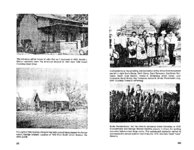
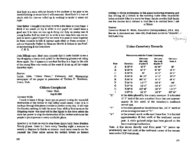
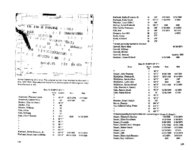
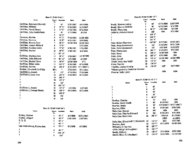
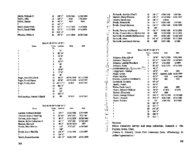
| OCR Text |
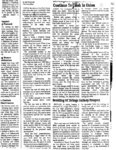
Show A few members met and seeds distributed as follows: Bp. Cahoon $1.00, D. C. Thompson SOc., Jos. A Young $1.00, Wm. G. Young 25c., Wm. Boyce 5Oc., S. Richards 25c., M. H. Brady 25c., Thos. Birch 5Oc., H. W. Brown SSc., Chas. Wilkin 5Oc., C. Steffetson 5Oc., Wm. Wooton 25c., Thos. Labr~m SOc., James Winchester $1.05c., Green Flake 55c. 14 At the next meeting of the society, there was a show of fruit of good quality ... also several kinds of very fine apples, and the vegetable marrow, a \~ beautiful specimen. S. Richards exhibited a beautiful (\ e\ C . variety of excellent~a~ 15 In later sessions; members delivered lectw-es on raising wheat and potatoes. Stock raising was even mentioned in some of the discussions. Church leaders actively encouraged the members "to persevere in the good cause." Brigham Young's eldest son, Joseph A. Young, spoke by invitation at the second assembly of the society: He . . . made many comparisons, illustrating the advantages to be derived from eXperimenting in different localities, because of the variation in soil and climate, in one region of country. I' In February of 1871, participants voted to procure 3 agricultural papers at the expense of the society, and several members said they would contribute books. Thos. A. Wheeler was appointed to superintend the construction of a suitable place in the [South Cottonwood] Ward House to preserve the Library. 17 Eventu~lIy, the library holdings consisted of the following: The \ Prairie Farmer; American Agriculturist; Department of (,(,\ 'Agriculture, Agricultural Reports for 1867, 1868, and 1869; "one copy of the last Agricultural ,Census',' ; and monthly reports from the Department of AgricultUre, from January, 1871, to September, 1872. The last recorded meeting of the society was held March 21, if { 1872: Many remarks were made by Prest. [William G.] Young and others relative to the benefit derived by the members from seeds received from the Department [of \ \ ~e\e};~~~,~~~~~~I~ndBlsofrontQH)peratonC).I' 62 This idea of cooperation soon blossomed. The South Cottonwood Farmers Gardeners and Fruit Growers Association apparently became the forerunner of a cooperative retail unit. In the latter part of 1872, residents of Union and South Cottonwood created the )) "South Cottonwood QH)perative Stor6Jl ~as...Ri<;har~_!!'~_~P:'_$\ore, pointed one of the directors of the project. Richards took out shares in the institution amounting to $150.00. 1' Henry Brown, of South Cottonwood, became manager of the store.20 Generally, the cooperative retail stores proved unsuccessful. To begin with, the South Cottonwood store was among those that did not prosper. The unprofitable venture was blamed largely on loose credit arrangements extended to the people. Silas Richards explained the decline at that time of the local cooperative. There has been very little profit to the stockholders of the institution in consequence of the large amount paid for running the concern, and the great amount of bad debts incident to the loose credit system practised by the management. 21 The circumstances surrounding the losses of the South Cottonwood ({ Co-operaUve Store were not unique. q~,e_,parent , inst.itution,~~i( .(-1<}Z.C.M.IJalso suffered as a result of a liberal granting of credit to local cooperatives. "This liberality was to be expected because of the church policy of aiding those in need(.-:·'-X~_~!?~e_ Ard~n,B~I_de\e4e. Olsen, an authority on Mormon coopeiaffves. The extension of credit also became a serious handicap to other local cooperatives. Olsen states, "The decline of local co-operatives set in very early. In fact many of them had ceased by the end of the first decade to be cooperative."23 Other reasons have been given for its decline, including lack of experience, eastern competition, loss of support which had rested in many instances upon loyalty rather than eco~omic advantage, accumulation of stock into fewer hands, and in some cases, mi!?fortunes beyond human control. 24 As has been mentioned, in 1865, Union Ward was dissolved because of the emigration of many of the local leaders and residents. From 1865 to urn, ward records show, a temporary district organization was kept up at Union, with a Presiding Elder in charge, who acted under the I 63 |