| OCR Text |
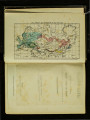
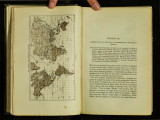
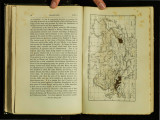
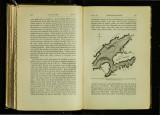
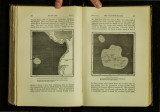
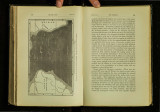
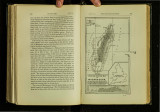
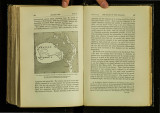
Show 111AP OF JAPAN AND FORMOSA (with depths in fathoms). Light tint, sea unrlcr 100 fathoms. Merlium tint, under 1.000 fn1homs. Dark tint, OYer 1,000 fathoms. Tho fl~ures show the depth in !hthoms. C::IJAP. XVIII.) JAPAN AND FOIUlOSA. 365 Y esso it is about 200. The island of Saghn.lien, however, separated from Y esso by a strait only twenty. five miles wide, forms a connection with Amoorland in about 52° N. Lat. A southern warm current flowing a little to the eastward of the islands, ameliorates their climate much in the same way as tho Gulf Stro:tm does ours, and added to their insular position enables them to support a more tropical vegetation and more varied forms of lifo than are found at corresponding latitudes in China. Zoological feat~wes of J apan.-As we might expect from the conditions here sketched out, Japan exhibits in aU its forms of animal life a close general resemblance to the adjacent continent, but with a considerable element of specific individuality; while it also possesses some remarkable isolated groups. It also exhibits indications of there having been two or more lines of migration at different epochs. The majority of its animals arc related to those of the temperate or cold regions of the continent, either as identical or allied species; but a smaller number have a tropical cltaracter, and these have in several instances no allies in Chi:r;ta but occur again only in Northern India or the Malay Archipelago. There is also a slight American element in the fauna of Japan, a relic probably of the period when a land communication existed between the two continents over what are now the shallow seas of Japan, Ochotsk, and Kamschatka. We wiJl now proceed to examine the peculiarities and relations of the fauna. Mam·malia.-The mammalia of Japan at present known are forty in number; not very many when compared with the rich fauna of China and :Manchuria, but containing monkeys, bears, deer, wild goats and wild boars, as well as foxes, badgers, moles, squirrels, and hares, so that there can be no doubt whatever that they imply a land connection with the continent. No complete· account of Japan mammals has been given by any competent zoologist since the publication of Von Siebold's Fauna Japonica in 1844, but by collecting together most of the scattered observations since that period the following list has been drawn up, and will, it is hoped, be of use to naturalists. The species believed to be peculiar to Japan are printed in italics. These a.re very numerous, but it must be remembered |