| OCR Text |
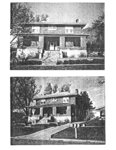
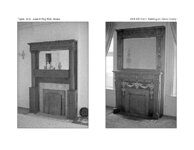
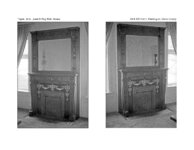
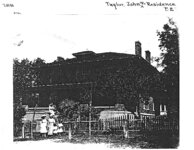
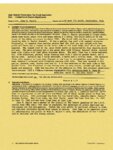
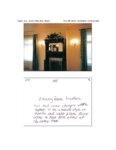
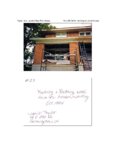
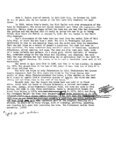
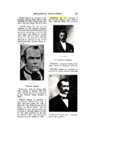
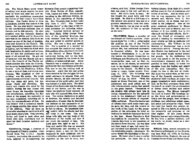
Show Section No. 8 Page 10 Narrati ve Statement of Significance cont. In Margaret S. Hess's history of Fannington, she stated: I remember when I (Margaret Steed Hess) was a girl, a few of us used to go up in the evening to see how the house was progressing. It was one of the largest in our town and we thought it would never be finished ••.. When the beautiful brickwork was finished, we went up to watch the builders one day and they let us go through the big home. We 'Here shocked to see the beautiful fireplaces in five of the large rooms and wondered why so many were needed. On August 29, 1901, Taylor Married two sisters from Farmington, Eliza Roxie and Rhoda Wellin~ _ T~ ltlQre the daughters of Job Welling and Emna Lucinda Holmes. Taylor then moved Nellie, Netti~and his two new wives to Mexico \ before the Fannington house was completed. These were trying times for the women who were living the principle, but the never let it interfere with their responsibilities as mothers to their children. In discussing life in a polygamist home with Emma Taylor Moon, she stated "despite all the anxieties that our mother faced, she never let us know of them. This was also true of the others. II The challenge of prtecting John W. was the greatest to be met. His position of church leadership served as a factor in motivating United States officials to seek him out and arrest him. In 1905, TaYI~<;Hl . ed E his position from .the Quorum of the Twelve. His strong belief in ~~ had resulted in his making a choice between church and family. The love and responsibility that he felt for his family and strong belief in the principle, resulted in his resignation. It came in part as a result of the Smoot hearings that had started earlier in Washington D.C.. Smoot's membership in the United States Senate had been in question as a result of the fact that many men, including church authorities, were still living with plural wives. Taylor was one of the stronger advocates of the principle and he now faced pressure from within the church in addition to that from the outside. His resignation helped Smoot receive his seat in the Senate. ~' TaYlOr'S letter of resignation, he stated: III have always believed that the government of the United States had only within its own boundaries, and that the term 'laws of the ( land', in the Manifesto meant merely the laws of the United States. I find not . \ that this opinion is different to that expressed by the Church authorities, who have declared that the prohibition against plural marriages extended to every part of the church. It is doubtless true that this view of the matter has been given by President Woodruff and others, but I have never taken that as binding upon me of the church, because it (such interpretation) was never presented for adoption by 'common consent' as was the Manifesto itself and I have disputed its authority as a law or a rule of the church. ~jurisdiction On June 12, 1909, Taylor married his sixth wife, Ellen Georgina Sandber~ SAe ',iaet 'ilie daughter of John Christian Sandberg and Anna t-lary Gabrielson. x see continuation sheet |