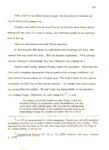
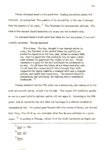
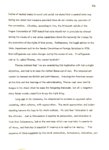
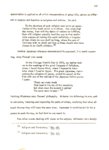
| OCR Text |
Show 154 repeati"" his view, CIt Gnother time ceuld be assumed that ment WQS making mClk. such Q or the to future belonged exclusively Congress its purpose. by 'lone interpretation repr••ntcrti¥e of the executive brcmch of promise in reSQrd statement Government, the treoty Q Q declored thot policy, the to of the United States. He objected simply 19 on our and that the it Govern- authority pol icy making branch Thomos had no the technical to of the objection to grouMs of governmental procedure. While reference to fnsi$ting the tron, by mak.ing on theory a plea Congress. In 1937 the maintaining of the spirit of aeparation of powers, redefined for "foir play he entered the If I • Supreme !:!:_. separation of fwnc- Court fight of the President, iudicicil written constitution and he liked It but that he took issue with its abuse. 9 _ Thorno. winds up with the supremccy of side of the President. Thomas declared the proper fune tioning of of the Constitution with on the review la etssential to the _eeptod the process. He noted the 10 He mid primary f.ult with oft. 10 "Now we can see that the part of our Constitution on which made it Q institution insted of 0 stoti¢ affair WQ$ the theory of review written into our c;onltitutionol development by our Sup-reme Court, $0 tM.t today we may say thet the $pirit of the genius of our Federal system is based upon the theory of the separation of powers whereJn the representatives of the people shall make the law, ond an elected President sholl enforce it I and in order thet the living shell not growing by their dead, or the present bound by the will of the pent, Q Court was Interpret and is the light of growth rendering 0 present meaning. Thus a stotic document became a living organism, and thus we have on idealization of our American ConstituHonal scheme. ConQ!essional R6C()rd, Vol. 83, p. 1435, (75th Congress, 3d Sess., April 11, 1938). be ruled set up to >t |