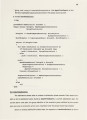
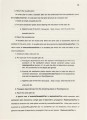
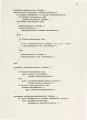
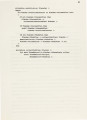
| OCR Text |
Show ABSTRACT This thesis describes the use of algebraic constraints and functional dependencies in the context of a geometric modeling system. The modeling system is assumed to have the property that COOl>lex, possibly procedural (as opposed to algebraic) geometry is functionally derived from elementary algebraic objects. This thesis is based on the belief that people understand and manipulate geometric models in terms of elementary geometry, and that the modeling system should be responsible for deriving the more complex model from the user's simpler geometry. As a part of this kind of modeling system, a constraint satisfaction system would aid the user effectively if its emphasis were primarily on the elementary geometry of the users construction and secondarily on the complex geometry of the derived model. Constraint Kernels is a hybrid scheme employing both algebraic constraint networks with their associated constraint satisfaction algorithms, as well as dependency graphs with their associated dependency propagation algorithms. These Constraint Kernels can be embedded in an effective user Interface allowing (but not requiring) considerable user input to the satisfaction process including Undo, and for underdetermined constraint networks a FirstSolution, NextSolution and PreviousSolution capability to step through the set of possible network solutions. |