| OCR Text |
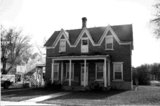
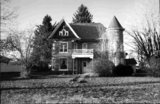
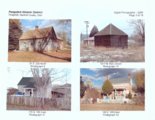
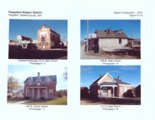
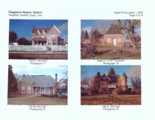
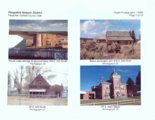
Show 0MB No. 1024-0018, NFS Form United States Department of the Interior National Park Service National Register of Historic Places Continuation Sheet Section No. § Page 5 Panguitch Historic District, Panguitch, Garfield County, UT 1960). Electricity came to Panguitch in 1910. Historic photographs show poles ran down the center of Main Street until the 1950s. The photographs also show Main Street slowly transforming into an urban streetscape. A weekly newspaper, the Progress, was established in 1895.23 The Social Hall was built in 1900. Another meeting hall, Mascott Hall, was a frame building (demolished). The Garfield County Courthouse was built in 1907. R. C. Watkins was the architect with E. Burton as general contractor. Brickmaker Frederick Judd died in 1911, but several men continued the work in the brickyard. Among them, were Ammon Lee, Charles Lynn, Richard Judd, James T. Daly, Sr., Walter Wayland, Fred Cheal, and George Hanks. Many of these men, like Fred Judd, also burned the lime to make mortar. Making brick was a community affair in Panguitch. It took several men three to five days to complete each batch. The men were often paid in bricks. The same arrangement occurred at the local sawmills. Men working at the local sawmills would be paid in building materials. The availability and affordability of materials has been noted as a major factor in the number of "lovely homes" in Panguitch. 4 George Dodds may have served as architect for some of the larger homes, but most were the product of local builders, particularly the Worthen family, and the property owners who provided much of the labor. Several of the largest homes during this period were built by the few Mormon polygamists of the period, but it is interesting to note that only rarely did polygamous wives share a home after the early settlement era. Typically, each wife had a separate residence. Mahonri M. Steele built a grand Victorian home at 210 S. 100 East for his wives, but at least one wife had a separate residence at 290 S. 100 East. The residences of Panguitch often represent upward mobility. The smaller Victorian Gothic house at 88 S. Main Street was built for the James Houston family while the larger house at 98 S. Main was being constructed. The smaller house was later used for a granary, undoubtedly the fanciest one in town. In a letter to the Deseret News, Andrew Jensen, gave the following description of Panguitch: Panguitch is, in my estimation, a fine place; it is in some respects unlike any settlement of the Saints I have visited so far. Nestling pleasantly at the foot of gently sloping mountains on the south end of a broad valley, its fine brick buildings present themselves to the gaze of the traveler in bold relief as he approaches from the north... .There is an air of comfort about Panguitch that one feels at once after getting there notwithstanding the absence of fine gardens like those met with at lower altitudes; the homes are generally well furnished, and most of the modern conveniences met with in the older settlements of the Saints are also found here.25 While the recreational opportunities around Panguitch were apparent from the time of the first settlement, it was only after the community was firmly established that they could be fully utilized. In the 1890s, a large resort complex was built around Panguitch Lake that included cabins, a racetrack and a dance pavilion. The 1900 Utah Gazetteer proclaimed that the Panguitch had the "finest trout fishing in the state of Utah." In Utah, decades of unregulated logging and overgrazing that had denuded the mountain slopes by 1890, forest and rangeland deterioration had become critical. The Forest Reserve Act of 1891 authorized the federal government to set aside forest reserves for the protection of timber and watersheds. In 1905 Congress transferred responsibility to the newly created United States Forest Service (USFS). The Powell National Forest was 23 An earlier newspaper the register was only published about six month between 1883 and 1884. 24 Panguitch Brick, [5]. 25 Deseret News, June 27, 1891. |