| OCR Text |
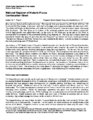
Show QMS No. 1024-0018, NFS Form United States Department of the Interior National Park Service National Register of Historic Places Continuation Sheet Section No. 8 Page 4 Panguitch Historic District, Panguitch, Garfield County, UT Agriculture. Ranching and Commerce Period. 1883-1914: Agriculture along with cattle and sheep ranching was the primary economic base during this period. The gazetteers for this period note that the "inhabitants [of Panguitch] are engaged principally in stock raising and farming."22 Nearly half of the businessmen listed in the 1892-1893 gazetteer were in livestock. William Cameron, Abe Church and J. W. Crosby Jr. raised cattle. Family names in the sheep industry included Hatch, Hancock, Haycock, Henry [Henrie], Houston, Judd, Levy, Showalter, Tubbs and Winters. Many women of the period worked in the livestock and dairy industry. Annie Houston gave her occupation as dairywoman on the 1900 census. The largest Victorian-era homes built in this period belonged to these men, women and their families. Many of these families had two homes: houses on their ranches where they spent the summer and homes in town for the winter. Several families had property near Panguitch Lake, where they engaged in dairying and cheese-making in the summer. Phoebe Sevy, a widow, who at one time took butter and cheese from her Panguitch Lake ranch to the mines at Silver Reef, received $60.00 in gold pieces in return. At the same time, commerce and the commercial business district were thriving. There were three general merchandise stores, a furniture and implements dealer, and a tinsmith. Hiram Pratt and I. D. Alphin were the town barbers. J. T. Daly sold musical instruments and Owens & Hanks were music dealers. Ray Owens made his living as a music professor. John Riding was an artist and photographer. There were three hotels: the Cameron & Belong, the Clark, and the Panguitch Hotel operated by Mrs. J. J. Steiner. Her husband, John J. Steiner was the town surgeon. Alonzo Foutz was the dentist. James W. Pace and Joseph McCullough were the proprietors of the town saloons. Edward McEwen ran a pool hall. Between 1890 and 1896, the Denver & Rio Grande Western Railroad built a spur from Thistle, Utah, to Marysvale, approximately fifty miles north of Panguitch. Although a line was surveyed to the Panguitch Valley, it was never built. However, the absence of the railroad was not a serious blow to the community. Both Alfred Delong and Martin Foy ran freight businesses out of Panguitch. The small town did managed to find its way into Wild West lore during this period: a small hole cut through the logs at the bottom of the old jail is believed to be where Leroy Parker (alias Butch Cassidy) escaped from the jail with the aid of a pocket knife. The population of Panguitch in 1890 was 1,015. The population grew to 1,338 by 1910. In 1906, Reverend T. M. Keusseff moved with his family to Panguitch in order to establish a Presbyterian congregation. The Presbyterian meetinghouse was built on north Main in 1907 (demolished 1946). It was the first non-Mormon church in Panguitch and many Mormon children attended school there until it closed in 1943. The oldest schools in Panguitch are no longer extant. There were two schools, one to the north and one to the south, which replaced the log school in the fort. Another school, called the "Old Sow" was located where the addition to the county courthouse was built. A multi-story elementary school was built around 1900. It was later demolished when a new building was constructed in the 1950s. Panguitch was incorporated as a third-class city on June 10,1899. The official population from the 1900 census is 883; however, the gazetteers list the population as around 1,200. There were a number of civic improvements after 1900. The Garfield Mountain States Telephone and Telegraph Company was established in 1906. The switchboard was located in the Cameron home at the corner of Main and Center Streets (demolished circa 22 Stenhouse Gazetteer of Utah, 1892-1893. |