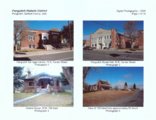
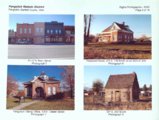
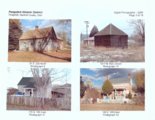
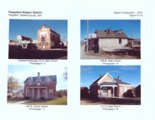
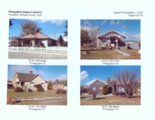
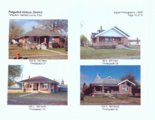
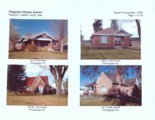
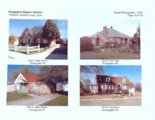
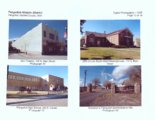
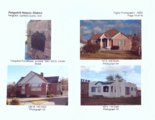
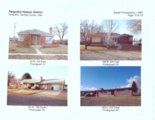
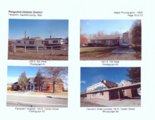
| OCR Text |
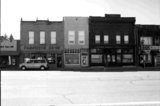
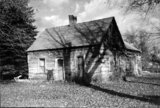
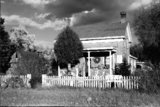
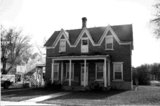
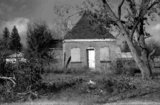
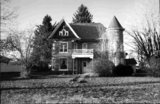
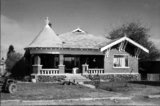
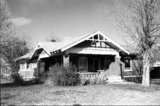
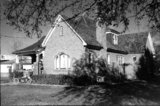
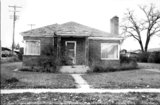
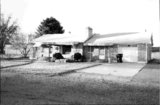
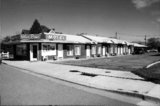
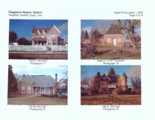
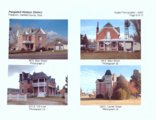
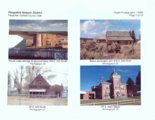
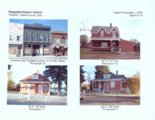
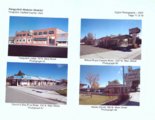
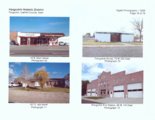
Show OMB No. 1024-0018, NPS Form United States Department of the Interior National Park Service National Register of Historic Places Continuation Sheet Section No. 7 Page 8 Panguitch Historic District, Panguitch, Garfield County, UT A relatively rare example is the Southern Utah Equitable Building (1906) on Main Street. This building is constructed of brick masonry with a pressed sheet metal facade [Photograph 29]. 13 At the end of this period, architecture in Utah moved from the Victorian-era to early twentieth-century styles and types. In Panguitch, a few Victorian-era residences were updated with bungalow-style porches. One example is 90 S. 200 East, built by the owner, James Worthen, in 1885, and given a bungalow porch (circa 1910) [Photograph 30]. The foursquare, with its distinctive pyramidal roof was popular in Utah between 1900 and 1920. Panguitch has several excellent examples. Most are like the Daly House at 93 E. 100 North, a onestory brick residence built around 1910 [Photograph 31]. Of particular note are several residences that represent a hybrid of the Victorian and Bungalow styles. An excellent example is the Henrie House at 320 E. 300 South, built circa 1905. The one-story brick residence is unusually large with two primary elevations. The house is a central-block with Victorian and Bungalow-era ornamentation [Photograph 32]. An example of a transitional bungalow, the Henrie House is a precursor to the distinctive Panguitch house which developed in the 1920s and 1930s. Community Development and the Rise of Tourism Period. 1915-1939 Approximately forty percent of contributing resources were built during this period. With only a few exceptions, most of the domestic architecture of Panguitch constructed in this period can be divided into two categories: Arts and Crafts-style bungalows, popular between 1915 and 1925, and the distinctly Panguitch version of the period cottage, built throughout the 1920s and 1930s. A large number of residences in both categories were built with Panguitch red brick. The few houses constructed of other materials and colors of brick stand out. The house at 50 W. 200 South is a beautifully maintained example of a frame bungalow (circa 1920) [Photograph 33]. A small clipped-gable bungalow built of concrete block at 213 N. 200 West (built in 1924) is another conspicuous deviation [Photograph 34]. Examples of yellow brick, such as the hybrid bungalow at 110 W. 100 North (circa 1925) are relatively scarce [Photograph 35]. Features such as the yellow brick, the cobblestone foundation, and the summer kitchen in the rear set this property apart. The Bigelow House at 35 W. 100 North (built circa 1930) is a distinctive period cottage with a square tower and the only residence in Panguitch constructed entirely of purple brick [Photograph 36]. The bungalow was extremely popular in Utah between 1910 and 1920, and quickly replaced the Victorian cottage as the house of choice. By 1915, the bungalow was ubiquitous in Utah, both as tract housing in larger cities and as infill on every block of rural towns. There are sixty-nine contributing bungalows in Panguitch, with the majority heavily influenced by the Arts & Crafts movement of the early twentieth century and built of round-edge Panguitch brick. In fact, relatively unadorned bungalows, such as the example at 205 N. 100 West (circa 1915), are the exception rather than the rule [Photograph 37]. Most Panguitch examples are similar to the Worthen House at 40 S. 200 East (built in 1915 according to the date in the gable trim), a square, rather than deep footprint, and an idiosyncratic mix of materials and ornamentation [Photograph 38]. The NR-listed Owens House is another excellent example of the Arts & Crafts movement [Photograph 3]. Two neighboring homes 13 Another example is at 83 N. Main Street. The elaborate historic fa$ade is visible on the upper floor, but the main level has been altered. |