| OCR Text |
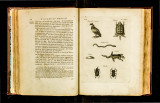
Show so it Is ToRy 0 F ME ' ~{ I C 0. :BO 0 K t. while others engage our attent.ion by their extraordinary infl:inet,, or \,o.oo~.~ . _,, fomc other remarkable quality. , Of the birds which aftord a wholefome and agreeable food, I have counted more than feventy fpecies. Betides the com_mon fi 1 which were brought from the Canary Illes to the Antilles, ow s, . . /.": 1 1' and from thefe to Mexico, there were, and fbll are JOW s pecu tar to that country; which as they partly refemble the common ~ow1; ~nd partly the peacock, were called . Gallt'pavos ·~ by. the S~amards, and Huexolotl and Toto/in by the Mexicans. Thefe b1rds bemg carried tG Europe in return fo.r the common fowls, have· m~tltiplied· very fafi:; and ofpecially in Italy, where, on account ~f t~e~·r man ... ners and their fi.ze,. they gave them the name of Gal/maccz (rt); but the European fo.w l has increafed greatly more in. l\1exico. There 1tre likewife wild fowls in great plenty, exaCtly l1ke the tame, but larger, and in many places of a much fweeter. fleih.. There are partridges, quails, pheafants, cranes, tur.tle-dov:es, p1geons) and. a gre~t variety of others,. that are· efteemed 111 Europe.. The· reader w11l form fome idea of the immenfe number of quails when w:e fh~ll. come to fpeak . of the ancient facri~ces.. The. pheafaqts are diffe1~nt from. -the pheatants of Europe, and are of three kinds (b). The Coxo{it/i and 'fepetototl,, which are. both. the. fize of a goofe, with a crell; upon their. heads, which they' c.an. raife and oeprefs at p1eafure, are diftingu~lhable by their colour,. and forpe particular q,ualities, The· Coxo/itlt~, called by the Spaniards,. Royal Pheafant, has· a tawneycoloumd plumage;·. and. its fiefh is more delicate than that of the· other. The Tepetototl will fometimes be fo tame as to· pick from its mafter's hand; to run· to. meet him,. with figns of joy,, when he comes· home;. to· leaFn tG ihut the door with its bill; and in every. thing. lhow greater docility. than could be expected in a bird which, is properly an. inhabitant of the woods. I hlve feen. one of thefc· pheafants which, after being fome time in a poultry yard,. had learnt tos fight in the· manner of cocks, and would fight with them,. ereCting, 6a) Tn Bologna, they arc called '/"occhi and 'T.occhini, and in· other places, Galli tl'l111iia •. 'lhc French cnlt them Dilldt•s, Dindims, and Coqs d' lnde. (b) Bomaa·e reckons the H11atzi11· nmong ahe phcafiu1ts ; but for what reafon,. I do not• k?ow, ~s the Ift~nlt:.ilt belongs with crows, zopilots and others,, to the. fecond c~1fs; the.· bards of prey~ • In Englith, the Turkey. , the ' • • . lli J s· T Q R Y 0 F M E X I C O, the feathe1•s of his cr-efb, as the •cocks do thofe of the neck. Its feathers are ·of a ihining black, and its legs and feet alh·-coloured. ·The pheafants of the third (pecies, called by the Spaniards, Gritone.r, thdt is, [creamers, are frnallcr than the other two; with a brown body, a:nd a block tail and wings·. The Chac/;a/aca, the fleih of which is very good eating, is a~out the fize of the common fowL The upper part of the body is of a brown colour, the under ,part whitifh, and the bill and feet bluci01. It is inconceivable what a noife thcfe birds make in the woods, with their cries; which, nl' though they fomcwhat reft!mble the cackling of fowls, nrc muct1 louder, more confinnt, and more difagreeable. There are fever~l fpecies of turtle-doves, and pigeons, fome common to EuropeJ· others ' peculiar ,to thofe countries. The birds valuable for their plumage are fo many and fo beau~ tiful, that we {hould aftord a greater pleafure to our readers, ~f we could bring them before their eyes, with all the colours which adorn them. I have reckoned five and thitty fpecies of Mexican birds, t.hat are fupcrlatively beautiful; of fome of which I muil: take particular notice. The Huitzitzilin is that wonderful little bird fo often celebrated by the hiftorians of America, for its finallnefs, its aebivity, the fingular beauty of its plumage, the thinnefs of its food, and the lengt~ of it ficep in the winter. That fieep, or rather fiate C?f immobility, occafioned by the numbnefs or torpor of its limbs, has been often required to be proved in legal form, in order to copvinoe fome incredulous Europeans; an im::t·edulity arifing from ignorance alone, as the fame kind of torpor takes place in many parts of Eur0p{i, in dormice, hedge-hogs, fwallows, bats, and other animals whoft! blood is of the fame tcm pemture ; although perhaps it d0es not cou.tinue fo long in any of them as in the Huitzitzi'/in, which in fome countries 'retnains without .motion from October to April. There are nine fpecies of Huitzitzilin, differing in fiee und colour (c). The (··) The Sp:miard• of Mexico call this bird Clmpam/rt(), becnufe it iucks chiefly the jlowcra. of a .plant known there, t.tltlough very im,pl·operly, by 'he name of a Myrtle. Ih }{ a , oth~ . • . ' |