| OCR Text |
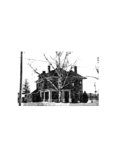
Show 142 COMMERCIAL DEVELOPMENT if)k~· V<? ut-;tl 20 feet, filled with salty brine, lids filled with fresh city water. through the salty brine and tOlw . ~"1 n of pipes filled with anhydrus a enters the pipes in the vat it ~tcS· ming on one side of which the he sudden transition from the 'e changes it from a liquid to a ; it to a temperature way below Id passes through the pipes to ine into the immersed cans of 1 reduced again almost to freezsubjected to a liquid again by .. ';SOL This process causes great IIClU lUlU uu~ uc;a. I~ .a",,, .. ..>ut by passing the liquid ammonia through a system of pipes which themselves are encased in pipes filled with flowing water, the latter as it runs away taking off the heat. The paper also noted that the meat box in the new store had a capacity of twenty-five beeves and many hogs and sheep. "Now patronize the kind of meat market you have been wishing · for," Garff's advertised in the 1 August 1914 Lehi Banner. Unfortunately a nightmare situation developed for the market. The riew cooling and ice making technology was faulty. Ammonia from the system leaked into the ice and permeated the meat, making it unfit for consumption. Though Garffs brought a lawsuit against Arctic-Ice, they received no compensation. They attempted to salvage their investment by leasing the business to George, Harry, and Norman Schown, who opened in February 1919 as Schown Brother's Market. This venture was only short-lived; during a sheriff's auction in the spring of 1921 the property was sold to Pacific States Savings, who resold it to Larsen Brother's. Lehi Slaughtering Company No building in Lehi has housed a greater variety of meat markets and other businesses than the small brick/ cement block structure at 101 West Main. The 23 November 1893 Lehi Banner announced that the Lehi Slaughtering Company (principal proprietors Thomas Austin, Thomas Webb, John F. Bradshaw, and Richard W. Bradshaw) intended to erect a new butcher shop. Masons Andrew Fjeld and Charles Ohran were laying brick by 7 December, and butchers Dick and John Bradshaw were cutting meat in the shop by early 1894. John Bradshaw, who later became a wealthy man, wrote that the meat-cutting business was "too tying for me. I got the 'get rich quick' fever and went to mining."12 During the next ninety years the building changed hands frequently. Peter Larsen paid Bradshaw Brothers $1,209 for the property in July 1894. After Smith and Dorton Meats rented the shop in 1896 it was leased by a host of others, including Ord Brothers Clothing (1897), Comer Ice Cream Parlor (1897), Dr. Robert Steele (1898), Merrihew Drug Store (1900), and Ross & Ross (1901). In late 1904 Wright & Company purchased the building from Hans Hammer and declared their intention to establish a meat market. The firm merged with Dorton Brothers one year later, after which Dorton Brothers bought them out. John Y. Smith purchased the building in the fall of 1905 and it became Wadsworth's Drug Store (1906) . From 1913 to 1989 it was the home of seven additional businesses, including Leland Powell's Grocery Store (1913-29), C. L. Johnson's Busy Corner Store (1931), Harold Jensen's Cafe and Beer Parlor (1937), The Lehi Sun (1938-47), Fashion Cleaners (1947), Lehi Cleaners (1947-71), and Pacesetter (1971-88). It is vacant in 1989 . 149 West Main Groceries In 1897 S. B. Wilson & Co. established a small mercantile in the old B. C. Earl tinshop at 149 West Main. The 24 August 1897 Lehi Banner noted that J. E. Campbell, who had been operating the Lehi Fruit Store there, sold the grocery to Charles Earl. Two years later an announcement in the 11 March 1899 Banner reported that Earl was losing money and would be closing his butchershop. M. B. Kearney and John Devy briefly operated Kearney and Devy Meat Market there in 1906, after which it became William Asher's tinshop. Asher, a jack-of-many-trades, maintained his law office there in the late 1920s. In the early 1930s the building became part of the Darling Hotel complex. 13 Cotter's Cash Grocery J. A. Robinson leased the Yearance Building at 102 West Main in 1902. In mid-1903 Missourian Jeremiah E. Cotter purchased the Robinson Corner Grocery's stock and established Cotter's Cash Grocery. An 18 February 1904 advertisement in the Lehi Banner noted that the merchant carried "staple and fancy groceries, table delicacies, condiments, and everything in good things to eat. His stock is fresh, and nothing but wholesome and toothsome and select lines." In early 1910 Cotter purchased the corner lot at 2 West Main from David Smith, obtained a mortgage from the former owner, and built a substantial brick building to house his grocery. Cotter's was noted for its fine quality merchandise-even by thieves. On the night of 3 January 1915 a ladder-toting burglar gained entrance by cutting out an upper window. After ransaking the place, searching in vain for money, the hungry man selected a can of Cotter's premium brand of sardines and a box of crackers. After eating this late night snack the thief had a few smokes - rolling his own stogies from a pilfered bag of Bull Durham. 14 The man was never apprehended. After Cotter went out of the grocery business in 1919, the store became a succession of other groceries: Goates Brothers' Grocery-Leo and Warren Goates (1919-21); People's Meat and Grocery - J. W. Gardner, Everett Turner, and Karren Turner (1921-24); Edward Southwick's Grocery & Hardware (1924-25); Booth |