| OCR Text |
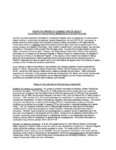
Show MEETING HOUSES the co-operative and families divided the proceeds according to the amount of their labor. In still other orders, like Lehi's, the group owned several co-operative enterprises. Lehi's co-ops included a dairy farm, a molasses industry, and the Lehi Union Exchange (initially established in 1868) on which dividends were paid to the investors. Lehi's United Order did not require members to consecrate all their property and labor, though most local participants did. Like earlier Mormon experiments with utopian ideals, the 1870s programs fared very poorly. "There has been considerable dissatisfaction and faultfinding with some of the Brethren who joined the United Order," wrote William Yates, "things hasn't worked quite as smoothely as we could wish."26 Lehi's United Order, like virtually every other, was discontinued by the late 1870s. Lehi Choir Even before the organization of Dry Creek Ward strong-voiced David Clark led the singing in most assemblies. In 1852 William Hudson orga:nized the ward's first choir. Members of this early chorus included Annie Brown, David Clark, Martha Clayton, Edward W. Edwards, Mrs. Folkner, James Harwood, Samuel Jones, William Littlewood [Rigby], Mrs. Littlewood, Mrs. Robinson, William Sharp, John Wield, and perhaps others. In addition to singing at Sunday services, funerals, celebrations, programs and other festivities, the group also engaged in the English custom of serenading on special occasions. Choir leaders over the years, in addition to William Hudson, included George Zimmerman, William Sharp, Isaac Fox, Sr., William Southwick, James Carter, Joseph Broadbent, Alfred M. Fox, John L. Gibb, Ebenezer Beesley, John Y. Smith, Isaac Fox, Jr., Abraham Anderson, June Whipple, and Isabel Brown. The Lehi choir, combined with a Provo organization and sang in an LDS General Conference in June 1891. Lehi's group, along with others from Utah County, also sang at a 6 April 1893 conference during the Salt Lake Temple dedication. Under the direction of Professor Beesley the sixty-voice choir took second place in the Esteddfod in Salt Lake City on 5 October 1898. The choir sang a capella in its earliest years. After an organ was obtained accompanists included Alfred M. Fox, Bishop Thomas R. Cutler, Hanna Pickle, Kate W. Kirkham, Winifred G. Goates, Juliet C. Carter, Harriet H. Allred, Lucy H. Fox, Pearl D. Broomhead, and Jennie W. Nostrom. When meetings were first held in the Lehi Tabernacle in 1905 the Lehi Tabernacle Choir (as it then was called) was accompanied by a majestic pipe organ. On 3 September 1905 the choir under Isaac Fox's direction gave a concert with Professor J. J. MCLelland at the conso!. Lula Dorton Anderson was the choir organist at this time with Jessie Butt Bahr as 9S her assistant. Subsequent Tabernacle organists included Joseph F. Smith, Hazel Goates, Jenna Bradshaw, Melba Fox, Velma Wing, Arreva D. Armitstead, Flossie D. Gardner, Lucile Anderson and LaPriel Goodwin. In 1947 the Lehi Stake Choir as it was then called was disbanded in favor of ward choirs. 27 Priesthood Quorums Lehi Ward's first Elders Quorum was organized on 17 January 1858 with William Goates as president. The four members included William Southwick, Isaac Chilton, Henry Simmonds, and Peter Christofferson. On 22-23 November 1862, President Joseph Young, Sr., and Horace S. Eldridge of the First Council of Seventy set apart and ordained John Brown, a former president of a Mass Quorum of Seventy, to organize and preside over the Sixty-Eighth Quorum of Seventy (which included Lehi and Alpine). On 28 November, Brown, Thomas Karren, and Jeremiah Hatch organized a presidency which consisted of John R. Murdock, Orrace Murdock, John C. Naile, and Israel Evans. Two days later John R. Moyle was added to the Council, followed by the 2 December appointment of W. S. Willes as the final member of the presidency.28 All seventy positions in the quorum were soon filled. Until the turn of the century the Aaronic Priesthood quorums of the church consisted of adult men - not boys as they do now. Prior to the organization of Lehi Ward's first Teachers Quorum on 28 November 1869, Seventies were called upon to serve as teachers. 29 The Teacher's Quorum was also organized later that year with Daniel S. Thomas serving as president and Joseph T. H. Colledge as secretary. The initial meeting of the ward's Deacon's Quorum was held on 7 March 1871. The first presidency of this group consisted of Andrew A. Peterson, John Jacobs, Jacob Bushman, and Elisha Peck. Lehi Ward Turmoil During the late 1860s problems began to develop in the Lehi Ward. Bishop David Evans, now in his seventies, came under severe criticism from several prominent ward and community leaders. A majority of the difficulties were self-caused. Evans, wrote contemporary Andrew Fjeld, was "very plain and blunt spoken in public," a quality which had "caused many people to dislike him."30 In his own words the bishop wrote, "I am a man of a turbulant disposition and have a continual Warfare with myself."31 In addition, with age Bishop Evans had come to rely heavily on the counsel of his son Israel, one of Lehi's first settlers. While Israel had gained considerable power in the community, he had alienated many people in the process. The earliest incident of his community difficulties occurred in 1861, when charges were brought against him by two other members of his Mass Seventies Quorum. John Murdock accused him of |