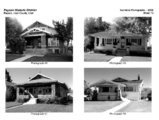
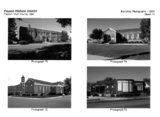
| OCR Text |
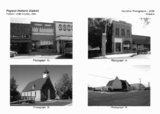
Show 0MB No. 1024-0018, NPS Form United States Department of the Interior National Park Service National Register of Historic Places Continuation Sheet Section No. 8 Page 8 Payson Historic District, Payson, Utah County, UT modernized storefronts for the Main Street's commercial buildings were extremely popular in this period. The fa9ade of 17 S. Main Street, which was built in 1884 and housed the Payson Post Office between 1914 and 1922, has been a bakery since the 1930s and has been remodeled three times (1950, 1963, 1990s) [Photograph 13, left]. By the late 1950s, Payson's historic period was ended ceremoniously with the beautification committee of the ^n Payson Chamber of Commerce announcing plans to "remove all evidence of horse-and-buggy days." However, the event with the single greatest impact on the community came in 1958 when the Denver & Rio Grande Railroad closed its downtown depot and relocate the facility on the outskirts of town. Times had changed. Increasingly Payson residents worked and chose to build their homes outside of the historic district. Residents began driving to more often to modern shopping centers in the Provo-Orem metropolitan area as roads were improved and a new freeway system proposed. In other words, the fundamental synergy had existed between the commercial district and the bordering neighborhoods throughout the historic period had ended. Subdivision and Twentieth Century Development Period, 1958-2007 In the 1960s, Payson continued to modernize the city. Several older commercial buildings were torn down. Commercial construction continued, but the newer buildings were larger, more modern, and more suburban in style (e.g. supermarket, bowling alley, new post office and new high school). In 1964, the mayor's improvement and beautification committee ordered the removal of 651 buildings in various states of decay. The old buildings were considered a "fire hazard, accident hazard, a breeding place for rats and mice and on the whole [a] disfigurement to the Payson landscape.21 Beginning in the early 1970s, several apartment blocks were constructed in the vicinity of the town center. In 1967, the Interstate 15 freeway was constructed through the northwest corner of the town. During this period population of Payson grew noticeably for the first time in nearly a century. The population grew from 4,237 in 1960 to 12,825 in 2000. After a decade of modernization, Payson City grew nostalgic in the 1970s. In 1971, four blocks of Payson's downtown were designation a special improvement district design to create a downtown "shopping park. . . with a turn-of-the-century theme."22 A new streetscape for the downtown was designed including new gutters, brickwork, planters, trees and ground cover. Historic preservation efforts in Payson grew in the 1980s and 1990s. In 1981, the adobe home of John and Sarah Fairbanks was dismantled and moved to "This Is the Place" Heritage Park in Salt Lake City. In a more successful effort to preserve Payson's heritage, the citizens of Payson fought a hard battle to save the Peteetneet School from demolition after its closure in 1988. During the 1990s, the ongoing rehabilitation of the Peteetneet School received numerous preservation awards. The Payson Historical Preservation Board was formed to help preserve the physical history of the Payson community. 20 Ibid, 63. 21 Tbid, 68. According to Madeline C. Dixon, the counts were 65 barns, 29 privies, 128 chicken coops, 32 granaries, 365 sheds and 41 |