| OCR Text |
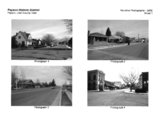
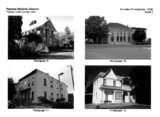
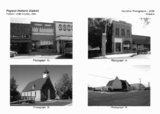
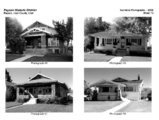
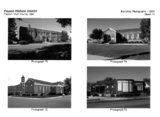
Show United States Department of the Interior National Park Service OM8 No. 1024-0018, NPS Form National Register of Historic Places Continuation Sheet Section No. 7 Page 5 Payson Historic District, Payson, Utah County, UT Landscaping within the district varies considerably and, for the most part, has been left to the discretion of individual property owners. Most residences have some lawn with shrubs and flowerbeds in front. Many of the backyards have large garden plots and several fruit trees. About half of the residential properties include a detached garage, but there are few remaining agricultural outbuildings considering the age of the housing stock. The Main Street streetscape has been beautified with bump-out curbs, angled parking, trees, planters, lampposts, benches and other accoutrement. There is a new urban plaza at Main Street and 100 North, a noncontributing site. Payson has erected numerous markers and monuments within the historic district through the years. Five are contributing. Three are of the four markers placed at the corners of the old fort in 1931 are extant and contributing [Photograph 6]. Eight other markers are out of period. Architectural Styles, Types and Materials by Periods The contextual periods below were modified from those developed for the Reconnaissance Level Survey (RLS) conducted in 2006. The RLS contextual periods have been revised to more accurately describe the building inventory within the historic district. The contextual periods represent the steady development of Payson from rural settlement outpost to suburban community with most of its contributing homes linked to the city's commercial business district. Early Settlement Period 1857-1874 The oldest building identified within the district is an adobe house at 389 N. 100 East, built in 1857 and reportedly the first home built outside of the Payson fort [Photograph 7]. Sixteen contributing resources were identified from this first contextual period. One resource is a log cabin now used as an outbuilding at 47 S. 400 East, circa 1860 [Photograph 8]. 5 The majority are residences made of adobe, but are currently covered in stucco and other veneers. These residences are modest in size, with classical symmetrical and a ridge line parallel to the street. Decorative elements include Greek Revival-style cornice returns and hood moldings over small windows. A substantial exception is the house at 215 N. Main Street. This two-story house was built of adobe in 1874, but modified with an Arts & Crafts cobblestone porch in 1912 (NR 08-21-1992) [Photograph 9]. Another building from the period is the Old Rock School, built in 1863, and located at 289 N. 200 West. The school was remodeled into a bungalow-style residence in 1923 and is counted in the resources for the later period. Early Railroad and Production Agriculture Period, 1875-1890 The period marks the first significant phase of development in Payson's business district as substantial brick storefronts replaced the early frame buildings. Forty-seven contributing buildings were identified from this period. Approximately 20 percent of these buildings are commercial. The most notable is the restored Payson Opera House, built in 1883, at 35 E. Utah Avenue [Photograph 10]. The public structure features a blend of the Italianate and Victorian Eclectic styles. Next to the opera house is a two-story brick hotel, built in 1882, at 35 N. 100 East [Photograph 11]. Another early hotel, now a residence, is located at 144 W. Utah Avenue. It was built of adobe in 1875 and expanded in 1894 [Photograph 12]. A second relocated log cabin, circa 1863, is located on the City Center grounds just outside of the historic district, but was moved |