| OCR Text |
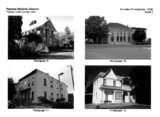
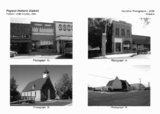
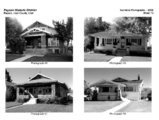
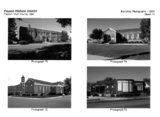
Show OMB No. 1024-0018, NPS Form United States Department of the Interior National Park Service National Register of Historic Places Continuation Sheet Section No. 7 Page 8 Payson Historic District, Payson, Utah County, UT Payson has numerous examples of what can be described as a typical bungalow in Utah. For example, the house at 174 W. Utah Avenue (built in 1919), is constructed of brick with full-width porch [Photograph 41]. The house is approximately 30 feet wide at the primary elevation. Bungalows such as these, particularly the brick variety, were ubiquitous in Utah between 1910 and 1925. They appear as tract housing on the narrow lots of early streetcar, suburbs in Utah's larger cities, but similar houses were also built on larger rural parcels throughout the state. What makes Payson exceptional is an unusually high number of extra wide bungalows, most of which are close to 40 feet wide across the facade. While these wide bungalows are not unique to Payson, it is remarkable to find so many within a relatively small survey area. The survey identified 54 wide bungalows, of which only six were non-contributing due to alterations. This is half of the total number of bungalows within the district boundaries. The wide bungalows are concentrated along north Main Street and west Utah Avenue, but can be found throughout the survey area. The most common type of Payson bungalow has a simple gable roof with ridgeline perpendicular to the street sheltering a full-width porch. The house at 492 W. Utah Avenue (built in 1916) is a representative example [Photograph 42]. Even where wide bungalows have been modified, the type is distinctive, for example, the neighboring homes at 390 W. 200 South and 380 W, 200 South (with altered gable trim), built around 1917 [Photographs 43 & 44]. Variations include hipped-roof versions (89 N. 100 West, built in 1915); perpendicular ridgelines (297 N. Main Street, built in 1913); indented porches (130 S. Main Street, built in 1916); or double fa9ade gables (393 W. Utah Avenue, built in 1920) [Photographs 45, 46, 47 & 48]. Many have Arts & Crafts elements such as textured stucco and exposed rafter ends (349 W. Utah Avenue, built in 1916) [Photograph 49], The wide bungalows are primarily built of brick, but used a variety of materials. Frame examples are less common. One example covered with clapboard siding is located at 118 S 400 West (built in 1915) [Photograph 50]. The brick in the bungalow at 130 S. Main Street is laid in Flemish bond [Photograph 46]. The bungalow at 341 N. Main Street, built 1919, is the only building in Payson built with clinker brick [Photograph 51]. The influence of the wide bungalow on Payson builders can be seen throughout the period. Several more traditional types are also extra wide. Examples include 589 S. Main Street (Arts & Crafts, built in 1920) and 197 E. 100 North (built in 1926 with Prairie School influence) [Photographs 52 & 53]. Tax cards and other sources tax cards suggest that a few older buildings were remodeled into wide bungalows. The building formerly known as the old Rock School (circa 1863) was remodeled into a bungalow in 1923 [Photograph 54]. While the wide bungalow dominates some streetscapes, there are exceptions. One block to the south, the residence at 278 E. 100 South, built circa 1924, is an Arts & Crafts bungalow with a pop-up second floor [Photograph 55]. The two-story house 286 E. Utah Avenue, built in 1909, was influenced by the designs of architect, Frank Lloyd Wright [Photograph 56]. Other significant themes of the period include the early use of rock-face concrete block. Concrete block was used extensively in foundations, with a few examples of complete buildings, such as the bungalow at 395 N. Main, built circa 1916 [Photograph 57]. One commercial building, the I.O.O.F. lodge at 36 W. Utah Avenue, built in 1914, was built of concrete block [Photograph 58]. There were fewer commercials buildings constructed during this period. Two of the most significant examples are Neo-Classical-styled Strawberry Water Users Association at 50 W. 100 North, built in 1916, and the Payson State Bank at 95 N. Main Street, built in 1918 [Photograph 59 & 60]. A plainer, but historically significant |