| OCR Text |
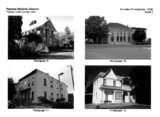
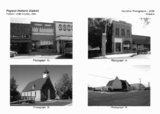
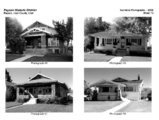
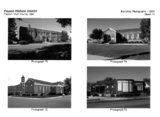
Show United States Department of the Interior National Park Service 0MB No. 1024-0018, NPS Form National Register of Historic Places Continuation Sheet Section No. 7 Page 7 Payson Historic District, Payson, Utah County, UT One of the most elaborate buildings is the Peteetneet School, built in 1901, which stands on a hill at the end Q apex of Utah Avenue (NR listed 5-30-1990). Though the school grounds are just out of the district, views of the building dominate the landscape [Photographs 26 & 1]. This Victorian Romanesque Revival school, constructed of brick and sandstone, is now a museum and community center. The best residential example of the Romanesque Revival style in Payson's historic district (and arguably in the state) is the John Dixon House at 218 N. Main Street (NR 02-17-1978) [Photograph 27]. This two-story residence was built completed of red sandstone in 1893-1894, Just to the north is the two-story Christopher Dixon, Jr., House, built in 1899 at 248 N. Main, which like the Peteetneet School, features the characteristic Victorian Romanesque combination of brick and sandstone (NR 11-07-1977) [Photograph 28]. The house at 59 E. 400 North is another good example of the Victorian Eclectic with Romanesque sandstone elements in Payson. This IV-s-story house, built in 1904, is on a large parcel of land and includes a granary built of the same brick (circa 1900) [Photographs 29 & 30]. Other extant brick arid frame granaries within the survey area are also from this period. Most of Payson's Victorian housing stock features ornamentation, even on simple house types such as the cross wing at 309 S. 400 East, built in 1896 [Photograph 31]. The domestic architecture also includes rare examples of the Second Renaissance Revival-style and Victorian Eastlake. With its mansard roof, the house at 550 W Utah Avenue (circa 1894) is a frame example with drop-novelty siding [Photograph 32]. The brick house at 228 W. 100 North features two extant Eastlake porches (built in 1898) [Photograph 33]. The later examples from this period illustrate a transition from the Victorian era to the early twentieth century styles. Later Victorian house types use the more complex central-block-with-projecting-bays type and have neo-classical decorative elements, particularly on the porch. Some examples include 110 N. 400 West (built 1894) and 410 S. Main Street (built 1902) [Photographs 34 & 35]. This period also includes a few representatives of the early twentieth-century foursquare, for example, 440 E. 100 South (built in 1900) [Photographs 36]. Commercial buildings of the period also became more elaborate, particularly the Victorian Eclectic two-part blocks. The most notable examples are at 80-86 S. Main (built in 1891 and 1898), 12 S. Main (built in 1902), and the corner block at 2 N. Main Street (built in 1903) [Photographs 37, 38 & 39]. The most significant institutional building of the period is the Payson LDS Fourth Ward Meetinghouse at 315 E. 100 North [Photograph 40]. The church building, constructed in 1910 with a 1966 addition, features an onion-dome on the corner tower. Neighborhood and Civic Development Period, 1909-1925 This contextual period illustrates several significant transformations took place in the architecture of Payson's housing stock beginning in 1909 as the bungalow succeeded the Victorian cottage as the most popular house type in Utah. While some manifestation of the "bungalow" revolution occurred in the vast majority of Utah towns, the builders of Payson were both prolific and innovative. This period represents the highest number of associated resources with 144 contributing buildings. The school is listed under several different addresses: 50 N. 500 East, 92 N. 600 East, 10 S. 600 East. This RLS used the latter, 10 S. |