| OCR Text |
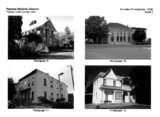
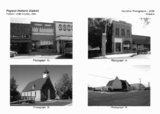
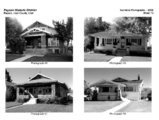
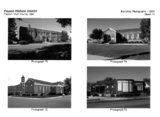
Show 0MB No. 1024-0018, NFS Form United States Department of the Interior National Park Service National Register of Historic Places Continuation Sheet Section No. 7 Page 9 Payson Historic District, Payson, Utah County, UT building, the Payson City Substation was built in 1912 at approximately 570 N. Main Street [Photograph 61]. A number of early garages were built during this period. Payson has both brick and frame examples (e.g. 57 W. 200 North and 259 W. Utah Avenue, circa 1915 [Photographs 62 & 63]. The Payson Memorial Park, was designed to honor Payson's veterans, and the park bandstand (1919-1920) are contributing resources from this period [Photograph 5]. Specialized Agriculture and the Interurban Railroad Period. 1926-1946 This period represents the second largest group of resources with 120 contributing buildings. The residential architecture of Payson during this period is similar to other towns throughout Utah. The housing stock varies from late transitional bungalows, period revival-style cottages, and World War II era cottages. An excellent example of a transitional type is the brick cottage with a bungalow porch at 48 W. 100 South, built in 1931 [Photograph 64]. Another example of a transitional house type is the clipped-gable cottage at 558 S. Main Street, built 1934 [Photograph 65]. Payson's period revival cottages are individualistic and not similar to tract housing in larger Utah cities. There are equal numbers of brick examples (161 S. 100 East, built in 1936) and those covered with stucco (209 N. 100 East, also in 1936) [Photographs 66 & 67]. The most elaborate example has a circular French Norman tower. It is located 298 W. Utah Avenue and was built in 1930 [Photograph 68]. Cottages built in Payson just before and after World War II are also individual designs and built as infill between the older houses. The house at 170 W. 100 South, built in 1940, has an unusual cast-concrete door surround for a relatively modest house [Photograph 69]. The two-story house at 111 S. 300 East, built in 1939, is a rare example of the Colonial Revival style [Photograph 70]. Examples of the Minimal Traditional-style cottages based on the FHA plans for small houses developed in the 1930s can be found in Payson in brick (353 N. 300 East, built circa 1945), and frame (337 N. 100 West, built circa 1945, sheathed in shingle siding) [Photographs 71-72]. There are several notable institutional buildings. Payson Junior High School, a Jacobethan Revival-style building, was constructed at 250 S. Main Street in 1926 [Photograph 73]. There were two LDS meetinghouses also built Jacobethan-style of this period: 191 N. Main Street in 1931 and 225 S. 400 East, was built in 1930 with a Colonial Revival-style steeple and addition from 1965 [Photographs 74 & 75].9 The Art Moderne LDS Church Seminary building at 590 S. Main Street, built in 1929 across the street from the former high school grounds, is a distinctive addition to the streetscape [Photograph 76]. This period represents renewed new construction activity in the commercial business district. One example is the large free-standing building, a furniture store, at 67 N. Main Street, built in 1935 [Photograph 77]. Four contributing historical objects (three extant fort markers and the Keele monument in the park) were placed during this period in 1931. Post-war Development Period. 1947-1957 This period includes 101 contributing resources. During this period, many of the town lots were divided and post-World War II infill housing constructed. Payson includes a high number of early ranch buildings in brick. The World War II-era cottage at 343 E. 300 North is located on an undivided corner lot with two contributing outbuildings [Photograph 78 & 79]. The house at 55 S. 200 East, built in 1955, is more typical of the suburban types found in Utah in the late 1950s [Photograph 80]. A few modern examples are also contributing, including All LDS Church buildings are within the district are eligible under the Multiple Property Submissions, Mormon Church Buildings. |