| OCR Text |
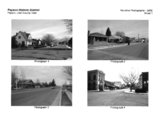
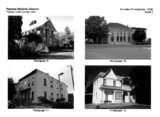
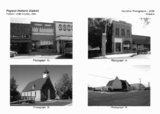
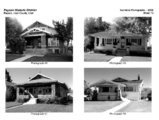
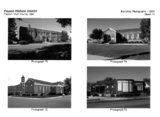
Show OMB No. 1024-0018, NPS Form United States Department of the Interior National Park Service National Register of Historic Places Continuation Sheet Section No. 8 Page 5 Payson Historic District, Payson, Utah County, UT crops. Most families still practiced traditional farming, such as the Loveless family, who built a large two-story adobe home at 175 N. 100 East [Photograph 17]. Other families became wealthy in the livestock industries of cattle, sheep and hogs. In 1876, George Patten, a cattleman, built a similarly large adobe home at 47 E. 300 North. This home was used as Payson's first hospital operated by Parley Pratt Musser between 1901 and 1913. The original house is currently non-contributing, but still visible behind a newer porch. Most of the residences constructed during this period were located close to the former fort boundaries and the emerging commercial district. However others, such as the early brick house owned by the Waters family at 287 S. 300 West, were built for farming families at the edges of the town plat. As the settlers of Payson began to build more permanent homes, the log cabins of the previous period were relegated to use as outbuildings. The Reece cabin was used for fruit and vegetable storage after the family built a sturdy brick house on the lot [Photograph 8]. Later Railroad, Commercial and Industrial Development Period, 1891-1908 The population of Payson in 1900 was 2,-636. It dipped slightly to 2,397 in 1910. There was little population growth, but several substantial buildings were constructed during this period: the Peteemeet School (built in 1901 and listed on the National Register in 1990) and the Payson Pavilion (1902, demolished circa 1925). Construction on a new LDS tabernacle began two years after the first tabernacle was destroyed by fire in 1904. City improvements included electric light meters (1906) and concrete sidewalks (1907). The Gaiety Theater was built in'1908 at the corner of Main and First North (demolished 1968). Some economic development during this came in the form of employment provided by two large projects: the Strawberry Irrigation Project (started in 1902) and the Orem Railroad (started in 1903). The business grew substantially during this period. The Utah gazetteer for 1892-1893 lists sixty businesses in Payson, mostly located near the commercial business district. For example, the Simons-Wightman Block, one of the most distinctive buildings was built in two parts, one built by Orrawell Simons in 1891 and an adjoining building for Joseph Wightman in 1898 [Photograph 37], Among those businesses not located in the commercial district were four honey-producing enterprises. Both Orrawell Simons and Joseph Wightman served as mayor of Payson. Like most of Payson's turn-of-thecentury merchants, Simons and Wightman lived near their businesses. The Simons house was located just one block south of the commercial district at 165 S. Main Street [Photograph 18]. In 1902, Joseph Wightman built £ large home for his family further south at 410 S. Main Street [Photograph 35]. The large homes on north Mair Street represent the prosperity of the ranchers during this period. John and Eliza Dixon, a cattleman, built i large sandstone mansion in 1893. He was a banker and the mayor of Payson in 1900. Their house at 218 N Main was listed on the National Register in 1978 [Photograph 27]. His brother's stone and brick mansion a 248 N. Main was built in 1897 (listed on the National Register in 1977) [Photograph 28]. Christopher "Jack' Dixon and his wife Lodasca had cattle herds and large land holdings. Architecturally this period represents the transition from Victorian era architecture to the more modern styles o: the early twentieth century. For example, the Huish House, a one-story foursquare built in 1900, has verj modest decoration compared to the Victorian-style Huber House, built six years earlier [Photographs 36 & 34] Both families were engaged in farming. Members of the Huish family were also employed in carpentry anc furniture making. |