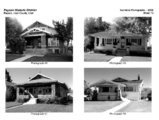
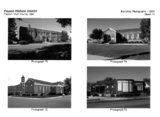
| OCR Text |
Show United States Department of the Interior National Park Service 0MB No. 1024-0018, NFS Form National Register of Historic Places Continuation Sheet Section No. 7 Page 3 Payson Historic District, Payson, Utah County, UT (100 North) eventually became the main route to the east, but in the early twentieth century was the route of the Salt Lake & Utah Railroad. Second South (200 South) was originally known as East and West Jog Streets with a "jog" at Main Street.4 The current street names were in use by the 1930s. While the blocks differ in size, the streets are a fairly uniform width of four rods (66 feet). For the first fifty years of Payson's history, residential infill within the original plat was slow and steady, and concentrated near the area of the old fort. As is common in most Utah towns, the oldest homes (settlement and Victorian-era) are located at the corners of the blocks. Commercial and light industrial activity occurred near the business district. In the first half of the twentieth century, division of the lots and residential infill dramatically increased and spread out from the town center, especially along Main Street and west Utah Avenue. Sporadic residential construction occurred along the transportation corridors between the orchards, fields, and pastures, as some farmers moved onto their land. By the mid-twentieth century, Payson was connected to the surrounding towns by paved highways and commuter rail. Until 1946, the town was the southern terminus of an inter-urban electric streetcar along the Wasatch Front. In the second half of the twentieth century, rural Payson saw only a trickle of the post-World War II suburban building boom. The first subdivision plats was filed until the early 1970s. The Interstate 15 freeway was constructed in 1967, sheering off a portion of the northwest corner of the town plat. In the last quarter of the twentieth century, Payson, along with other southern Utah County towns, is in the process of transforming into a viable bedroom community for the Orem-Provo metropolitan area with new subdivisions dotting the previously agricultural lands outside of the historic town plat. Infill has increased and today there are only a handful of vacant lots within the town site. The boundaries of the Payson Historic District have been drawn to include an area featuring the three most distinguishing characteristics of Payson's historic city center. The first is the irregular block pattern, in particular the exceptionally narrow blocks between 200 and 300 East, and 200 and 300 West, where there is only room for two residences at the narrow ends. The second is Payson's extraordinary well-defined historic business district. The storefronts along Main Street between 100 North and 100 South maintain a turn-of-thecentury streetscape with several significant buildings. The third is the concentration of high-end residential architecture found along Utah Avenue and Main Street, where most of the Payson's businessmen built their homes. Boundary Description Because of its cruciform shape, the boundaries of the Payson Historic District's can best be described in quadrants. The north tip of the district is at approximately 580 North Main Street. Beyond this point to the north there are no historic buildings and an extensive late-twentieth commercial area near the freeway on-off ramps. Just to the south 400 North forms a logical east-west boundary line. The historic street was originally known as the "Cow Lane" because farmers would move their livestock along this route to the outlying pastures. There are several historic homes on both sides of the street, but the landscape is fairly open to the north. In the northwest quadrant the boundary is the east side of 200 West. Although there are historic homes further west, 4 Payson's street names have changed several times in the historic period. The State Road was originally Water Street and Utah Avenue was Wall Street (the southern edge of the fort wall). Other north-south streets were Potter, Pleasant, Telegraph, Pound, German, North East and Bench. The east-west streets were Broadway, Centre, Main, and Burr. By the 1890s, the State Road (Main) |