| OCR Text |
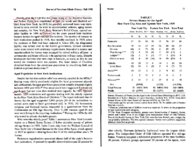
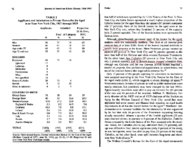
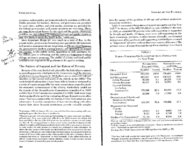
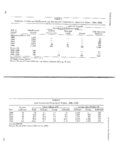
Show 86 Journal of American Ethnic History / Fall 1992 23. Forty-eighth Annual Report of the Methodist Episcopal Church Home (New York, 1898), p. 9 from Butners, "Institutionalized Altruism," p. 161. 24. First Annual Report of the Isabella Heimath (New York, 1890), p. 9, and Third Annual Report (1893), p. 7 from Butners, "Institutionalized Altruism," pp. 208-216. 25 . Haber, "The Old Folks at Home," pp. 248-249; Butners, "Institutionalized Altruism," p. 185 . Although Butners did not draw this conclusion, the documents presented described different attitudes toward men and women . 26. First Annual Report of the Isabella Heimath, p. 9 from Butners, "Institutionalized Altruism," pp. 189, 208-216. The private institutions were able to choose carefully before admitting residents. Between 1889 and 1893, Heimath accepted only 178 out of 400 applicants. According to Butners. offensive behavior and rule breaking were accepted under the guise of senility by 1903 . Unlike the homes for women, the Brooklyn Home for Aged Men had "an elaborately detailed set of procedures for disciplining the inmate population." Like the women , they had already been selected by rigid criteria. The preference for women expressed by private home administrators was not shared by all almshouse matrons. According to Francis Bardwell, almshouse inspedor for the state of Massachusetts, "old women are more exacting than old men, more opinionated and harder to take care of. Men a re better mixers and more adapted to almshouse life," "I do not want the woman," lamented an almshouse matron in a midnight phone call. "I would sooner have 28 more men ." Bardwell expected private homes to take care of women who were more sensitive and refined than men. "Minutes of meeting of section Welfare Council of New York City, on the care of the aged," January 12, 1928, Box 163, Community Service Society Papers. See also Adeline Buffington, "Francis Bardwell on the Future Care of the Aged," Fami/yo 10 (March 1929): 18-22. 27 . National Civic Federation, Women's Department , Study of a Croup of Almshouses in Connecticut, New Jersey, New York al/d Pel/nsylvania (New York, 1927), p. II. Testimony of Lee M. Dooday, Commissioner of Public Welfare, City of Albany, and President of the New York State Association of Poor Law Authorities. Typescript of "New York Commission on Old Age Security Hearings," July-December, 1929 (Albany, New York State Library), p. 637. 28. Social scientists have pointed out that Veteran's pensions substituted for old-age pensions. Ann Orloff, Ann Shola, and Theda Skocpol, " Why not equal protection? Explaining the politics of public social spending in Britain, 1900-1911, and the United States, 1880s-1920s," American Sociological Review, 49 (December 1984): 726-50. Jill Quadagno, Th O! Transformation of Old Age Security (Chicago, 1988), pp. 31-49. 29. Florence E. Parker, Care of Aged Persons in the United States (Washington, D.C., U.S. Department of Labor, Bureau of Labor Statistics, Bulletin 489, 1929), pp. 210-213. 30. Augustine R. McMahon to Honorable Bert Lord, 7 February 1921, Bert Lord Papers, Department of Manuscripts and University Archives, Olin Library, Cornell University. Other lellers protested a legislative proposal to move the old women from Oxford to Bath and close the Woman's Relief Corps home. Most of the women aged 75 to 96 were under medical supervision. Fifty-fourth Annual Report of State Board of Charities (1920), pp. 393-394; Thirty-fourth Annual Report of State Board of Charities (1900), pp. 269-280. 31 . Kutznik, "American Social Provision," p. 50 and Katz, In the Shadow, pp. 4652. Weiler R7 32. See Weiler, "The aged, the family" pp. 170- 181 for an analysis of New York almshouses. 33. Schneider and Deutsch, History of Public Welfare, pp. 130-135, 143-145 . Ninety percent (1080) were private institutions, half (663) of which received some public resources. The New York State Board of Charities had weak powers to supervise the state institutions and lost the authority to supervise private welfare in 1899. Although a New York City Department or Public Charities created in 1895 allowed the city to pay private institutions for maintenance of public charges, responsibility for relief remained fixed in the county, town or city until 1931. As a consequence of a major court battle won by the Society for the Prevention of Cruelty to Children, private welfare agencies not receiving public funds were no longer subject to supervision of the State Board of Charities. The power to inspect the facilities and receive data on private instilutions was restored in 1931 . 34. New York Commission on Old Age Security, Seabury Mastick, chairman, Old Age Security (Albany, N.Y ., 1930), p. 382. The number of institutions receiving public aid and reporting data to the state dropped to 33. The numbe r of inmates of private institutions receiving state aid ac tually dropped from 399 in 1900 to 339 in 1930. The number of state supported inmates in private institutions peaked in 1910 with 593 people plus another 3451 residents at the Soldiers and Sailors Home at Bath and the Woman's Relief Corps Home at Oxford . 35 . Florence E. Parker, Care of Aged Persons in the United States and Directory of Homes for the Aged in the United States (Washington. D.C., U.S. Department of Labor, Bureau of Labor Statistics, Bulletin 505, 1929). Third Annual Report of the Central Information Bureau for tire Care of the Aged (C1BCA). pp. IS, 24-25, 41, 47-49. 36. Third Annual Report of the CmCA, p. 20. The Bureau estimated that 69 percent of the applicants needed rooms . 37. Bulletin of the Welfare Council of New York City (February-March, 1930), p. 7, Box 115. American Association for Social Security Papers, Labor-Management Documentation Center, M. P. Catherwood Library , Cornell University, Father Brennock, Catholic Charities, testified concerning the shortage of institutions for the aged sick. The Little Sisters of the Poor handled only well people . " Hearings of New York Commission on Old Age Security," p. 297. See also Social Service Commission of the [Episcopal] Diocese of New York. 38. Third Annual Report of the CmCA (1930), pp. 15,24-25,41,47-49. 39. Third Annual Report of the CmCA (1930), pp. 28-31, 47, 51. Table 2 uses people aged 65 plus from the 1925 census, but the Welfare Council also defined women aged 60 to 64 as elderly . A table in the report used 1920 census data for those 45 and over in New York City. 40. Alter F. Landesman, Brownsville: The Birth, Development and Passing of a Jewish Community in New York (New York, 1969), pp. 274-277 . 41. Robert H. Bremner, From the Depths: The Discovery of Poverty in the United States (New York, 1956), pp. 28, 34. 42. Jay Dolan, The Immigrant Church, (Baltimore, Md., 1975), pp. 121-140. 43. Daniel T. McColgan, A Century of Charity (Milwaukee, Wis., 1951), I: 316; John O'Grady, Catholic Charities in the Ullited States (Washington, D .C., National Conference of Catholic Charities, 1930), pp. 236-238, 216. 44. McColgan, A Century of Charity, I: 199-200; 2: 492-493. 45. Ibid., I: 53,115-197,235-236,360; O ' Grady, Catholics Charities, pp. 9091, 147. See also Marguerite Boylan, The Catholic Church ill Social Welfare (New York, 1941), pp. 23-26. Boylan states that the Calholic charity movement was a reaction 10 the AICP and missionary zeal of Protestants. |