| OCR Text |
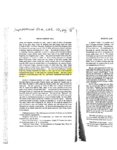
Show 68 Journal of American Ethnic History I Fall 1991 private facility with respectability for the middle class. "Charity ruined the poor, stealing their self reliance and undermining their work ethic." But founders of old-age homes recognized a class of virtuous poor, those who were respectable in character and conduct because they were used to better days. According to historian Brian Gratton, respectable character meant Yankee birth, whereas paupers were usually foreign born. Most clients of Boston's Home for Aged Women and Home for Aged Men had relatively low status or, in the case of women, low paying occupations. Their misfortune was a lack of children or family support. 21 Residents of the home sponsored by the Association for the Relief of Respectable, Aged, and Indigent Females (ARRAIF) were American born; or if foreigners "have long dwelt among us, and have been citizens a sufficient length of time to entitle them to th is charity."22 While the ARRAIF and other Protestant homes analyzed by Astrida Butners in a political science dissertation provided only for inmates of superior social background, the Methodist Episcopal Church Home also offered a reward to those whom church represen tatives-Juclged h_ad 1C1l lives df piety. Some had "fill-;a-posi tions honor and usefulness in the Church .. . others have all their lives felt the pinching hand of poverty, and have never before enjoyed the measure of comfort they have found in our Home."23 Many nominally nonsectarian homes catered to a homogeneous popu.Jt!iQ~ :..Jor example, ethnicity bound founders and r~ogether i;the Isabella Heimath Home, established for women in 1875 and for men __ .i!1 18s9.MostresJdeOts-;e-;:-e LUtheniris.B utners spec~l~t;sth;t .. the managers were more intent than others in isolating their residents in order to maintain a closed ethnic community. In contrast to most Protestant homes, beer given by local brewers, cigars and wine, along with I variety of German-language newspapers, appeared on donation lists. Despite thorough admission committee investigations, dismissals for absenteeism, inability to adjust, or breaking other rules appeared more frequently than from other facilities. 24 Benevolent societies broadened their scope to protect pious men as well as women from mingling with the "irreligious and profane" and from "a pauper's grave." Giving special services to destitute old women was justified because if widowed, her husband failed, and if single, she never earned enough money to save for old age. But admitting men to the philanthropic institutions created "moral" and "disciplinary" problems. Historian Carole Haber noticed that the first solicitations for financial support stressed the plight of the abandoned old man who had lost of ( (fe;;; Weiler 69 his manhood. But soon the rhetoric was similar for men and women, emphasizing respectability and disdain for a pauper's grave.25 Women were ideal inmates, "grateful for their much improved condition," whereas men often refused to submit to discipline, explained one caretaker. Men were accused of violating rules prohibiting alcoholic beverages, or making false statements, of having quarrelsome dispositions and irregular habits. Dismissal from the home was the ultimate punishment and men who failed to comply with the rules were dismissed more often than women. According to the 1893 annual report of the Isabella Heimath Home, "[i]t is difficult to make them understand that their active life is closed, and that refuge is for them the most desirable." Too much activity conflicted with the conception of old age as a time of decline. The managers also linked the inability to adjust to general personality characteristics which had caused a dependency status. Men whose want of success in life has been mainly attributable to their aversion to submit to any discipline and a regulated life, prefer a precarious living on occasional charity , but with the liberty to roam about at will. 26 Immorality still justified wretched conditions for both sexes. Women were "more welcome in the stranger's home [as well as] .. . the family's home, because they can do some little service." But those women (30 percent of the poorhouse population) "whose only refuge is the almshouse are almost certain to be undesirable either because of mental incompetence, moral obloquy or chronic disease," according to the National Civic Federation's almshouse study. Alcoholism and venereal disease accounted for the presence of so many men. Most were "homeless, childless men, who have outlived their industrial usefuln ~:n A major source of aid to "worthy" old me~~~has often been overlooked. Although supported by public funds, these institutions were classified private. Consequently, dependent sailors and soldiers, most of whom were American-born Protestants, avoided the fate of paupers.28 Two privately endowed homes were located on Staten Island..The Mariners' Family ~f!!., established in 1843, housed 30 merchant marines and their dependents. In a will drawn up by Alexander Hamilton in 1801, a New York City resident left his estate for the establishment of a home for "aged, decrepit, and worn-out sailors." Sailors' Sn ug Harbo~omprising 150 acres and 20 buildings on attrac~~ Iand, comfortably housed 850 retired seamen in 1926. 29 |