| OCR Text |
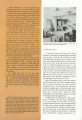
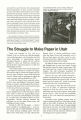
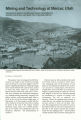
Show Three of the " Blg Four" mines that made Ewela a giani rrtlnemls producer. From the tap, CanknnP81 Eureka ( Blue Rock) mine, Eureka Htll, and- Bullion Beck and Chmnpion mi* All phofugrrrphs courtesy @ Gay B. Peterson, Phgtogewraphlcs. Eureka's Strange " G Tell a Story WHEN MINING WENT UNDERGROUND, COMPANIES HAD TO FIND A WAY TO LOWER AND RAISE MEN AND EQUIPMENT AND HAUL OUT ORE. BY PHILIP F. NOTARLANNI Driving through Eureka, Utah, some 70 miles southwest of Salt Lake City on Utah Highway 6, one is s b c k by the sight of massive wooden structures that resemble hanging gallows. Some peer out over conical- shaped mounds of parched eroded dirt, partially overgrown with brush. Such remnants of Utah's mining past offer glimpses into the role played by developing technology in the hard- sock mining indusky. These s ~ perched ~ over deep, mine sha fts, are headframes, used to bansport men, animals, supplies, ore, and overburden ( waste material) in and w t of underground workings. They illus-trate the development of mining from the small individual prospect or claim to the largeaale operations of the minisg corporations and the technology needed to accomplish this change. when early prospectors roamed the Utah mountaim and hills, especially in the 1860s and 18709, they looked for outcroppings where veins a€ gold and silver had come to the surface. They were able to mine those with pick and shovel without much effort, but once the sur-face depdts ran out, the miner had to dig deeper. To haul crut the ore and overburden, a windlass was used. hoking like an old water well with a hand mank, b l , ro ll, and bucket this apparatus sat over the excavation, with om p ~ aned a cross piece. Horses would be tied to and its load in and aut of fk shaft. " 8 d I < o> c > 1 L C I < I * Some mines were worked out ( depleted of : 2 ,- 7 :,* L5 ore) at this stage. Others awaited further devel- ,> >: .> apment that is, tRstEng to see if ore veins were , : : ,: ;. > hidden deeper in lhe earth and determine where 2, : :, R - ,< :>> ~ 7, -( they went. Usually, thb type type work called far . I , , x lafge amwts af money that only mining cm- .5 < -. L , : IN . p i , NoI > I<, - > panies could afford. With dseper wdcings, new : e! :: :': 16 and heavier machinery was needed. - : < < > ' i < - ; I < 8 less 11o0t c p, > The headfram~ enabled miners to mine d!-:, I:"': > )' :*,,,- < < > >-< y > + " I , , , I j ; J from deptbs of 300 to over 3,000 feet below the J > ' ' 6:) ,' : I < >*< ,10-: > 5 surface. This mechanism, mads first of wood ~ ~ r $ on and w d y a n o m ha* the " 4 ;[: then steel, consisted mast often of a bavily ,: $ ij 2/? ,>, 1 u I,?;;~ braced right triangle, placed directly over the 3 2 >> c: . > t want deeper, ar nniners shaft. ~ n top of frame sat shaves, large the veins ran, a hand- $ ' f wheels over which ran the hoisting rope. This powered windlaas proved inadequate, /$,: rope, which cuuld have been a wire cabb o n@, a whim m a t be a d 4 A whim,$ :; braided belt, ran from a hois was usually operabed by harse power and con- b:" ' dLtEtnce from the hea& ame. topped & a drum and ~ pindeto which or a cage, that traveled in and out of the s The bucket functioned primarily ducing developmental stage of work. Once a min began Eull production, the bucket by a cage of sirngle or doubb deck This cage had sections of tr floor where: ore cars could be loaded. S cages would hold up to a dozen men lb process of getting men, equipment, ore in and rrut of the mine was called ho Therefore, the headframe served as part o histing plant ( or works). Basically, the process Remains of a whim near the Godiva min Tintic Mountains, east of Eureka . . Ore buckets lowered men into the shafl of the South Swansea mine, Silver City, Utah. involved a threeman team - hoist operator, cage tender, and top lander. The hoist operator ran the hoisting engine according to a set system of bell signals. Removing loaded ore cars and sending down empty cars or supplies was the job of the top lander, while the cage tender deposited the loads to the different levels of the mine and loaded cars of ore or overburden to be wnt to the surface. Headframes are of various types. The A- type, or modifications of it, exists in greater numbers in Utah than do those of the 4 or & post type. A- type headframes were also called 2- post and A double- deck cage carded shlft of miners Into the Centennial Eureka mine. included those sitting over inclind shafts - shafts not vertical or directly under the head-frame but inclined away from one of the posts of the m& ed A- type shcture. Four- or 6- post types became necessary when the shaft compart-ments, or openings, were excessively large. Min-ing engineers' handbooks contain stress sheets and diagrams for headframe designs. Each com-ponent was placed at angles and positions d+ signed to hold the mount of weight and stress d dto do the job. Sizes of frames depended on load weight, shaft size and depth, special equipment requirements, and weather condi-tions. The angle of the supporting braces had to be such as to keep the headframe from being toppled over by the wind. The Centennial Eureka surface plant during the I-. Utah's best collection of headframes is found in the Tintic Mining District, of which Eureka City is a part In fact, Tintic's array of extant headframes is among the finest in the en-tire West. There one can see the different types of headframes mentioned, both w d e n and skel, dating from the late nineteenth century through 1982. Some shaft houses remain as well - wood or metal buildings that covered the head-frames and supporting machinery. The lonely Grand Central mine, near Mammoth in the Tb tic district, remaim complete with an A- type steel headframe tucked into iron- clad hoist house and surface plmt ( the complete surface workmgs of the mine). The 1897- 98 Grand Can-tral headframe was considered a novelty for its time in Utah. Stml headframes represented an evolution in mining technology. Cornish miners, experienced in rock work, came to Utah from England, bringing with them rich mining folk traditions. Lore of the sbange sounds heard underground abound, as do slang words used by the Cornish to describe miring dcles and processes. Headframes were called " gallows," as they appeared like the shctures used for hangings. On at least one occasion the name held b e in Eureka, when in 1886 one Joe Fisher was lynched by a mob at the Norway mine gallows. Western mining historian Otis E. Young, Jr., stated, " The headframe with its giant sheaves is the most prominent feature in almost any repre-sentation of the ordinary mine of the frontier period." As such, it represents both the tech-nology developed to mine the earth and a stark reminder of the mining landscape. Dr. Notarianni dhcts the Utah State History Museum Program. The Showers mine used an Inclined headframe in its operation. |