| OCR Text |
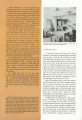
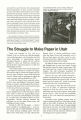
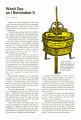
Show Wash Day as I Remember It BY ALTA J. HOWARD When I was a girl in Richfield in 1908 1 lived in om of the better homes. We were considered affluent because Papa built Mama a Wash House. This was no simple task. It required care ful planning. The building was about 10 feet by 12 feet in size, of frame construction with a shingled roof, one window, one door, and a wide front step, It was painted white so it would match the house. The building stood about 10 feet from the back kitchen door and was equipped with the 4 latest conveniences - a wood stove, a wooden washer with a wringer attached, a bench with two tubs, one for rinsing and one with a wash-board for scrubbing, and a table on which to sort clothes. The water was just a few steps out-side, which was so convenient. From the doorstep, Papa had erected two pulley lines. Each line was extended about 50 feet away into the trees. We could stand at the door and hang the clothes on the line and pull them up into the air to dry. They looked beauti-ful hanging there; but if the wind happened to be blowing, we were unable to use it because the line would break and the clothes would land on the ground. I remember that happened once, and it was necessary to rewash some of the clothes. Now, this entire operation was very advanced for 1908, and we were the envy of the neigh borhood. Papa always bied to make Iife better for Mama. The Wash House made wasMay so much easier because it kept the mess out of the kitchen, kept the house cooler, and was really a great convenience for Mama. We were a large family - six girls, one boy, two grandmothers, one uncle, and Mama and Papa - which meant that washings were large and required family cooperation. The two older girls helped Mama with the wash, and the younger ones dressed and cared for the small children and prepared breakfast. There were certain rules rigidly followed at our house. WasMay was always on Monday. A neighbor who failed to wash then was judged accordingly. One could always tell the good housekeepers by the Monday washday arid how the clothes were arranged on the clothesline. A Fulton American washer advertised In the lW2 Sears catalog. The washer remembered by the author was a dlffer-ent model and had a wringer attached. 1 People in little towns have various ways to classify their neighbors. Those who failed to wash on Monday were poor housekeepers. Monday morning was well pIanned. Mama and the two girls were up at 5: 00 a. m. and busy. First a fire was started in the Wash House stove. Then it was necessary to fill the two boilers with water from the nearby well and place them on the stove to heat. The boilers were large containers designed to fit over two holes on the stove and to fit side by side so both could heat at the same time. That was a real convenience. Heating the water was a slow process, and it was necessary to keep feeding the fire. This time was used for breakfast and for sorting clothes to prepare them for the washer. Sorting was very important If any colored clothes were mixed with the whites, they would fade and ruin the others. There were no colorfast dyes then. While the water was heating, lye was added to soften the water and to keep the clothes white. A lye can was in every home. We were always warned to be very careful because it was poison and very caustic. There were many chddmn d i s f d for life, and some died because they f dthe lye can. After the water was heated, it was emptied into the washer. Soap, which Mama had made, was shredded and put into the water. Then a batch of clothes was added and the machine was ready to be turned. Papa was proud of our new washer. It was the very latest d* and it '- The authors home in Richfield, behind which was the Woman Saver." It was made of wood with a Wash Hwse by neighm. wringer attached. The dasher for agitating the d o h was attached to the lid on tlw underside with a handle on the top. When the washer was What a thrill it was to stand on the step and closed, the handle could be pushed back and fasten clothes on the line and see them floating forth to agitate the clothes. We would take turn in the brseze. of come, thm was a sp& operating the nn*. It required about 20 way to fasten clothes on the he, or the neigh-minutes for each load and took patience and bors wwld know you were sloppy. Sheets must prodding to keep washer g o u until every- be hung together and towels, etc., and they must thing was washed. be even and straight, each with the eJlds securely ~ f t e ra load was finished, if it was white, it fBStenedY. ou had to be an artist to hang clothes was put in the boiler, which had been refilled on M~~~ line. and treated with lye. Mama said this was neces- When the line was full and clothes were sary to keep the clothes white. gently fanning in the breeze, they were white While dothes wm boiling, we would a d beautiful. The neighbors would how that stir them with a long round stitick. When the boil- y, - good hou~ mpers. ~ f you were the ing was finished, which took about 20 minutes, first to get your on the E ~ yo~ u , they were Mid into a tub of cold water and , dY proud. thoroughly rinsed, put through the wringer, It took a day to do the family wash With a which was operated by hand, and placed in a sigh of satisfaction and pride we would prepare tub of blueing water, which kept the whites supper and sit down to eat and plan for ironing from yellowing. all day Tuesday. Now the blueing wabr had to be just right. If When supper was finished, it was time to not, the clothm would be spotted or too blue. ga& f th, clothes from the line and prepare That wodd never do. If that the them for ironing. The clothes were separated in-clothes would have to be rewashed. Afbr the to two p k - one to be folded and rinse* the were put bough the put away and the other to be sprinkled and wringer again separated into two piles - , d, ready for ironing day, one ready for the line and the other to be, Sprmkhg was done by spreading a garment starchd on tha table and sprinkling a small mount of Much of the Of the wash depended water over it. Then it was mued up and covered on starching. MFima would with cold and dowed to stand ov- i& t so the water until it was dissolved and then add hot be evenly dis~ hted. It reqM just the water and boil it until it was dear and thick. of mo* v If thegarment was tM3 Afteritwascooked, itwas~ dtojustthe wetitdidn'iimn. isht, andifitwastmdryit right shngtk If it was ' 0' heavy, cloth's didn't iron at all. was a] so impO- t after would be sl3f and would stick to the iron. When dothes were spaed not to let Ulem too the starching was just rightI it gave MYto long or they d ddh Wand be garments and they stayed dean much longer. After the sprinkling was done, it was time to the were put - ltanh go to bed and be rested for Tuesday's ironing. wah, they were wnsng by hand and were ready to be put on the line to dry. Mrs. Howard is a & dent of Richfield, Utah. |