| OCR Text |
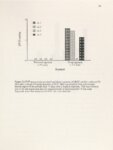
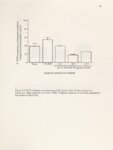
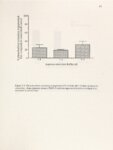
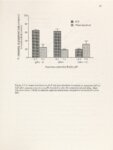
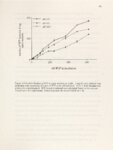
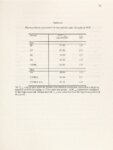
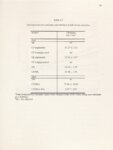
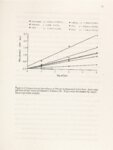
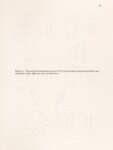
Show 52 of PCP (pH 8.5). increasing amounts of incorporated PCP are removed from the hair. The amounts of PCP removed from pigmented hair were 39%, 33%, 38%, 49%, and 81 % at pH 6.5, 7.5, 8.5, 9.5 and 10.5, respectively. Figure 3.3 compares the amount of PCP remaining in LE nonpigmented hair after a lO-day aqueous extraction protocol as described above. Data are expressed as a percentage of non washed control hair. The mean amounts of PCP removed from nonpigmented hair were 61 % with deionized water and 46% with 1 % SDS. The buffer solutions extracted 57%, 78% and 74% of incorporated PCP at pH 6.5, 8.5 and 10.5, respectively. Figure 3.4 illustrates the amount of phenobarbital remaining in pigmented hair after the 10-day aqueous extraction protocol described above. The pH of the buffers used encompass 2 pH units above and below the pKa of phenobarbital (pH 7.4). The mean amounts of incorporated phenobarbital removed from pigmented hair was 72%, 81 % and 71 % at pH 5.4, 7.4 and 9.4, respectively. Figure 3.5 shows a comparison of PCP remaining in LE pigmented hair with phenobarbital remaining in LE pigmented hair after 10 days of the aqueous extraction procedure described above. In vitro incubations Figure 3.6 shows PCP bound to sepia melanin in vitro. There is a concentration dependent increase in the binding of PCP to melanin. As the pH of the incubation buffer increases from 6.5 to 10.5 there is a decrease in the amount of PCP bound to sepia melanin. In the aqueous extraction experiments (Figure 3.2), hair was used that had PCP incorporated and presumably bound to melanin. In an attempt to duplicate that in vitro, PCP was allowed to bind to sepia melanin for 1 hour. Buffer solutions were then added to displace PCP from melanin. Prior to the addition of buffer, incubations were |