| OCR Text |
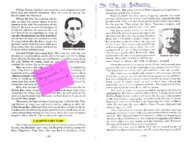
Show The father and sons always traded and worked to get established for the future. They took sheep and cattle for their labor, and for four years were interested with Wm. R. Smith, in the Davis County Cooperative herd . The first start in sheep was mad e when John Ford purchased thre e females from Franklin D . Richard s for $10.00 Each one had twin s and o ne h appe n ed to be a black mal e. When the emigrants came through on their way to the go ld rush in California, Mr . Ford would trad e cattle and horses that we r e in good condition for the tired ones a nd after they were recruited they turned o ut to be double in vJlue. H e wou ld exc hJn ge grain for gold dust to miners who came through w ith PJck horses. For the first few years af ter arriving here th e Ford family suffered a lot for want of food. They lived on bran br ead, sm utt y wheat flour and thi s tl e roots, and were glad to get th em, for even these were not plentiful. " It was very trying to me," says Mr. Ford, "to see my children cry for food when I did not have enough to give th em, but I never felt to complain, and was never sorry that I left my native land for the Gospel's sake ." Those early days of hardship passed and they began to prosper financially . They went into the stock raising business under the name of Ford and Sons . This firm prospered and continued together until 1886 when the father retired from active business life. At the time of his death he was well-to-do. There were no threshin g nor bindin g machines at this time, and the first grai n on the Standish place was tramped out w ith horses. The ground was leveled and a canvas laid down. A post, ten or twelve ft. high was set in the ground with a sweep on top to which the horses were fastened and wo uld take them aro und in the circle. As the wheat was tramped out it would be thrown aro und th e pole and the straw to the outside. Th e wheat wo uld lat er be cleaned wit h a fanning mill. One man had to be o n hand to take care of the droppings. Mr. Ford was an expert with a sick le and cut most of his first gra in that way. He could cut, bind and shock from one-half to three-quarters of a n acre per day. He had th e second lucern e patch raised in Davis County. The seed had to be flailed by hand and was sold for $1.00 per pound. Wh en Mr. Ford was trying to keep Jhead of the stork at the time of Hyrum 's birth, he had gone after the midwife (Siste r Brown) with bare planks on the running gears. When making the turn west trom the main highway th e team started to run, he couldn't check them, and not wishing to frighten the midwife he shouted, "Hang on Sister Brown I am in a hurry." All the planks fell off but the one they were sitting on, he on the front end and she on the rear holding on for dear life. The horses circled the house twice before they could be stopped, demolishing the children's playhouse . (212) He was the first man to bring blooded sheep and cattle into Centerville and delighted in having the best of everything. He made a specialty of breeding blooded stock, raising the shorthorn cattle and registered Ramboulet sheep which were imported from Canada. As was the custom for immigrants, the father, mother and children, who were old enough, were rebaptized soon after arriving in Utah , in the Jordan River. John Ford Sr. was baptized September 29, 1856, by Elder Johnson and confirmed the same day in the 17th Ward meetinghouse S.L.e. by Simon e. Dalton. He fulfilled no foreign mission, but was a zelous Church member, serving for many years as a ward teacher, also as assistant superintendent of the North Centerville Sunday School. He was ordained a Patriarch June 13, 1897, by President Joseph F. Smith . His first wife, the mother of all his children, died April 16, 1881. He married Mary Ann Wright, a native of Warwickshire, England, on March 29, 1883 . Mr. Ford was small of stature, but very active and alert. His home and surroundings were kept beautiful with flowers, shrubs and fruit trees up to the time of his death. He loved horses and enjoyed getting ou t in his surrey and driving them. He loved and appreciated his family and delighted to call them together on his birthday. He had an extremely amiable and jovial disposition and enjoyed singing and cracking jokes . Mr. Ford was a firm believer in education and gave his children every advantage the schools afforded in those days. He aided them in every way to get a good start in life, which resulted in a most highly and respected family . Mi. Ford died of general debility at his home at Centerville, Utah, November 22, 1901, at the age of ninety-five years, eight months and fourteen days . JOHN FORD, JR. The history of John Ford, Jr. was wrillen by Mary F. Parrish. The slory oflheir voyage on the "Windnmere" is included with the history of his father, John, Sr. -'--',~ John Ford Jr. was born in Gravely, Cambridgeshire, England, August 27, 1843, the son of John and Rebecca Chandler Ford. John Jr. was the fourth child in a family of eleven children, nine born in (213) |