| OCR Text |
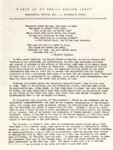
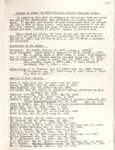
Show Let us now consder, in part, the experiencess of some of the typically ttwestern" India.n tribes, who perhaps did not suffer so much directly from the effeGts of the.Indian Removal Act of President Jackson, as had the .tribes whose sncestral home had always been east of the Mississippi River. The Sioux This large and powerful tribe of abcr igines may have been driven from farther When we to the eastward by the Chippewas, at an early date in American history. came in contact with them, they were occupying·extensive territory in the Da kotas, andeastern Wyoming and Hontana. Tey were a Itspirited" -race---in that respect, perhaps somewhat like the Navajoes and the Apaches; and at least in one matter, had experience somewat similar to those two more southern tribes of the mountainous regions of Arizona and New Nexico. We have evidence that horses were existent in ancient America long before the dawn of our accepted history; but for many centuries, apparently, these The early Span useful animals had been extinct in the western hemi spher-e , occupation of lexico and countr-Ies to the southward, brought excellent horses, of the Arab-Barb-Hoor breeds, with them; 8.;1n these turned loose in an abtindane of good pasturage, soon formed into ba.nds which spread In time, these spirited animals came into the land of the Sioux. northward. It has been said of the Navajo that he and the horse were made for each other; and that statement would no less apply to the Sioux warriors and hunters; and' This forms an important here soon developed many of the world's best horsemen. feature in the American history of these Indian tribes. iards, , in their In the le601 s gold was dts cover ed in I-lontana, perhaps a littl e north of I t could be reached by a route fiwmuF7,h South Pass the main Sioux territory. northward along or near the continental divide; but this route was high, and If a road were long, and perhaps subject to heavy snowfall in winter. . opened from te Oregon Trail, say in te vicinity of Casper, and via the upper Powder and the Little Bighorn Rivers, it would probably be much more travelable, and some 500 miles shorter; but such a road would pass through mncb o<6'! the best territory hunting grounds of the Suoux, pr-act.a upon which the Indians depended for their The plan was to- construct the road under Ll.y bi-secting living. ca the militcry protection, buiihg four forts---Ft. Reno, Ft. Phil Kearney, Ft. L. C. Smith, and Ft. Buford-- well garrisoned to protect the construction and then to .nai.nt.adn its . safety from the Indians. The Indians strongly objected, since it would endanger their very existence as a tribe through t.he depletion of the vdld game supply. The Sioux had long maintained their ecology with nature; but sice the game---the buffalo and other game---were being slaughtered by tre milli.ons, rather wantonly along the roads used 'by the white men in their journey across t h econtinent, they feared the nww road would make it practically impossible for them to live. (.;hief Red Cloud and a number of hi,s braves went to Ft. Laramie; and st.r-ongo Ly made t hed r 01:- jections, giving their reasons, which were already well known to the military men; but at that time the goverrunental policy W['S to destroy the Lndi.en societies; and to divide and then destroy was according to the regular plan. Red Cloudtold the army officers that if the road were put through, the Sioux would fight, despite the fact that some of the trops arrived, with considerable noise, during the conference. The Indians seem to have not t roub Led the construction of the fort the road until it hed passed Ft. Reno, and Ft. Fhil Kearney vias uder construction. This was practically in the middle of their terri tory, perhaps earlier guaranteed them, as elsewhere, by treaty with the United States. The redmen would ride around the fort, brandishing their or |