| OCR Text |
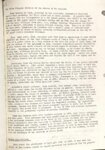
Show These may have geen about the 13th and 14th centuries. Wupatki was probably sbandoned 'because o eepletion'-'ofthe soil, which had been greatly enriched about from Sunset crater, which covered some 800 l070 A.D. by ash, et. erupted of that mountain with a squar-e miles of territory tothe north and' northeas Here at splendid mulch which also acted favorably as a moisture retainer. she Hupatki district was a real aboriginal ";nelting pot", since r-epr-esent.at.Lves came together to obtain bEnefits from this excellent land.' )f so many tribes lside from the wearing out of the richness of thesoi, there was prbably also orokonzed drouth that may have had much to do with almost forcing t he Lnnabf. At t.he other cities mentioned, drouth may also .ant s to seek tetter Locat i.ons lave had s:'met!1ing to do with their abandonment---they were well located for lefense in recesses in canyon walls; but of course continued oc cupation of the It seems sur-r-oundf.ng country might have made continued occupation undeai.reb l.e iof unreasonable that some of these would drift into the Hopi Locations. , , ;- It ;71 might not be too difficult for these ear l.i.er nrt. such wou Ld a "Mormonn to postulate a sef-mingly plausible pueblos wi.t.h the closing events of the Book of Kormon history; be rather conjectural. be Nava,ioes As mentioned acove, this large tribe numbering now some 60,000, is considered be of Athabascan stock; and came southward from Canada near the eastern side )f the Rockies, end then into thE country they have since' occupied. tlecause so ,0 _ittle is he?rd of them in early times, it is thought they must then have been small tribe; and perhaps were forced to move often by more )owerful Indians. It seems that originally, in the AriiOna-NewMexico country, .hey were in the terri tory between V1e Jemez Mountains and the Colorado River; .nd held land for as much as 80 miles to the southward of the present Highl.... ay 16 •. ut a relatively A. number of pueblos were within this large area; and upon the Pueblo peoples, often Navajoes preyed. It is said that the Navajoes are primarily more r-ad.der-s" tan fighters; and they often dispossessed the pueblo peoples of their .ivestock; and perhaps because of having so much wild and unoccupied territory, YiMxEEs they found it to their advantage to increase their lumbers more rapidly by abducting pueblo women to assist them in the matter he • thought that, since animals belonging to thE' Navajo seem to be gener Spanish stock, V\': l:ve brought few animals with them Lnt o the coun Ty; but in their r-e i.d s tObk£the!1 from the villagers, although is is probable ey received some directly from the Spanish as vie 11. eoth Coronado and Onai e Ir()uht antme l.s into the country in numbers---the former for the use of his crge force of conquistadores; 8nd the latter, since he brought families ,1oTIQ' with him 't-r:i.th the evident intention of making settlements in t.he country, is .it .l.Ly of roug:ht animals for t'1e A,S we u eb l.o have seen Indians; but use of the colonists. Spcmish had but partial success in controlLing they had less success with the scat t.er ed Navajoes the the who , if it could e considered successful at In 1804-05, when Lewis no C'Lark wer-e exploring the upper Missouri and a way to the Pacific, the Spanish naged in a miLitary campaign against the Navajoes. The stre>nphold of the edmen W2S then in Canyon de Chelly in the eastern part of what is now Arizona. hen the sol.d i.er-s arrived at the canyon, the "br-aves" were for the most part n one of teir raiding expeditions. The and old men had arely settled in villages. een left, as tiilitary force with the all, was only t emporary. avajoes, women, cildren, touaht, securely secreted in a cave in the Canyon del luerot, because Qf this event. 1:lt1en the Indians walls of at vias later called the so 1iers passed up the canyon bed below the cave, an old w0man, who had been a cap ive of t.he ','hites ear-Li.er- in her life, taunted them. Te so ldi.er-s deployed , |