| OCR Text |
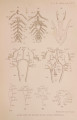
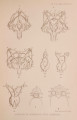
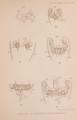
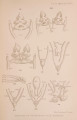
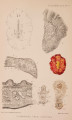
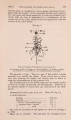
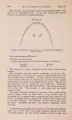
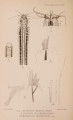
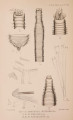
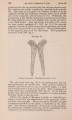
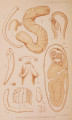
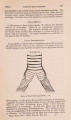
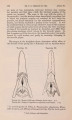
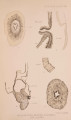
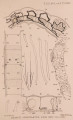
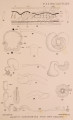
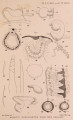
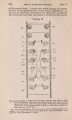
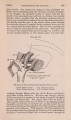
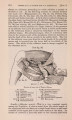
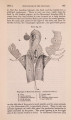
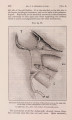
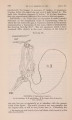
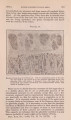
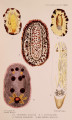
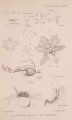
Show 1903.] MONSTROSITIES IN FISHES. 9 There is one pair of trigeminal nerves representing the right and left 5th nerves of the right and left twin heads. The succeeding cranial nerves are also normal, i. e. there is only a single pair of each. A rudiment of inner or adjacent pairs of trigeminal ganglia may be recognised in the form of a thin elongated band of tissue containing small nerve-cells and lying in the middle line underneath the region of the pons. This band of tissue has no central or peripheral nerve-fibres. The pons and cerebellum are single, but their internal structure shows traces of duplicity, especially in the case of the pons. The medulla oblongata is slightly expanded transversely, but otherwise is normal. In the anterior part of the spinal cord there is a curious and interesting reappearance of duplicity, coextensive with the duplicity of the notochords, and with the presence, ventral to them, of a median composite muscular mass representing united adjacent lateral muscles. In this region, the spinal cord is greatly expanded in a transverse direction, its cavity is spindle-shaped, and, in addition to the usual nerve-roots, it gives off, on the ventral aspect in each segment, a pair of small additional motor roots which are distributed to the median muscular mass just mentioned. There are two pairs of olfactory organs and nerves. The outer eyes (right eye of right twin head and left of left head) are normal, but lie further back than usual, so that their optic nerves pass backwards as well as outwards from optic commissure to eyeball. The inner or adjacent eyes may or may not be fused with one another. In the former case, there is usually a single lens, which is sometimes larger and sometimes smaller than in the normal case ; the sclerotic and choroid coats are single ; the retinae never unite, each showing its own choroidal fissure, optic nerve, and choroidal gland. In all cases the external rectus muscles are absent; the superior obliques are absent or rudimentary, but the remaining ocular muscles are present in two sets. The heart and the ventral aorta are normal, but the dorsal aorta and its roots, and the choroidal and carotid arteries, require description. The union of the main collecting-trunks on either side to form the dorsal aorta is carried backwards for a very considerable distance, and takes place only at the level of union of the notochords. The pseudobranch on either side receives a branch from the hyoid artery, and its efferent vessel passes to the choroidal gland of the corresponding {i. e. outer) eye. The choroidal glands of the inner or adjacent eyes are supplied by blood which has not passed through the pseudobranch. In the specimen from which PI. I. figs. 3, 4, & 8 were taken, the arrangement of vessels is quite symmetrical and is indicated in PL II. fig. 12. A transverse arch vessel connects the upper aortic roots, and gives off a common choroidal artery which soon bifurcates. The two resulting vessels pass through the separate pituitary spaces, and are distributed to the choroidal glands of the adjacent eyes. |