| OCR Text |
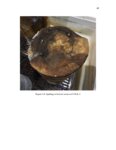
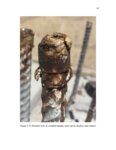
Show 15 2.4 Instrumentation of Specimens for Mechanical Testing Each of the uncorroded column specimens was outfitted with a series of seven strain gages; three on different vertical bars at the column midpoint and four in a full circle around the spiral in a region centered at the midpoint of the column reinforcement, as shown in Figure 2.13. A protective coating was applied to the strain gages after placement to protect them during the casting process. Strain gages were not applied to the corrosion specimens, although two LVDT’s were instrumented for all columns prior to compression testing, as shown in Figure 2.14. A 2000 kip load cell was used to measure the vertical compressive force. 2.5 Sample Preparation and Testing Protocol In order to ensure failure at midheight in the center of the column, a single layer of carbon fiber wrap was applied to the full circumference of the column at each end up to a height of 8 in. Steel collars 6 in. tall were secured to the top and bottom portions of each specimen prior to testing. Some of the samples experienced significant spalling in the collar region as a result of localized corrosion and needed to be reassembled and patched using grout before the CFRP wrap could be applied. A high-density polyethylene cap was fitted to the top and bottom of the columns to ensure that the load was evenly distributed over any surface irregularities. Loading was applied with a 2000 kip actuator controlled by the displacement of a Temposonic LVDT at a loading rate of 0.10 in. per minute. This loading rate prevented dynamic effects in the columns from occuring. Strain data were collected using a VISHAY data acquisition system from both LVDT’s and internal strain gages. |