| OCR Text |
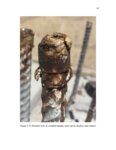
Show 12 stainless clad reinforcement required an additional step of preparation where caps made from grade 316 stainless steel (an alloy containing 17% Chromium, 12% Nickel, and 2% Molybdenum) were applied with silicon adhesive to the ends of each bar. This was done to protect the exposed carbon steel core of the stainless clad bar and prevent dissimilar metal corrosion by exposure to air or the electrolyte used in the corrosion study. Once the bars were prepared, they were used to form rebar cages using GFRP spiral for the CG series and stainless-steel spiral for the CN series. Stainless-steel wire was used in both cases to build the cages, as in all other columns except the control. Copper wires were attached to each of the vertical bars prior to concrete casting. The reinforcement for these series is also shown in Figures 2.3 through 2.6. 2.3 Design and Assembly of Corrosion Environment The central goal of the corrosion study was to create an exceptionally aggressive environment to observe the corrosion modes of the columns with all types of reinforcement. The technique used was similar to the Florida Department of Transportation method (Florida DOT, 2000) and El Maadawy and Soudki. (2003) where the concrete samples were submerged in a salt solution and an electrical potential applied to the metallic reinforcement. For the present study, a 5% NaCl by weight saltwater solution was used with the samples submerged up to approximately half the column specimen height. The salt used was procured from a UDOT maintenance shed and is the same rock salt used for snow removal. Column specimens were submerged in the solution for a period of 2 weeks prior to application of current in order to allow for infiltration of the electrolyte to the depth of |