| OCR Text |
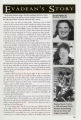
Show Stories about making a living in the West usually get told from a man's point of view. Here is one told by a woman. Evadean Francisco has lived in the valley east of Bryce Canyon for more than half a century. When I came over here [ to Henrieville, 19481 there was no oiled roads at all. We traveled on dirt roads. It broke my mother's heart cause I had an old wood stove to cook on. She thought I had lost my mind coming backwards to this hillbilly country. My father's expression was " You have come to the end of the world." And it still is the end of the world, as far as how advanced we are here compared to other people. It was very hard. I washed on a washboard. It took us quite a few years before we had enough to buy a washer. We used to have the old cooler down in the cellar. We would keep it wet and that is where we would keep all the butter and milk and stuff like that. When we came over here the stars were just gorgeous because there were no street lights, nothing. You had everydung done so when it got dark at night you was in the house. I remember the old coal oil lamps. Aunt Sarah Willis, she had a store. You could buy anything you could buy in the supermarket. If she didn't have it she would get it for you. She was a little old sweetheart from England. I can see her toddling around there. She went to cvery chld's birthday party. She went to all of the dances, she went to all of the weddings. If Aunt Sarah didn't come everybody would say, " What is wrong with Aunt Sarah?" I was the only woman in the town of Henrieville that could drive. All the men had to leave this area and go out to work on construction or any job they could find. So all these women were left without a soul who could drive. So if I went anywhere, I always told them in church that I was going to Cedar [ City] or wherever. I would have a list two and a half feet long.. . . I used to take everybody to the doctor, night or day, or whenever. I used to because when the men would haul their sheep out and stuff, they wasn't here to do that. When they would come home, you had to go when the auction day was. So guess who drove the big trucks of sheep? I've drove sheep; I've drove cattle. I drove beside those silage cutters, ' cause no other women knew how. Ths is why I said it's hard here. Angeline Ahlstrom told me when she moved down here, " Evadean, it is a prison. It is a paradise here for men and chldren, and it truly is. But it's a prison for women, because a lot of women simply can't handle it. There is nothing here culturally.. . all you have is the [ LDS] church." I feel really sorry for all of these women who move in here who have this wonderful idea of h s beautiful town and country life and that. Before a year is up they are having all sorts of mental trouble and every-dung. I went through that myself.. . . I learned more about me, just to learn how to live in h s area. Evac It is very trying. Hard. But if you ever have any children here they in I ! never want to leave. It is a country that literally holds its p- eop- le who . I are here. They get out of here and all they see is to come back here, even if they have to live on nothing. It is, it is a very hard country to live on. rcmper in Loreevil, e. I used to say we couldn't even give it back to the Indians, durty years ago. The Indians wouldn't even have the damn place. [ A woman makes her] world here, you have to make it. Like I say, when we came up here we came with eighty- five head of sheep. We could have made it. It was the government that broke us. I can hon-estly say that. Because we got a government loan, we bought 160 acres. Had they left us alone with the sheep, we could have made it. The guy that was in here first, he didn't like sheep. He insisted that we buy cows. Then we go in and buy cows. We haul our milk to Panguitch every day. Do that, the silage bit, the big farm, the whole thing. It was hard, it was damn hard. I lost my health trying to do it. I used to do the plowing. When we first come up here, Charlie would pitch the hay on, and I done the tromping and the staclung of the hay. It was just everything like that. You had to work just like a man. And Charlie will always say, " I did this and I did that." But he had a woman in his [ back] pocket, which was me, and three little girls. Without us he would have never made the farm. We are like white squaws here. This is the truth; I am telling you the truth. These men here are lords unto themselves. It's always " I did": I, I, I. I, me, mine, and my. But there is always a woman in their [ back] pocket that walks four steps behnd. [ Charlie and Evadean later sold the farm, and Charlie got a job worlung on the state road- which gave the family their first steady income. They also bought a trailer house but still owed $ 500 to the government (" It just as well been a million"). She got a loan for $ 400 to build a greenhouse to pay off the loans, then worked the greenhouse from 1964 to 1985, when continual bouts of pneumonia forced her to quit. Charlie and Evadean then built a log house and began rcnting bed- and- breakfast rooms.] I have people come in here and they will say, " Where do you go to shop?" I say, " You don't go shop." If the stores depended on us women, they would never survive because we never have to go to the store. We are self- sufficient. You have to be and you had to be. I do all of my own canning. I walk into those great big malls.. . down in St. George and in Cedar City, and to me it looks like so much clutter. I can't believe they buy that stuff. Taken from a 1998 Interview for the Southern Utah Oral H~ story Project conducted by Sun Montgomery at the Francisco house In Tropic. Photos by Suz~ Montgomery |