| OCR Text |
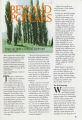
Show Stegner then proffers an interpretation of this distinct landscape feature: Perhaps it is fanciful to judge 1 a people by its trees. Prob- " Many large trees, especially elms, about a house are a surer indica-tion of old family distinction and worth than any evidence of wealth. Any evidence of care be-stowed on these trees secures the traveller's respect as for a nobler husbandry than the raising of corn and potatoes." Henry David Thoreau, " Journal," JTuly 2, 1H 8O5 1R. EAUO'BSS ERVATION holds true for communi-ties and society as a whole. Cities with impressive, towering street trees gain our notice and res~ ectS. ome of the 1 most memorable streetscapes in Utah include the main streets of Brigham City and Santa Clara with their rows of overarching sycamores, Torrey's cottonwood-lined Main Street, and the syca-more- shaded neighborhood along east Center Street in Pro-vo. You feel like you are in an important place, one worthy of respect, as you pass under the dense and lofty canopies of these treescapes. Trees are indeed potent sym-bols of the cultural landscape, the built environment we have created for ourselves. They tell us much about the lives and atti-tudes of those who planted and used them. They symbolize both practical and passionate aspira-tions we have for the world we create around us. Much about Utah's lustory can be deciphered from the trees we find on the landscape. When it comes to trees and the Utah landscape, one tree dominates the memory, the Lombardy poplar. Rows of these tall, columnar trees planted as windbreaks povide one of the most evocative images of Utah. Historian and writer Wallace Stegner observed: " Wherever you go in the Mormon coun-try. . you see the characteristic trees, long lines of them along ditches, along streets, as bound-aries between fields and farms.. . . These are the ' Mormon trees,' Lombardy poplars." ably < he piedominance of poplars is the result of noth-ing- more interesting- than cli- 0 0 matic conditions or the lack of other kinds of seeds and seedlings. Probably it is pure nonsense to see a reflection of Mormon group life in the fact that the poplars were practically never planted singly, but always in groups, and that the groups took the form of straight lines and ranks. Perhaps it is even more nonsensical to specu-late that the straight, tall ver-ticality of the Mormon trees appealed obscurely to the rigid sense of order of the settlers, and that a marchng row of plumed poplars was symbolic, somehow, of the planter's walking with God and hs solidarity with his neighbors. ' While Stegner's comments ring true for many, the story of trees and their influence on those who have lived in Utah is more complex than this image suggests. While Lombardies may be important symbols, they don't tell the whole story. The First Plantings w E KNOW THAT trees had great practical and spiritual signifi-cance in the lives bf ~ tah'sabo-riginal peoples. The relationships between native peoples and native trees were probably mul-tifaceted and deep. On the other hand, Anglo- American settlers, though they may have had deep feelings about trees, probably differed in their arboreal rela-tionships. For one thing, the col- onizers used trees as one of their strategies for manipulating and creating landscape. Indian alter-ations of the landscape were far less dramatic- and probably did not include tree plantings. Settlers planted trees for both aesthetic and practical purposes. Actually, the first tree planted by the pioneers was a black locust tree- not a " producing" tree but an ornamental. Purportedly, it was planted the day the pioneers arrived in 1847 on the lot that would later be occupied by Brig-ham Young's Beehive House. The black locust quickly became a favorite street tree throughout Utah. Its wood was strong and durable for farm implements, though it is doubtful that the thought of harvesting the wood in thirty years was the primary motivation for planting that first tree. Intentionally perhaps, that tree symbolized a long- term commitment to this land and a sirdung of roots. There was also probably a de-sire to re- create part of the past and former homes in this new land by planting familiar trees. Although pioneer accounts indi-cate that there was actually more than one tree in the Salt Lake Val-ley in 1847, the legend of a " lone cedar tree" in the valley has en-dured through the years. The per-ception that this was a near- tree-less wasteland likely added to the motivation to plant trees in the territory. ANY OF THE EARLY set-tlers of Utah were ex-erienced arborists and quickly set about importing and propagating desirable species of trees. Among the first pioneers, " George A. Smith brought peach stones,"" Edward Kay brought locust tree seeds [ to Mona]," Harriet DeckerYoung also brought locust seeds in the toe of her sock, and Eliza Saunders Johnson brought a variety of tree seed-lings and cuttings in her wagon crossing the plains and would soak them in streambeds whenev-er possible to keep them alive. 2 These tree pioneers were com-mitted to a vision of leafy maturi- A cottonwood near Ouray held what is believed to be an American Indian burid plat-form. The photo was taken by Charles Kelly in the 1930s. ty that would take decades to fully develop. In 185 1 Salt Lake City passed an ordinance stating that " every holder of lots.. . are [ sic] hereby required to set out in front of their lots such trees for shade.. . [ that would] be the best calculat-ed to adorn and improve the city." Three years later LDS ( Mor-mon) Bishop E. D. Woolley in-structed a group of men in his congregation to " see that shade trees be set sixteen feet apart around each b10ck."~ Smaller towns also made trees a priority. Only twenty years after pioneers struggled to settle Ephraim, a traveler enthused at its loveliness: " its neat cottages, and streets shaded by long lines of trees. . . .'* In addition to imports, settlers made use of native trees, trans-planting junipers, cottonwoods, and evergreens from the hillsides and streambeds onto town lots. Small towns throughout Utah are still dotted with remnants of these first plantings or with trees transplanted by later generations. For example, the c. 1906 Iver and Maria Christensen house in Spring City is fronted by seven M1- grown " white pines" brought down as seedlings from the mountains by the original homeowner, a sec-ond- generation Utahn. Existing trees sometimes served " structural" purposes in early Utah. The settlers of Pleas-ant Grove named their town after the grove of trees that gave them shelter that first winter of 1849- 50. Though trees were sparse in Utah Valley and the need for con-struction timbers was great, the Pleasant Grove settlers chose to preserve their sheltering trees, so they ventured several miles south to the Provo River bottoms to obtain cottonwood logs for build-ing. s The 1879- 80 settlers of Bluff in southeastern Utah used a tow-ering cottonwood along the banks of the San Juan River as a meeting place in the early days. The tree offered welcome shade in this desperately hot region, and it probably created a sense of enclosure and protection for them as well. These settlers, ex-hausted from their arduous, five-month Hole- in- the- Rock trek, were willing to take whatever shelter they could find. The " Old Swing Tree," as it was known, was lost to the river in a 1908 flood. The residents of Fruita, in what is now Capitol Reef National Park, also used a large cotton- wood for community purposes. The MailTree, named for the mailboxes nailed to its trunk, was a social gathering place in ths small town for many years. Al-though the mailboxes have long since been removed, the tree still stands and is a significant feature of the Fruita Rural Historic Dis-trict. ATrboricH uElt uMrOalR AMdOvaNnPScA'e TTmEReNn tosf systematic settlement and their intent to make self- sufficient, family- farm econo-my characterized rural Utah life in the nineteenth and early twen-tieth centuries, as most families had a cow, chickens, pigs, a gar-den, and fruit trees to provide them with much of their food. The trees are often all that re-main to document this way of life. Utah their permanent home fos-tered a cooperative and commit-ted effort toward planting trees. Garden clubs and horticultural societies were formed throughout the state. The St. George area was especially active in this regard, due in large part to Joseph E. Johnson, a horticultural expert and ardent promoter. Johnson's foremost contribution was in the growing of fruit trees and grape vines ( more than 100 varieties), though he also advocated the introduction of ornamental plants and shade trees. In the early 1870s Johnson even published a statewide horticultural newspa-per, the Utah Pornol~~ ist.~ Through the efforts of Johnson and others, hundreds of species of trees and other plants were brought into Utah and " tested" under various soil and climatic conditions. Some prospered and some did not. Fruit and nut trees grew reasonably well, especially in the more temperate southern parts of the state. Old fruit trees, especially apple trees, still remain on many home lots in rural Utah. Often over-grown and untended now, these old trees probably descended from or replaced fruit trees planted by the original settlers. A This black locust, which grew on the Beehive House grounds, is said to be the first tree planted by Euro- Americans in Utah. Mulberry trees represent a dis-tinct phase of Utah's history. The silk industry, which started in Utah during the 1860s and con-tinued in some places for dec-ades, relied on mulberry leaves as food for the silk worms. Many households planted their own trees. Because silk production re-quired no special buildings or structures, nothng remains of thls remarkable, and seemingly exotic, industry but the nonde-script mulberry trees. Trees remained important even as the population shifted to urban areas. During the late nineteenth and early twentieth centuries, developers used the promise of tree- lined streets to help sell homes in their residential subdi-visions. In the 1910s one Salt Lake developer, Kimball and Richards, reportedly planted 7,000 ornamental shade trees in its massive Highland Park devel-opment .' 0 F COURSEth, e Lombardy poplar8 was another import that thrived. Introduced to Utah in the early 1860s, the Lombardy was a fast-growing tree that adapted very well to local conditions. Dozens of other species took hold in Utah as well and have gained al-most- native status through their longevity in the landscape. Ex-amples include the Carolina pop-lar, white poplar, catalpa, black locust, Siberian elm, ash, tree of heaven, and others. These trees are still present in most Utah towns, though they have fallen out of favor over the years because of their various " vices." The qualities of the various species of trees came under sci-entific scrutiny during the late nineteenth and early twentieth centuries. One of the foremost arborists of this period was Jos-eph Alastor Smith ( 1 852- 1924). A native of England, Smith estab-lished a remarkable tree- covered estate in Providence, Cache County. Between 1887 and 1924 he planted thousands of non-native trees on his 40- acre Edge-wood Hall property. In one stand alone he had more than 1,500 ash trees. Smith proved that a wide vari-ety of trees could prosper in Utah. In the laboratory of his es-tate he successfully planted doz-ens of varieties of fruit and nut trees and a vast array of hard-woods: birch, alder, beech, elm, linden, hawthorn, hackberry, The " Old Swing Tree9' in Bluff was a place for community gather-ings until a flood swept the tree away in 1908. oak, sycamore, and more. His nursery provided thousands of saplings to surrounding commun-ities, greatly expanding the spec-trum of Utah's tree plantings. He also shared h s careful records of soil and climatic conditions with the nearby Agricultural College. One tree Smith did not pro-mote was the poplar. He actually held a deep antipathy toward cheap and undesirable vari-eties, and added to by defec-tive information issued by the Agricultural College in its early bulletins. Smith's views may have been colored in part by the condition of many of the first generation of poplar trees, which were proba-bly dying at the time. But mod-ern arborists reaffirm Smith's these trees. judgment. ( 0) ne sees in passing from village to village, poplar trees, always poplars.. . . In Logan the poplar has become a nightmare. It stands on every street, on every block, on every lot.. . . Its limbs are sere and issue from a withered trunk. Others are only half decayed, and present the me1 ancholy spectacle of life in death. All give the effect of wearied, futile, unconscious indifference. The cause of this distressing plague is easy to find. It origi-nated in the unwise enthusi-asm of certain dealers in trees who flooded the country with Despite Smith's criticism of the Agricultural College, the school worked hard to improve Utah's plantings. In 1925 the college established in north Farmington a botanical garden and arboretum to test the suitability of trees and other plants for the Utah climate and to serve as a showcase for recommended species." Trees Today 0 N THE CURRENT land-scape, trees still provide us with hints about larger issues and events. Urban growth and sprawl are forcing the orchards from such traditional fruit- growing areas as Orem, the " Fruit Way" in Willard and Perry, and Fruit Heights above Kays-ville. New orchards are emerg-ing, however, around Santaquin and Goshen in southern Utah County. And whether for nostal-gic or practical reasons, some of these new orchards are bordered with vigorous windbreaking rows of poplar trees. Trees are often the center of controversy between downtown business owners and those pro-moting Main Street revitalization efforts. Shade trees, brick pavers, and period benches and light-posts, all designed to make the streetscape more pedestrian-friendly, are common upgrades for old commercial areas trying to make a comeback. But busi-ness owners tend to dislike the trees once they start to fill out; merchants feel that the trees block their signs and obscure their businesses. As a conse-quence, dozens of Utah towns bear evidence of a cycle of tree planting, pruning, and even removal. Many small towns are losing their old shade trees because they have replaced the open ditch sys-tem with piped, pressurized irri-gation. This results in greater water efficiency, but the ditch-reliant trees suffer. Even in towns without pressurized irrigation, not all the ditches remain in working order, so many trees are literally left high and dry. For whatever reasons, town leaders and residents today do not seem as concerned as their forebears were with planting and maintain-ing street trees. In larger towns, the choice of trees that can be planted along the street is often regulated by a city forester. The large shade trees of decades past do not rate well with these professionals. Black locust, sycamore, black walnut, cottonwood, green ash, - catalpa, box elder, mulberry, and all varieties of poplar- Fremont, Carolina, and Lombardy- are among the trees deemed " less suitable" for street plantings. Their faults, in addition to their too- large size, include invasive - roots, messy fruit, heavy leaf drops, suckering, weak wood, and susceptibility to disease. Cousins of some of these tradi-tional trees, however, have gained favor. The fruitless mulberrv is J not messy like the original, pur-ple- berried variety. The honey locust is faster- growing and less imposing than the old black loc-ust. And if a really fast- growing tree is needed, a recent hybrid strain of poplar is considered more acceptable than the tradi-tional Lombardy. " Most trees recommended for planting today, especially street trees, fit into a safe middle-ground of practicality. The home and garden centers steer our choices to the tried and true: maple, flowering plum, Bradford pear, honey locust, aspen, and so forth. The urban foresters and tree experts' recommendations make sense to those loolung for attrac-tive, non- aggressive, low- mainte-nance trees: small- to- medium size with moderate crown-nothing too tall or spreading-flowering but fruitless, shady but not too shady for grass and flow-ers below, fine leaf for minimal autumn cleanup, and no invasive : roots or suckers. Perfect. They won't offend or cause trouble for anyone. They fit in well with our busy lifestyle. These " perfect" street trees are probably pretty good symbols of our current LDS Seventeenth Ward Relief Society, Salt Lake City, plants a tree on Arbor Day ( not dated). society and culture. EGARDLESS of any faults they may have had, early tah trees were cherished for their good qualities. Those who planted them had a vision of makmg Utah a better place, and they succeeded: Joseph Johnson and his fruit trees in St. George; Joseph A. Smith and lus groves of - exotic hardwoods in Providence; and unnamed settlers across the state who planted their hopes and dreams in the Utah soil. Their passion for creating a tree- stud-ded landscape in the Utah desert became, in places, a reality. But in many places the cultural landscape is changing with the changing of Utahns' values. Trees no long- e r seem to matter as much as they used to. Air- condi-tioning has replaced overarching shade trees. Family economies don't rely on the fruit from home- lot orchards. And civic improvements usually focus on roads and ballfields instead of onstreet trees. If Wallace Stegner were still alive today, he might be surprised to learn that Lombardy poplars are actually hard to find on the Utah landscape. Then again, he might not be surprisedztt all. Roger Roper is the USHS preservation coordinator. I Wallace Stegner. Mormon Country ( New York: Bonanza Books, 1942), 21, 23- 24. 2 Quoted in Richard V. Francaviglia, The Mormon Landscape ( New York AMS Press, 1978). 104- 105. 3 Quoted in Camille]. Russell, " The Historical and Cultural Significance of Trees in the Lives of Early Utah Pioneers" ( unpublished University of Utahrree Utah internship thesis, 1994), 3- 5; available at USHS. 4 Quoted in William Mulder, Homeward to Zion ( Minneapolis, University of Minnesota Press, 1957), 191. 5 Howard R. Driggs, Timpanogos Town, ( Manchester, NH: Clark Press, 1947), 30- 3 I. 6 Douglas D. Alder and Karl F. Brooks. A History of Washington Couny From holotion to Destination ( Salt Lake City: Utah State Historical Society and Washington County Commission, 1996), 105. Copies of the Utah Pomologist are amilable on microfilm at the Utah State Historical Society. 7 Salt Lake Tribune, May 5, 19 1 2. 8 Technically, the Lombardy is a male clone of the Italian poplar. 9 Quoted in Providence and Her People ( Providence, Utah: Providence History Committee, 1974). 187. I0 The facility was demolished in 1999 to make way for a highway expansion. I I E. Gregory McPherson and Gregory H. Graves, " Ornamental and Shade Trees for Utah: A Tree Guide for Intermountain Communities," ( Logan: Utah State University Cooperative Extension Service, 1984). Photos from USHS collections. |