| OCR Text |
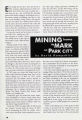
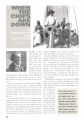
Show E ven though the last silver mine shut down in 1982, mining is still big business in Park City. Walk down Main Street any weekend day-make that any day- and you'll find the sidewalks packed with window shoppers. Refurbished turn- of-the- century mining- era buildings stand chic to chic with recent imitations, luring visitors with upscale souvenirs and ethnic fare. Modern hotels self- con-sciously mimic the heavy- timbered look of the old mills. About 75,000 people, thirsting for more infor-mation about the colorful history of the old silver-mining camp, visit the town's museum each year. It is easy for tourists and newcomers to romanti-cize Park City's mining- p- ast. But they only have to venture a block east of Main Street, to the edge of Rossie Hill, to find a different kind of legacy. Flowing beside Swede Alley-though parts of it are now buried in a pipe- is a tributary of the Weber River that pioneer explorer Parley P. Pratt christened Silver Creek in 1848. Pratt was struck with the bucolic beauty of the basin drained era1 other large mining operations, including the Daly, the Daly West, and the Silver King. On the banks of Silver Creek just below town were the Park City Smelting Company and a concentrator owned by the Crescent Mining Company. With little appar-ent regard for the environment or the health of local residents, the mills spewed effluent loaded with heavy metals onto the ground and into the air. One early photograph shows mill waste cascahng down the hillside above present- day Swede Alley. By this time, Park City residents had come up with their own nickname for Silver Creek: Poison Creek. Fouled with mill tailings and human waste, b - leaves by D a v i d H a m p s h i r e by Silver Creek and other tribu-taries of the Weber River. However, it wasn't a quest for Shangri- La that drew hordes of immigrants to Parley's Park some twenty years later. It was a lust for silver. By 1870 several mines were operating; that year Parley's Park had a total population of 164. In 1872 came two events that helped mold the future of this adolescent mining camp. One was the federal Mining Law of May 10, 1872, which announced that " all valuable mineral deposits in lands belonging to the United States. .. are hereby declared to be free and open to exploration and pur-chase." The other was the discovery of a rich vein of silver on the banks of a Silver Creek tributary and its subsequent sale to mining entrepreneur George Hearst. The fabled Ontario Mine helped make Hearst a very wealthy man. Settlements grew up around the major mines, then consolidated in a narrow canyon where three tributaries of Silver Creek came together. The new mining camp became known as Parley's Park City and, before long, simply Park City. By the late 1890s, two large mills, the Marsac and the Ontario, loomed along the banks of Silver Creek, dominating the Park City skyline. Above town, also in the Silver Creek watershed, were sev-the water was no longer fit for human consumption. The contamination forced farmers in the down-stream community of Wanship to stop using Silver Creek water for irrigation. For years, local residents appeared to tolerate this fouling of their nest. But in 191 3, 200 east- side res-idents signed a petition urging the city council to compel the operators of the Ontario Mill to control the fumes circulating in the city. An investigation ordered by the council revealed that " Wires on pianos were corroded, sewing machines put out of commission by the needles made useless; clothing rotted by the fumes and carpets, rugs, etc., ruined," according to the Park Record. " Many complained that throat and lung trouble were prevalent in that vicinity and doctor's visits made more frequent on account of the obnoxious smoke. The trees were all , dying and flower beds and vegetation generally being killed." At the urging of the council, the mill operators agreed to install equipment to control the emissions. Critics of the Mining Law of 1872 point out that it made no provisions for the reclamation of land ravaged by mineral extraction. While miners and their families bore the brunt of the environmental damage, mine owners reaped the financial rewards. Besides the millions it made for George Hearst, the Park City mining district nurtured a number of other fortunes. By the early 1960s the region had produced minerals worth more than $ 470 million. Over the past fifty years little ore has come out of Park City mines. The last producing mine- the Ontario-- sputtered to a halt in 1982. Today, skiing has replaced mining as the lifeblood of Park City. Many of the remaining miners' cabins have been the metal- bearing ores have been processed. And the Prospector area on the edge of Silver Creek had been used for years as a dump for mill tailings. Park City officials estimate that 700,000 tons of tailings were dumped there between 1900 and 1930. In the 1940s the Pacific Bridge Company reworked the tailings using an acid- leaching process. The area became a dusty wasteland where local kids some-times went to ride their bikes. However, as property prices exploded in the 1970s, the old tailings carefully restored and the surrounding hillsides now support a growing number of million- dollar man-sions. But that's not quite the end of the mining story. In 1983 the Utah Geological and Mineral Survey conducted a soils study in a newly developing area north of town known as Prospector Park ( residen-tial) and Prospector Square ( commercial). The study was designed to test the ability of the soils to sup-port new buildings. But it found somethmg else quite startling. The Prospector soils had high con-centrations of lead, arsenic, cadmium, and mercury, toxic metals known to be dangerous to human health. Lead, arsenic, and cadmium were all by-products of the silver mines; mercury was used in the milling process. The old silver mine dumps that stud the Park City hillsides are composed largely of waste rock that is unsightly but, from an environmental standpoint, relatively benign. Most of the toxic contamination comes from the mill tailings, a fine powder left after dump became prime real estate. Heavy equipment clawed into the contami-nated soils, digging foun-dations for houses, condo-miniums, and office build-ings. Significant portions of the Prospector area were already occupied when the first soils study sounded the alarm. And what an alarm it was. The widening investi-gation soon involved the Summit County and State of Utah health depart-ments. The state health department ordered fur-ther soils testing, collected samples of the water in Silver Creek and dust from area homes, and drew blood from Prospector chil-dren to look for elevated lead levels. The soils studies confirmed that levels of lead, cadmium, and arsenic were several times higher than safety standards. The studies also found higher levels of lead in Silver Creek below Prospector and elevated levels of lead and cadmium in household dust. Although blood tests found that lead levels were, on average, no higher than the national norm, four children tested statistically hgher than average. The state health department took its findings to the U. S. Environmental Protection Agency ( EPA). By 1985, the site had been recommended for inclu-sion on the EPA's National Priorities List, better known as the Superfund list. The media knew a story when they saw it. Each step in the unfolding inquiry was reported by area newspapers and broadcast media. In one instance, television station KUTV even arranged early on for private blood tests on some Prospector children in First page: The Ontario Mill was only one of the mills that left a huge waste dump. At lee Park City, looking south, in @ 189 1. Opposite: the order to get a scoop on the official findings. Prospector residents- and Park City officials-were incensed over the way the investigation was handled by state and federal agencies and reported by the media. In December 1986 came the ultimate insult. " EPA Official Says Park City Site Comparable With Love Canal," said a headline in the Salt Lake Tribune. Although this comparison with an infa-mous toxic- waste site in upstate New York was quickly repudiated, the newspaper devoted more attention to the original story than to the subsequent correction. " The publicity stirred by Superfund- the state's news media descended on Park City- sullied the pristine image of this town of 5,000 people," the Washington Post reported in a front- page story in March 1987. " Soon, property values plunged. A hotel- condominium complex went bankrupt. The Federal Housing Administration stopped underwrit-ing mortgages. Tourists called off ski trips. And a supermarket planning to locate in Park City post-poned its plans." Concern over the town's sullied image, Prospector's plunging property values, or both, prompted city hall to roll up its sleeves and take on the EPA. The city hired a consulting engineer who found flaws in the state studies that had attracted the attention of the EPA. City officials also charged that the EPA was more interested in fmding the culprit and collecting damages than in finding a solution to the problem. " More is at stake here than the cleanup of toxic 20 Prospector mill tailings in the 1920s, from a viewpoint to the west, above the Spiro tunnel entrance. The intersect-ing roads are state high-ways 224 and 248. Photos courtesy of the Park City Museum. wastes," said the Washington Post story. " It is a bat-tle for control of a city's destiny: residents who see no health risk versus regulators who do. A look at what happened here suggests bungling by state health officials, compounded by bungling by the EPA. And it demonstrates the destructive forces of politics, mass media and the marketplace when unleashed by a single government decision." Park City ultimately devised its own solution. Utah Sen. Jake Garn, then a Park City resident, attached an amendment to the 1986 Superfund reauthorization bill that prohibited Prospector from being considered for the National Priorities List as long as no new data justified its inclusion. The bill passed in October 1986. The city council also passed an ordinance calhg for all exposed mine tailings in the Prospector area to be covered with at least six inches of topsoil. In July 1988 an EPA report also called for exposed tailings to be capped with from six inches to two feet of " suitable cover." Even with this protection, the EPA noted, activities such as gardening, construc-tion, street repair, and utility maintenance ' could present a potential exposure pathway to the resi-dents." However, the agency concluded that there was no evidence that area residents were being exposed to harmful levels of lead, arsenic, or cadmi-um. " Park City gets a clean bill of health," said a head-line in the Deseret News announcing the results of the EPA study. In the dozen years that have passed since then, Prospector has vanished from the headlines. Property for sale in the area no longer carries the stigma that it once did. But no one is under any illu-sions that the city has permanently buried the envi-ronmental legacy of its mines. In fact, recent events only emphasize how pervasive that legacy is. First, soils tests revealed that other parts of town have, in the words of one city official, " enjoyed the same influences" as Prospector has. Those discover-ies prompted the city council to greatly expand the boundaries of the area governed by the so- called soils ordinance. Second, the major remaining mining company, United Park City Mines ( UPCM), which still owns about 7,000 acres of resort property in the Park City area, has announced its intention to develop Empire Canyon and Richardson Flat, two parcels of land in the Silver Creek drainage that have also felt the impact of mining. Third, the city itself became involved as a landowner in the process of tailings mitigation when it and tailings in the Park City mining district- mil-lions of tons of it- as unnecessary and prohibitively expensive. The solution of choice, especially if there is no apparent contamination of surface or ground-water, is to take the Prospector approach: stabilize stream banks and cover the waste with a layer of top-soil. Park City's experience with contaminated mine residue is hardly unique. In Salt Lake County, a large plume of contaminated groundwater traced to cop-per- mining operations around Bingham Canyon threatens water supplies in South Jordan and West Jordan. Contaminated soils also have been found around old smelter sites in Midvale, Murray, Sandy, and Tooele. A popular campground in Little Cot-tonwood Canyon was closed in 1998 after hlgh lev-els of lead and arsenic were found in its soils. And, in an eerie echoe of Prospector's 1980s nightmare, tests conducted in the old mining town of Eureka, Utah, in the summer of announced to build a , , 2000 found areas where soil transit center on a 2%- acre I was contaminated with parcel that overlapped the lead; some children had ele-site of the old Marsac Mill. vated levels of lead in their Predictably, parts of the blood. Some media reports sitewhich is on the banks on the Eureka test results of Silver Creek and only a stone's throw from Main Street- were found to have elevated levels of lead, cad-mium, and mercury. I even mentioned the dread-ed " Sn word, suggesting that Superfund designation was possible. Mark Mesch, adrninistra- All of these events again 2tor of the Utah Abandoned " attracted the attention of the Denver office of the EPA, which contended that the time to do any investigation or cleanup was before any development occurred. But to address the " seri-ous environmental issues" in the watershed, the EPA said that this time it would use the carrot instead of the stick. Toward the end of 1998 the agency began quietly talking to a number of individuals and agen-cies that had a stake in seeing the contamination cleaned up. ' We think there are some serious envi-ronmental issues we need to look at in the water-shed," Jim Christiansen, the EPA's Park City project manager, told a group of citizens in May 2000. * Silver Creek could sustain an ecosystem, but it isn7t." The watershed needs to be cleaned up, but this time the EPA has promised that any solution will be a group decision, not a decree. Cleanup could take years, Christiansen said, but exactly what constitutes a " cleanup" remains to be seen. Officials see the removal of all the waste rock Pop jenks photo Mine Land Reclamation Program, estimates that there are about 1,000 aban-doned mines along the Wasatch Front and perhaps 20,000 in the state as a whole. In neighboring Nev-ada, he says, that number could reach 200,000. As people begin to develop these waste sites as housing developments, shopping centers, and ski resorts, these issues will, no doubt, come to light. How many times the industrial past will thus affect the suburban present across Utah and across the West is an open question. And whether today's solutions will protect the people of later generations remains to be seen. Writerleditor David Hampshire is co- author of A History of Summit County ( 1998) and author of articles in Utah Historical Quarterly and Utah Preservation magazine. Information for this story came from the files of the EPA and Park City Municipal Corp., from personal interviews, from the minutes of the Upper Silver Creek Watershed Stakeholders, and from stories in the Utah Historical Quarterly, the Utah Mining Journal, the Utah Mining Gazette, the Deseret News. the Park Record, the Salt Lake Tribune and the Washington Post. |