| OCR Text |
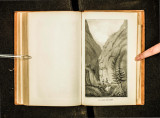
Show [(23} 100 h rd horrid accounts of diabolical mutilations to which the bodies oef at he victims han been su bJ' ecte d . . . . The Americans htre, too, seern.ed anxiOus. about some msurrec-tionary symptoms which were dally developmg. January 2.-We procured as much corn as we could well carry in our wagons, and I gave the ow.ner a draft for a blank amo~nt, leaving the quartermaster to d.ecid.e what .was the market P.nce. We were detained a long whde m. cro~sing. some "acequias," which had been filled with water dunng the mght, and were now covered with ice. It was with great difficulty that our mules could be forced upon the ice, they had become so fearful of falling, and it was near eleven o'clock before we got clear of these troublesom'e . aceqUias. Soon after crossing the ''Rio <Je los Gallinas," we saw Jarge herds of antelopes, apparently from two to three hundred animals in each herd, but the snow on the ground exhibited the hunters in such bold relief as to prevent all possibility of approaching them without being observt:d. One of our hunters, by the name .of Raymond, seeing the fruitlessne~s of continuing the pursuit, drew up his rifle and fired, although 400 yards distant; we all felt deeply disappointed when we saw the whole herd bound away, but before they ran very far one of them stopped and lay down, ' and soon a second shot laid it on the ground to rise no more. Shortly after this occurrenc.e, we met a train of 50 commissary wagons going to Santa Fe. They had no corn for their oxen, and the poor beasts were suffering from ~ant of sustenance and from exposure to the cold. Several of them lay dying by the road side. We encamped near "El Arroyo de St>pullo," at the foot of a lofty mass of rocks which completely sheltered us from the winds. Here we built our fires, and at n1ght the huge projecting masses of rock, which beetled over our little camp, seemed, as they were illuminated by the rudrly glare of our fires, to be threatening to topple down. I suffered in~~nse agony fro~ my feet having been frosted. The greatest reuef I could. .obtam was ·by keeping them firmly pres~ed to the ground. I hacl Inadvertently mounted my mule after hav'wg walked in the wet snow, which had soaked through my moccasins, and when I carne to dismount my left foot was frozen fast to the stirrup) so that I was obliged to draw my case knife and use it to ·free myself. · This morning the wir~d blew keenly, but we started before the. sun was ~alf a~ hour h1gh. After marching one mile we reached tbe c.rossmg ot the . Sepullo.. Her~ we had a siege of troubles. The Ice was very thtck, and 1t requ~red some time to cut our way acr.oss the stream, for the ice was not sufficiently strong to bear the weight of the wagons. The river banks were steep, and as the wagon rushed down to the water, the mules became frightened and swerved from the road we had cut, and, getting upon the firm ice they were not ~ble to kee~ their feet; several of them fell, and 'one, after . ~akm~ many vam eff?rts to rise again, gave up in despair, and we -were forced to drag hun out of the stream by main strength. As be had got very wet, and the air was freezing cold, we had to keep 101 [ 23] bim moving about lest he should die. In a little while, by the h.elp of ropes, which we attached to tbe uppermost felloes of the hind wheels, we drugged the wagon out, antl immediately hitching up the beast that had got wet, we kept him in brisk motion until his limbs regained their wonted flexibility. Having marched four miles further, we reache~ "El Rio Moro," and .by being e~tremely careful to cut away all the ice, we crossed without any accident. But the fording of these rivers delayed us so long that our day's march clid not exceed ten miles. We encamped about three-fourths of a mile from the road, in a mountain gorge, where the high precipices which surrounded us completely protected us from the cutting winds. We had snow water for our own use, and drove our mules to a ~pring which was about a mile distant, near "Ponds in the prairie." ~ne of my men was P.erfectly overc~me by the cold, and gave up entirely. We were obltged to ·put htm to bed antl we gave him large doses of rum. He complained of a pain in his chest and seemed to be tormented with extreme thirst. ·This ~vening: the du~y of guard mounting commenced; I cautioned the sentmels to be vtgilan t, which was hardly necessary, as my men had already heard, at " Los V eo· as " of the Arapahoes and their horrible attroci Lies. b ' Janua~y 4.-yv e were up long before day; the wind blew biting cold until ten ~clock, when the sun shone forth with some warmth. . We no~ noh~ed .a great many prairie dogs that had come forth f~om thei; habttatlODS 1 .to enjoy the sun's rays. I fired several tJ~es at .dt.fferent ones with a shot-crun · I wished to obtain one Wtth ou t InJury t o t h e s k'm , but. I. dt·d b no' t succeed in killing any . . NaturalJsts say, that the pratne dog remains dormant during the wt.nte~ season; wherever we met wit lt the villages of these little a.mma s, we founrl them a~ lively as if it was summer· we must th;;ore, conclude that this animal tloes not hibernate.' ' dens hsa\~ great numbers o~ the antelope, they had congregated in d e e 11 r s, anrl were seekmg shelter from the cold winds in the eep va eys and gorges. re~cohoi~ w:h ar;,ive.d at some v~lcanic hilJs; which rise up just before snow gH e Rto Ocate;" m their vicinity there was but little was htok er~ w~ found that the fore axletree of our leading wagon to reach ~~ci~~ 1e ~hub of the whe~l. With great <.;are we managed eros>: IT . att::, but were obliged to unload before we could comf,o. rtableel ea we enc'balm pedw ant1 enc1 e avorec1 to make ourselves as but not one stsi[~ss~ t.e. b fie had ple~ty of cedar woo·d for fuel N o Im er t to repau our waO'on ' ear our camp . tl b • the wolves d WeJ e le carr.ass~s of se,·eral oxen, upon which ~orne beauttfaunl mr acvr en. s w"epre· cror . th 1 n gJng erose ves. I also noticed <>ne. . abples, 1ca melanoleuca," and I killed a fine .January 5 W ~xle. The lowe e,~o~v en,~eavored t~ patch the broken part of the • lt for the u r s een of th~ Rp.tnd]e was brokeu we chan d we should ~~e~b~?e, ;ntd tlhen. star~ed, determined to ~roceed u~~il Ige o t:!aV e thts wacron Aft.ur rna '· . fi b • " rcumg ve |